Review
. 2016 Jul;46(7):1563-73.
doi: 10.1002/eji.201546131. Epub 2016 Jun 8.

A novel "complement-metabolism-inflammasome axis" as a key regulator of immune cell effector function

Affiliations
Review

A novel "complement-metabolism-inflammasome axis" as a key regulator of immune cell effector function

Giuseppina Arbore et al. Eur J Immunol. 2016 Jul.

Abstract

The inflammasomes are intracellular multiprotein complexes that induce and regulate the generation of the key pro-inflammatory cytokines IL-1β and IL-18 in response to infectious microbes and cellular stress. The activation of inflammasomes involves several upstream signals including classic pattern or danger recognition systems such as the TLRs. Recently, however, the activation of complement receptors, such as the anaphylatoxin C3a and C5a receptors and the complement regulator CD46, in conjunction with the sensing of cell metabolic changes, for instance increased amino acid influx and glycolysis (via mTORC1), have emerged as additional critical activators of the inflammasome. This review summarizes recent advances in our knowledge about complement-mediated inflammasome activation, with a specific focus on a novel "complement - metabolism - NLRP3 inflammasome axis."

Keywords: Complement; Metabolism; NLRP3 inflammasome.


Figures

Figure 1
Figure 1
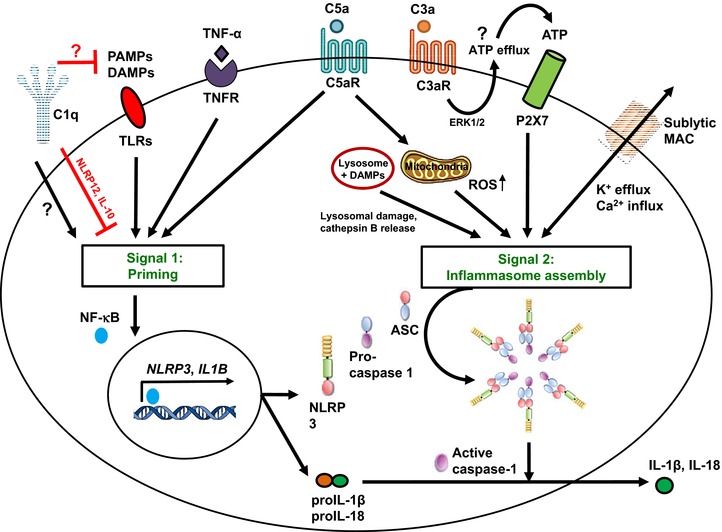
Mechanisms of complement‐mediated NLRP3‐inflammasome regulation. NLRP3 inflammasome activation requires two distinct signals. The “priming” Signal 1 is triggered by PAMP/DAMP recognition by PPRs (e.g. TLRs) and certain cytokines (TNF‐α) and drives NF‐κB nuclear translocation and NLRP3 and IL1B gene transcription. Signal 2 induces the assembly of NLRP3, ASC, and caspase‐1 supracomplexes to form an active NLRP3 inflammasome, where active caspase‐1 processes proIL‐1β/proIL‐18 into mature IL‐1β/IL‐18. The complement components C1q and C5aR1 (together with tumor necrosis factor receptor and/or TLR signaling) potentiate Signal 1. C5aR1 act as a priming signal to sustain inflammasome activation during the uptake of DAMPs, with a mechanism involving increased lysosomal damage and cathepsin B release. C5aR1 activation directly delivers Signal 2 for NLRP3 inflammasome activation, via induction of mitochondrial damage and intracellular accumulation of ROS. The C3aR regulates ATP efflux (via a not yet identified channel, denoted by a question mark) and subsequent autocrine P2X7 engagement, and sublytic MAC formation increases intracellular Ca2+ levels and mitochondrial membrane potential. Of note, C1q can increase canonical NLRP3 inflammasome activation in epithelial cells through a not yet defined mechanism (denoted by a question mark) but can also function as a negative regulator of NLRP3 inflammasome activation by sequestering DAMPs (such as cholesterol crystals) and inhibiting PPR signaling.
Figure 2
Figure 2
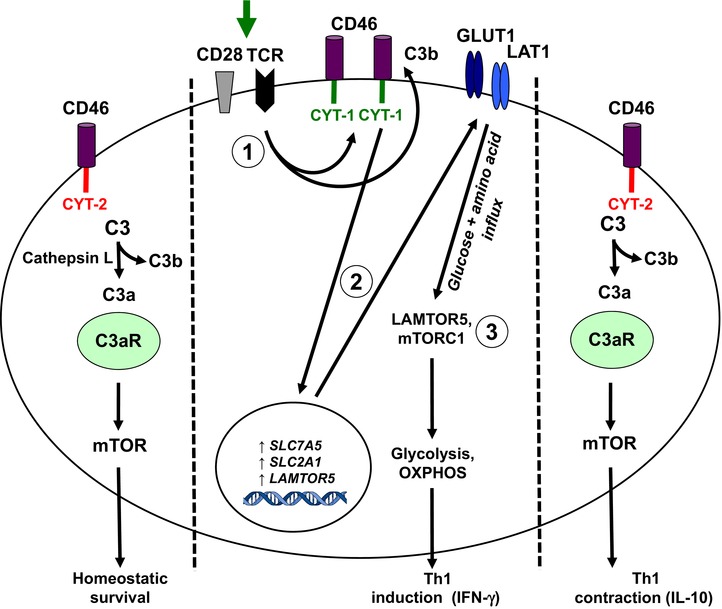
The role of C3 activation fragments in T‐cell homeostasis and in the induction of key metabolic events during Th1 responses. In resting T cells, the “tonic” generation of intracellular C3a via cathepsin L leads to the activation of the C3aR expressed on lysosomes and the low‐level activation of mTOR that sustains T‐cell survival (left). TCR activation and CD28 costimulation of resting T cells induces the local generation of the CD46 ligand C3b and increased expression of CD46 isoforms bearing CYT‐1 (1, middle). Autocrine CD46 CYT‐1‐driven signals then lead to upregulation of genes coding for the glucose transporter GLUT (SLC2A1), and the amino acid channel LAT1 (SLC7A5), allowing for increased influx of glucose and amino acids into the cell (2). In parallel, CD46 CYT‐1‐mediated signals induce increased expression of LAMTOR5, and via this assembly of the lysosome‐based machinery enabling amino acid sensing via mTORC1, which then leads the induction of glycolysis and OXPHOS required for IFN‐γ production (3). During Th1 contraction and induction of IL‐10 coexpression, CD46 isoform expression reverts to a CYT‐2 predominant pattern (through a mechanism that is currently unknown) and this is accompanied by reduced expression of GLUT1 and LAT1, downregulation of glycolysis and OXPHOS and reinstatement of C3a‐driven low level mTOR activity (right).
Figure 3
Figure 3
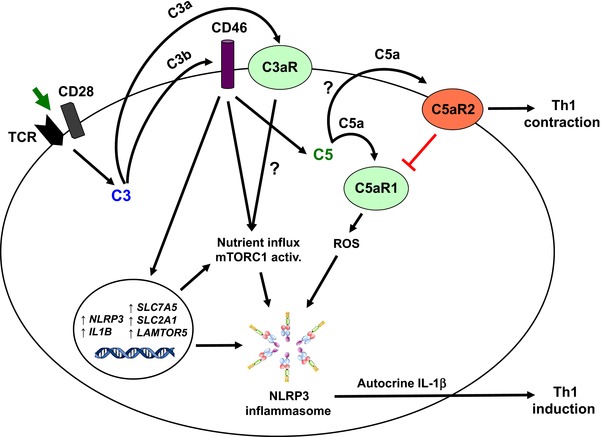
A complement‐metabolism‐inflammasome axis regulating human Th1 response induction and contraction. TCR stimulation of human CD4+ T cells induces the autocrine activation of CD46 and the C3aR via the “C3 system” that cumulates in nutrient influx, mTORC1 activation (which is a NLRP3 inflammasome activator) and induction of key metabolic events (see Fig. 2 for details). In addition, CD46 stimulation simultaneously induces gene expression of NLRP3 and IL1B to prime the NLRP3 inflammasome as well as increased intracellular C5 activation and C5a generation (of note, the enzyme cleaving intracellular C5 into C5a and C5b has not yet been identified and is denoted by a question mark). Intracellularly generated C5a then engages the intracellular C5aR1 to amplify ROS production. Increased ROS levels, together with the indicated metabolic changes, induce the assembly of the NLRP3 inflammasome and subsequent IL‐1β (but not IL‐18) production required for optimal Th1‐cell induction. Cell surface expressed C5aR2 (engaged via secreted C5a/C5adesArg) negatively regulates C5aR1 signaling via a yet‐unidentified mechanism—and therefore controls the Th1‐cell responses.

References

    1. Creagh, E. M. and O'Neill, L. A. , TLRs, NLRs and RLRs: a trinity of pathogen sensors that co‐operate in innate immunity. Trends Immunol. 2006. 8: 352–357. - PubMed
    1. Köhl, J. , The role of complement in danger sensing and transmission. Immunol. Res. 2006. 34: 157–176. - PubMed
    1. Dowling, J. K. and O'Neill, L. A. , Biochemical regulation of the inflammasome. Crit. Rev. Biochem. Mol. Biol. 2012. 47: 424–443. - PubMed
    1. Asgari, E. , Le Friec, G. , Yamamoto, H. , Perucha, E. , Sacks, S. S. , Köhl, J. , Cook, H. T. and Kemper, C. , C3a modulates IL‐1β secretion in human monocytes by regulating ATP efflux and subsequent NLRP3 inflammasome activation. Blood 2013. 122: 3473–3481. - PubMed
    1. Samstad, O. , Niyonzima, N. , Nymo, S. , Aune, M. H. , Ryan, L. , Bakke, S. S. , Lappegård, K. T. et al., Cholesterol crystals induce complement‐dependent inflammasome activation and cytokine release. J. Immunol. 2014. 192: 2837–2845. - PMC - PubMed

Publication types

Substances

LinkOut - more resources