. 2016 Jan;22(1):69-76.
doi: 10.1007/s12298-016-0340-8. Epub 2016 Jan 23.

Expression of an endochitinase gene from Trichoderma virens confers enhanced tolerance to Alternaria blight in transgenic Brassica juncea (L.) czern and coss lines

Affiliations

Expression of an endochitinase gene from Trichoderma virens confers enhanced tolerance to Alternaria blight in transgenic Brassica juncea (L.) czern and coss lines

Suchita Kamble et al. Physiol Mol Biol Plants. 2016 Jan.

Abstract

An endochitinase gene 'ech42' from the biocontrol fungus 'Trichoderma virens' was introduced to Brassica juncea (L). Czern and Coss via Agrobaterium tumefaciens mediated genetic transformation method. Integration and expression of the 'ech42' gene in transgenic lines were confirmed by PCR, RT-PCR and Southern hybridization. Transgenic lines (T1) showed expected 3:1 Mendelian segregation ratio when segregation analysis for inheritance of transgene 'hpt' was carried out. Fluorimetric analysis of transgenic lines (T0 and T1) showed 7 fold higher endochitinase activity than the non-transformed plant. Fluorimetric zymogram showed presence of endochitinase (42 kDa) in crude protein extract of transgenic lines. In detached leaf bioassay with fungi Alternaria brassicae and Alternaria brassicicola, transgenic lines (T0 and T1) showed delayed onset of lesions as well as 30-73 % reduction in infected leaf area compared to non-transformed plant.

Keywords: Agrobacterium -mediated transformation; Brassica juncea; Endochitinase activity; Fungal resistance; Trichoderma virens; ‘ech42’ gene.


Figures
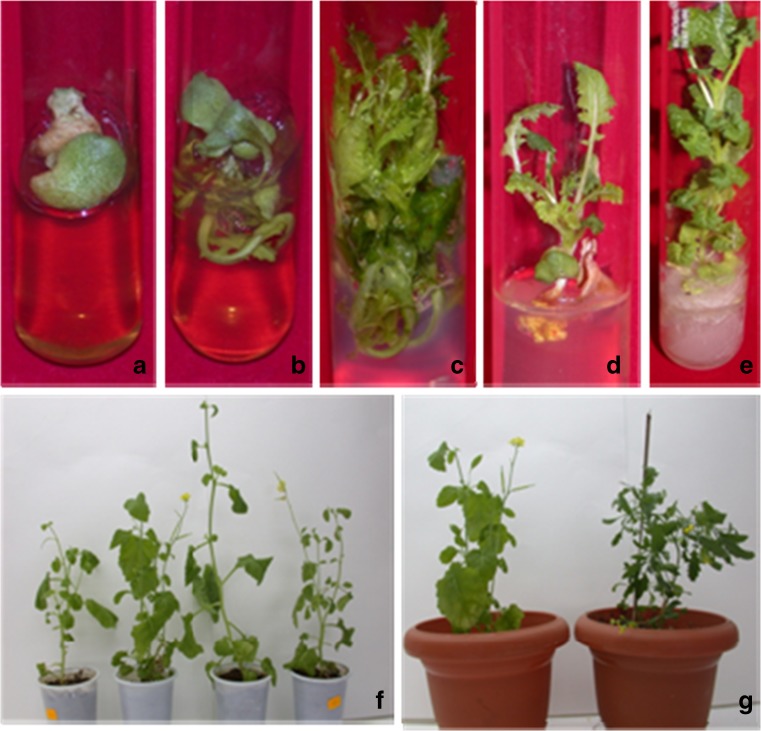
Fig. 1
Fig. 1
Development of transgenic B. juncea with ‘ech42’ gene (a) Cotyledon with petiole cultured on shoot regeneration medium (b) Explants showing regeneration on selection medium after infection with Agrobacteria. (c) Multiple shoots growing on selection medium (d) Elongated shoot transferred to rooting medium (e) Shoot with well developed roots (f) Transgenic plants transferred to soil for hardening (g) Hardened plants in pots showing flowering and pod setting
Fig. 2
Fig. 2
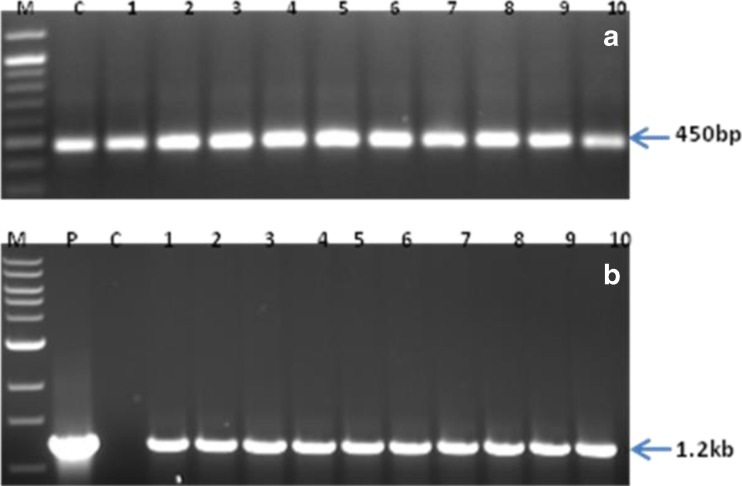
RT-PCR analysis of transgenic B. juncea lines (T0) (a) actin as ‘house- keeping’ gene (b) an ‘ech42’ gene. Lane M- 100 bp ladder (a), 1 kb ladder (b), C-control (non-transgenic) plant, P- positive control- pCAMBIA1301-ech42 plasmid, Lane 1–10 -Transgenic lines
Fig. 3
Fig. 3
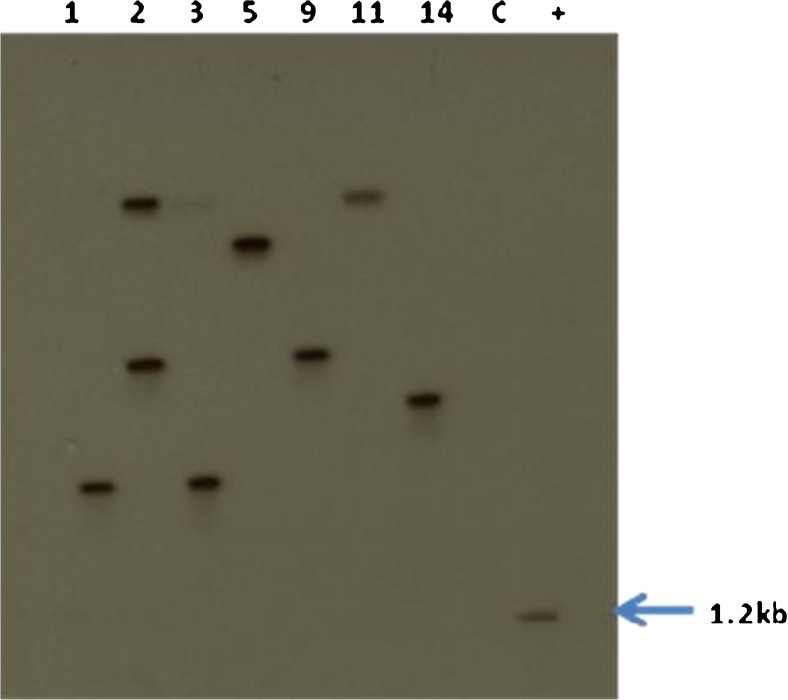
Southern blot hybridization of transgenic B. juncea lines (T0) - 1, 2, 3, 5, 9, 11 and 1, C- control (non-transformed) plant, (+) - positive control - HindIII digested PCR product of ‘ech42 gene
Fig. 4
Fig. 4
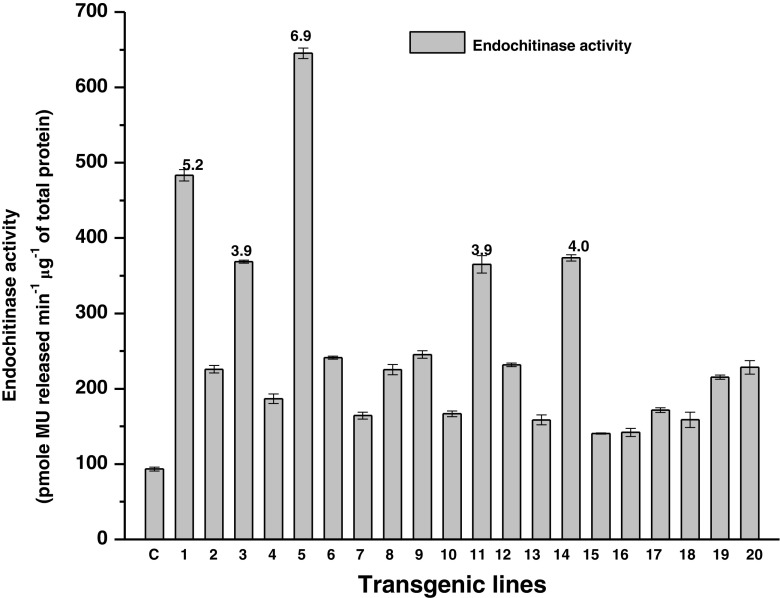
Fluorimetric assay for transgenic B. juncea lines (T0). Error bars indicates ± standard error of means. The number above the error bar represents fold increase in the endochitinase activity over the control plant. The values were statistically significant at P ≤ 0.05 over the control (non-transgenic) plant
Fig. 5
Fig. 5
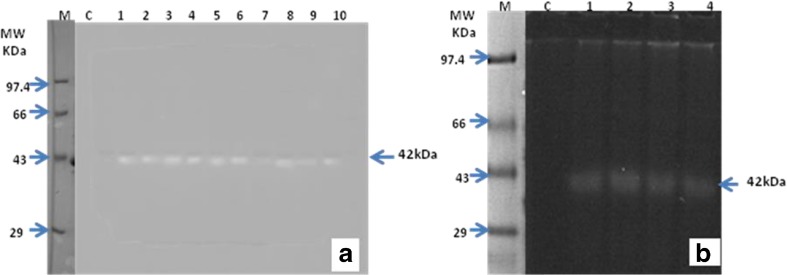
Fluorimetric zymogram for detection of 42 kDa endochitinase in transgenic B. juncea lines. M- protein marker; C- control plant; Lanes 1–10- T0 lines (a), Lanes 1– 4 T1 lines (b). Marker lane was cut and overlapped with the zymogram
Fig. 6
Fig. 6
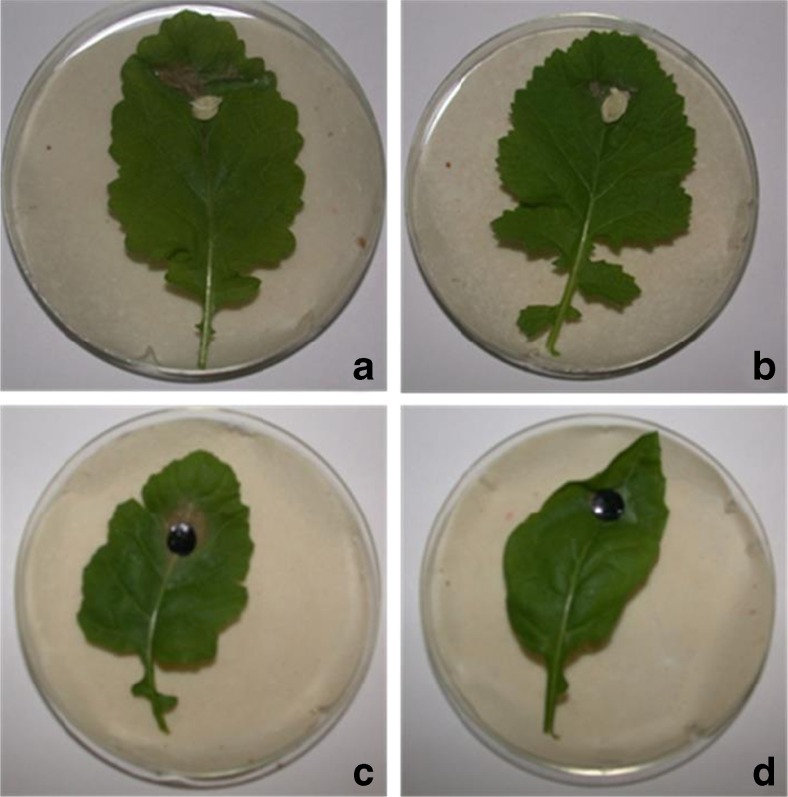
A representative photograph of transgenic B. juncea lines showing resistance to two fungi, Alternaria brassicicola (a- nontransgenic plant; b-transgenic plant) and Alternaria brassicae (c- nontransgenic plant; d- transgenic plant) in detached leaf bioassay
Fig. 7
Fig. 7
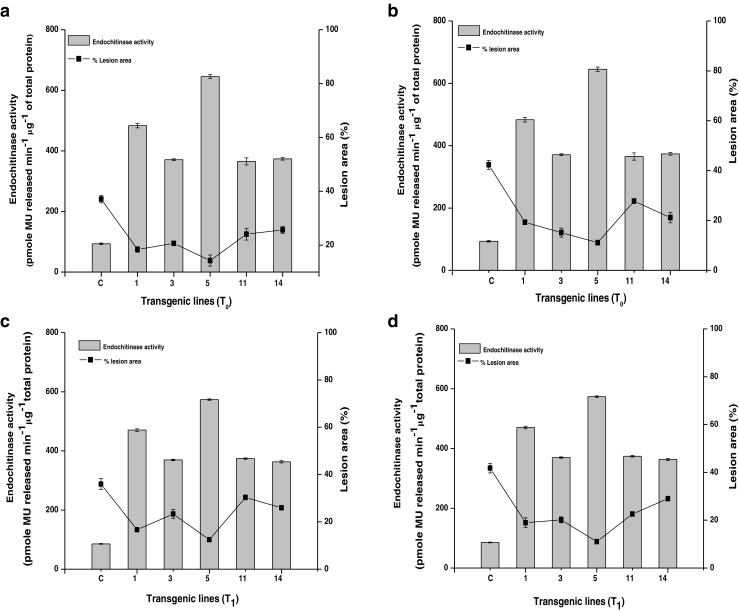
Endochitinase activity and average lesion area in control and transgenic B. juncea lines. (a and b: T0 lines challenged with A. brassicicola and A. brassicae respectively); (c and d: T1 lines challenged with A. brassicicola and A. brassicae respectively). Error bars indicates ± standard error of means. The values for the all the transgenic lines are significantly different from the control plant at p < 0.01

References

    1. Abdel-Farida IB, Jahangira M, van den Hondelc CAMJJ, Kim HK, Choi YH, Verpoorte R. Fungal infection-induced metabolites in Brassica rapa. Plant Sci. 2009;176(5):608–615. doi: 10.1016/j.plantsci.2009.01.017. - DOI
    1. Benefy PN, Chua NH. The cauliflower mosaic virus 35S promoter: combinatorial regulation of transcription in plants. Sci. 1990;250:959–966. doi: 10.1126/science.250.4983.959. - DOI - PubMed
    1. Bolar JP, Norelli JL, Wong KW, Hayes CK, Harman GE, Aldwinckle HS. Expression of endochitinase from Trichoderma harzianum in transgenic apple increases resistance to apple scab and reduces vigor. Pytopathol. 2000;90(1):72–77. doi: 10.1094/PHYTO.2000.90.1.72. - DOI - PubMed
    1. Chhikara S, Chaudhury D, Dhankher OP, Jaiwal PK. Combined expression of a barley class II chitinase and type I ribosome inactivating protein in transgenic Brassica juncea provides protection against Alternaria brassicae. Plant Cell Tiss Organ Cult. 2012;108:83–89. doi: 10.1007/s11240-011-0015-7. - DOI
    1. Dellaporta SL, Wood J, Hicks JB. A plant DNA minipreparation: version II. Plant Mol Biol Rep. 1983;1:19–21. doi: 10.1007/BF02712670. - DOI

LinkOut - more resources