


Mechanisms underlying glucose-dependent insulinotropic polypeptide and glucagon-like peptide-1 secretion
- PMID: 27186350
- PMCID: PMC4854499
- DOI: 10.1111/jdi.12478
Mechanisms underlying glucose-dependent insulinotropic polypeptide and glucagon-like peptide-1 secretion
Abstract
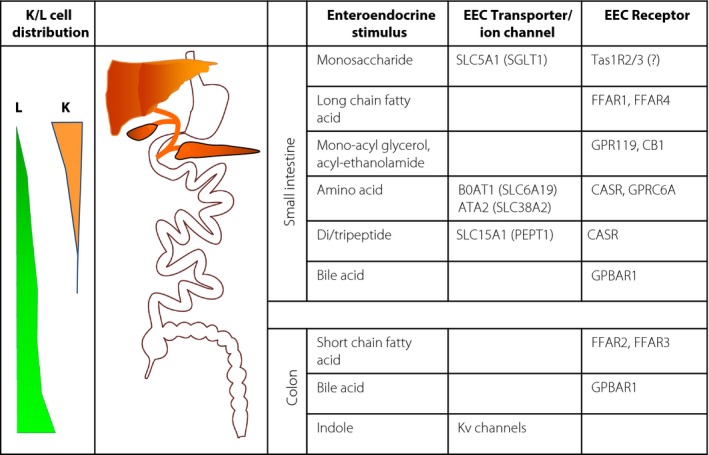
The incretin hormones, glucose-dependent insulinotropic peptide and glucagon-like peptide-1, are secreted from intestinal K- and L cells, respectively, with the former being most abundant in the proximal small intestine, whereas the latter increase in number towards the distal gut. Although an overlap between K- and L cells can be observed immunohistochemically or in murine models expressing fluorescent markers under the control of the two hormone promoters, the majority (>80%) of labeled cells seems to produce only one of these hormones. Transcriptomic analysis showed a close relationship between small intestinal K- and L cells, and glucose sensing mechanisms appear similar in both cell types with a predominant role of electrogenic glucose uptake through sodium-coupled glucose transporter 1. Similarly, both cell types produce the long-chain fatty acid sensing G-protein-coupled receptors, FFAR1 (GPR40) and FFAR4 (GPR120), but differ in the expression/functionality of other lipid sensing receptors. GPR119 and FFAR2/3, for example, have clearly documented roles in glucagon-like peptide-1 secretion, whereas agonists for the endocannabinoid receptor type 1 have been found to show largely selective inhibition of glucose-dependent insulinotropic peptide secretion. In conclusion, although K- and L cell populations overlap and share key molecular nutrient-sensing mechanisms, subtle differences between the responsiveness of the different cell types might be exploited to differentially modulate glucose-dependent insulinotropic peptide or glucagon-like peptide-1 secretion.
Keywords: Gastric inhibitory polypeptide/glucose‐dependent insulinotropic peptide; Glucagon‐like peptide‐1; Secretion.
Figures
References
-
- Drucker DJ, Nauck MA. The incretin system: glucagon‐like peptide‐1 receptor agonists and dipeptidyl peptidase‐4 inhibitors in type 2 diabetes. Lancet 2006; 368: 1696–1705. - PubMed
-
- Miyawaki K, Yamada Y, Ban N, et al Inhibition of gastric inhibitory polypeptide signaling prevents obesity. Nat Med 2002; 8: 738–742. - PubMed
-
- Cho HJ, Kosari S, Hunne B, et al Differences in hormone localisation patterns of K and L type enteroendocrine cells in the mouse and pig small intestine and colon. Cell Tissue Res 2015; 359: 693–698. - PubMed
Publication types
MeSH terms
Substances
Grants and funding
LinkOut - more resources
Full Text Sources
Other Literature Sources
