Review
. 2016 Jan 15;6(2):562-76.
eCollection 2016.

The life and works of S100P - from conception to cancer

Affiliations
Review

The life and works of S100P - from conception to cancer

Filip Prica et al. Am J Cancer Res. .

Abstract

Since its discovery in 1992, the small, 10.4 kDa calcium-binding protein S100P has gained the attention of researchers from different scientific fields due to its potential roles in both healthy and neoplastic tissues. Although not ubiquitously expressed, in tissues where it is present, S100P is associated with distinct changes in cellular behaviour. In this review we have summarized the evolutionary history of S100P, its expression and involvement in implantation and human embryonic development, as well as important functions in normal tissue and cancer. Finally, we have demonstrated its pivotal role as a potential diagnostic and therapeutic target, which opens promising avenues for further fruitful research on S100P.

Keywords: S100P; cancer; embryonic development.


Figures
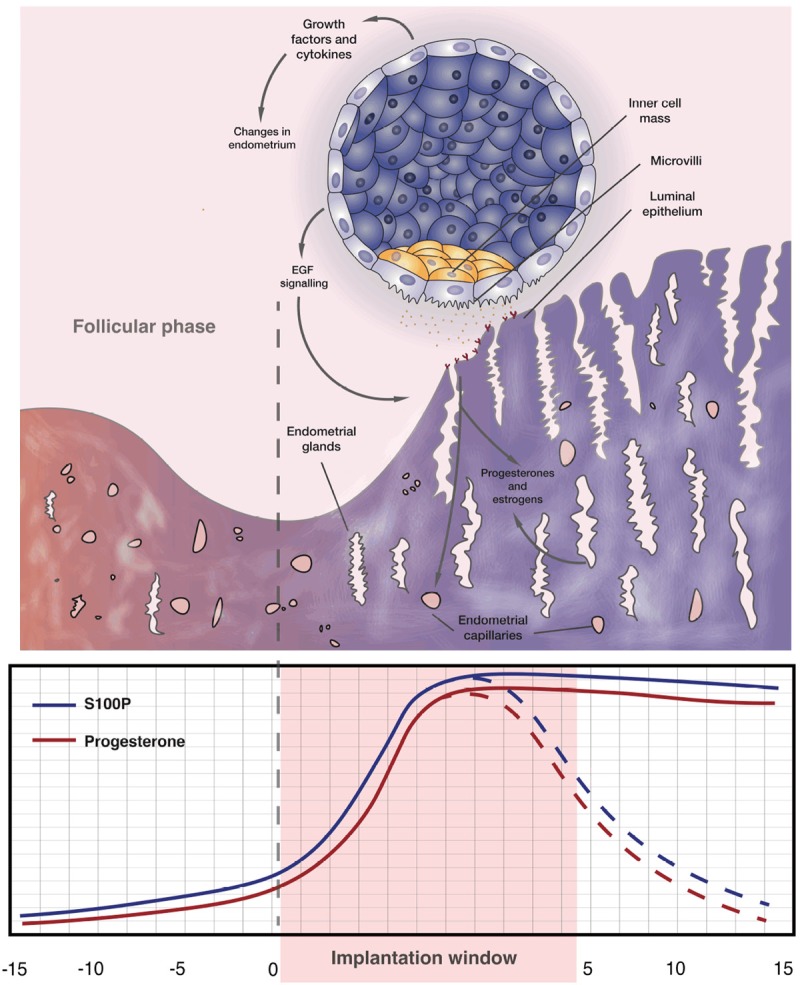
Figure 1
Figure 1
S100P expression during embryonic implantation. During the implantation of the human embryo, S100P expression is closely correlated with the rhythmic hormonal changes in the endometrium, particularly with the levels of progesterone (P4). When a developing blastocyst is implanted, S100P is expressed in both the trophoblastic layer of the embryo, as well as in the endometrium of the uterine wall. When implantation is not achieved, S100P expression in the endometrium returns to a basal level. The graph below the image shows a correlation between progesterone and S100P, and is represented in red and blue, respectively.
Figure 2
Figure 2
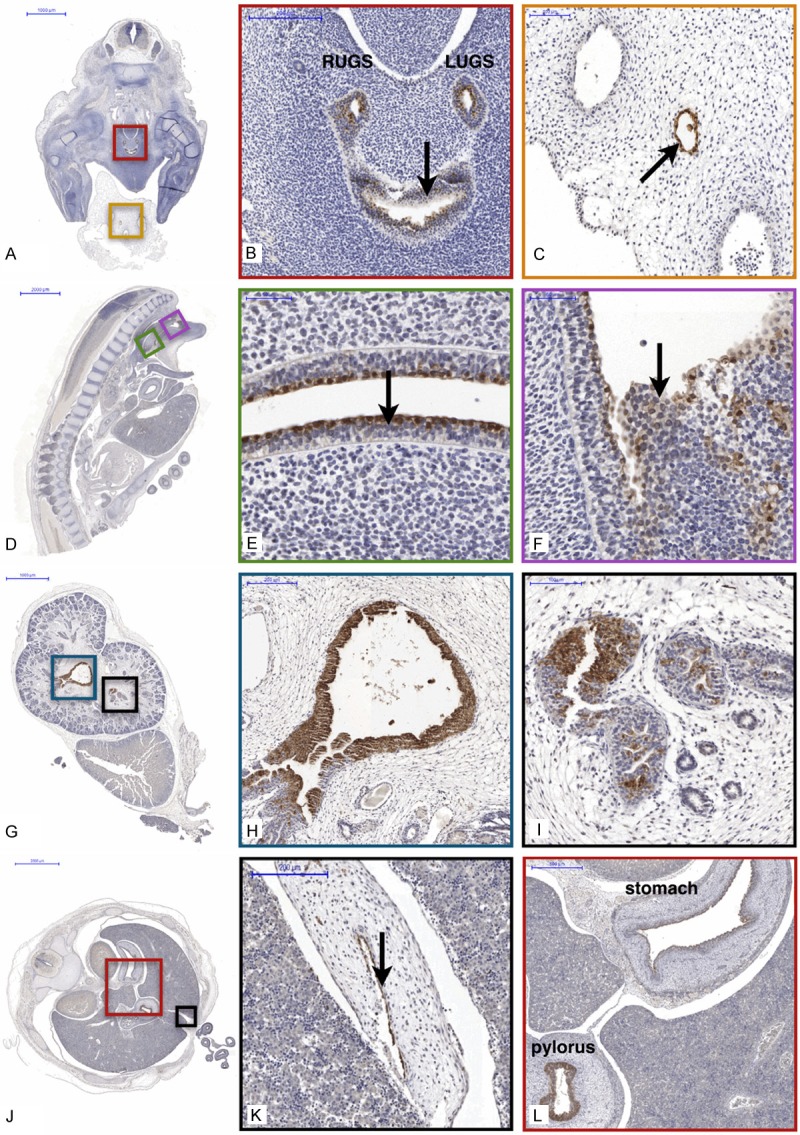
S100P expression in the human embryo. S100P is expressed in the right and left horns of the urogenital sinus (RUGS and LUGS), as well as in the bladder portion of the urogenital sinus (indicated by arrow) in CS17 (A, B), as well as in the allantois (C). In CS21 (D), S100P in the urethral portion of the urogenital sinus (E) shows stronger immunoreactivity than in the bladder portion (F). In the kidney, expression of S100P is seen in the renal pelvis (G, H) as well as in the glomerulus (I) in PCW10. Further expression is seen in the gastrointestinal tract (J-L), including the gallbladder (indicated with arrow) (K) as well as the stomach and pylorus (I) in CS23.
Figure 3
Figure 3
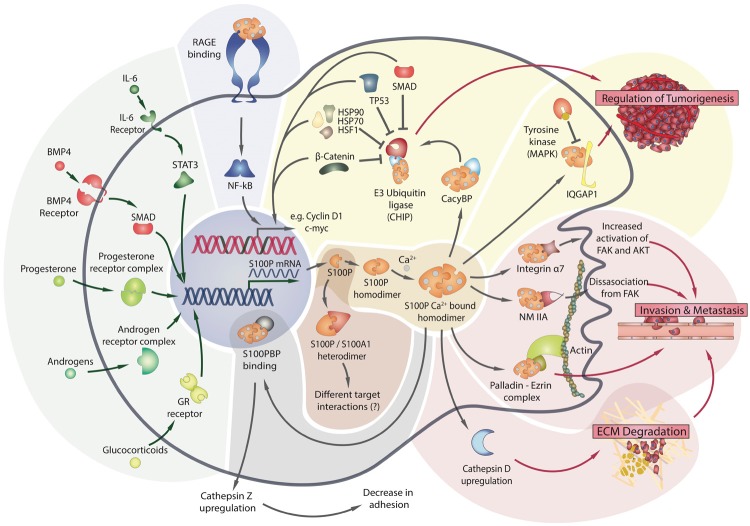
S100P interactions. A summary of known S100P pathways within and outside of the cell is illustrated, starting with transcriptional regulators of S100P expression (green shading). The protein is capable of forming heterodimers (in brown) as well as homodimers (in orange), with most known interactions occurring with the latter. The intercellular interactions are divided into those associated with tumorigenesis (in yellow), regulation of migration, invasion and metastasis (red shading) and translocation into the nucleus (in grey). The extracellular interaction with RAGE is shown in blue.

References

    1. Donato R. S100: a multigenic family of calcium-modulated proteins of the EF-hand type with intracellular and extracellular functional roles. Int J Biochem Cell Biol. 2001;33:637–668. - PubMed
    1. Gribenko A, Lopez MM, Richardson JM 3rd, Makhatadze GI. Cloning, overexpression, purification, and spectroscopic characterization of human S100P. Protein Sci. 1998;7:211–215. - PMC - PubMed
    1. Becker T, Gerke V, Kube E, Weber K. S100P, a novel Ca(2+)-binding protein from human placenta. cDNA cloning, recombinant protein expression and Ca2+ binding properties. Eur J Biochem. 1992;207:541–547. - PubMed
    1. Zhu HY, Tong XM, Lin XN, Jiang LY, Wang JX, Zhang SY. Expression and Distribution of Calcium-Binding Protein S100P in Human Placenta during Pregnancy. Int J Fertil Steril. 2015;8:445–452. - PMC - PubMed
    1. Bresnick AR, Weber DJ, Zimmer DB. S100 proteins in cancer. Nat Rev Cancer. 2015;15:96–109. - PMC - PubMed

LinkOut - more resources