Review
. 2016 Apr;5(2):172-82.
doi: 10.21037/tlcr.2016.04.07.

The role of epithelial to mesenchymal transition in resistance to epidermal growth factor receptor tyrosine kinase inhibitors in non-small cell lung cancer

Affiliations
Review

The role of epithelial to mesenchymal transition in resistance to epidermal growth factor receptor tyrosine kinase inhibitors in non-small cell lung cancer

Kristine Raaby Jakobsen et al. Transl Lung Cancer Res. 2016 Apr.

Abstract

Inhibition of the epidermal growth factor receptor (EGFR) is an important strategy when treating non-small cell lung cancer (NSCLC) patients. However, intrinsic resistance or development of resistance during the course of treatment constitutes a major challenge. The knowledge on EGFR-directed tyrosine kinase inhibitors (TKIs) and their biological effect keeps increasing. Within the group of patients with EGFR mutations some benefit to a much higher degree than others, and for patients lacking EGFR mutations a subset experience an effect. Up to 70% of patients with EGFR mutations and 10-20% of patients without EGFR mutations initially respond to the EGFR-TKI erlotinib, but there is a severe absence of good prognostic markers. Despite initial effect, all patients acquire resistance to EGFR-TKIs. Multiple mechanisms have implications in resistance development, but much is still to be explored. Epithelial to mesenchymal transition (EMT) is a transcriptionally regulated phenotypic shift rendering cells more invasive and migratory. Within the EMT process lays a need for external or internal stimuli to give rise to changes in central signaling pathways. Expression of mesenchymal markers correlates to a bad prognosis and an inferior response to EGFR-TKIs in NSCLC due to the contribution to a resistant phenotype. A deeper understanding of the role of EMT in NSCLC and especially in EGFR-TKI resistance-development constitute one opportunity to improve the benefit of TKI treatment for the individual patient. Many scientific studies have linked the EMT process to EGFR-TKI resistance in NSCLC and our aim is to review the role of EMT in both intrinsic and acquired resistance to EGFR-TKIs.

Keywords: Epidermal growth factor receptor (EGFR); epithelial to mesenchymal transition (EMT); non-small cell lung cancer (NSCLC); tyrosine kinase inhibitor (TKI).


Conflict of interest statement

Conflicts of Interest: The authors have no conflicts of interest to declare.

Figures

Figure 1
Figure 1
EMT induces a cellular phenotypic shift. Epithelial cells are characterized by the presence of apico-basal polarity, intact cell-cell contacts, barrier function, and lack of movement. During the EMT process, cells with partial EMT appear characterized by the incipient presence of a front-rear polarity and have leaky cell-cell contacts. At the same time upregulation of the mesenchymal markers vimentin, N-cadherin, ZEB1 and 2, SNAIL, SLUG and matrix metalloproteinases begin. In addition, these partial EMT cells express lower amounts of E-cadherin and ZO-1 than epithelial cells. After finalization of EMT, the established mesenchymal cells have a clear front-rear polarity and no or few cell contacts. The expression of mesenchymal proteins is increased, and a cadherin gene-expression shift, most often from E-cadherin into N-cadherin expression, appears. EMT, epithelial to mesenchymal transition.
Figure 2
Figure 2
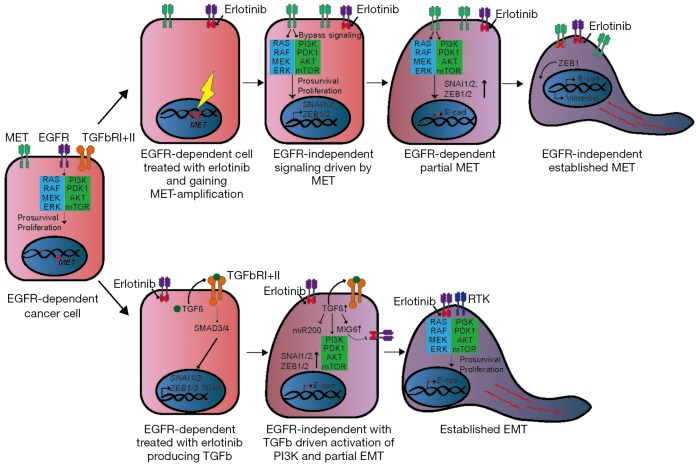
Models for induction of EMT during erlotinib resistance development. Above: erlotinib treatment induces increased IGF1R activation, which restores signaling through PI3K/AKT and MAPK pathways. Restoration of the signaling triggers transcription of mesenchymal transcription factors and leads to an IGF1R-dependent partial or full EMT. Eventually some cells might only depend on EMT signals in order to survive and hence no longer rely on IGF1R-signaling. Below: most cancer cells produce TGF-β, but TGF-β has both tumor-promoting and tumor-suppressing roles at early stages. When the cells are treated with erlotinib, the balance may shift so that cells primarily benefit from the tumor-promoting TGF-β signals. TGF-β initiates EMT through inhibition of miR-200 family and hence upregulation of mesenchymal transcription factors. In addition, TGF-β upregulates the EGFR repressor MIG6 and restores PI3K/AKT signaling. Secondly, PI3K/AKT signaling can activate a kinase shift, giving rise to the expression of another RTK. Hereby, MAPK signaling is restored and EMT solidified (40). EMT, epithelial to mesenchymal transition; TGF-β, transforming growth factor-β; EGFR, epidermal growth factor receptor; RTK, receptor tyrosine kinase.
Figure 3
Figure 3
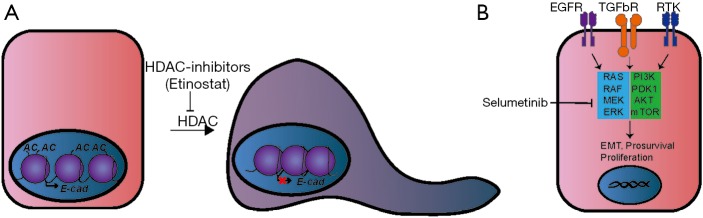
Inhibition of EMT in NSCLC cells. (A) The HDAC inhibitor entinostat maintains an open chromatin structure and the transcription of E-cadherin. Entinostat hereby enforces the epithelial state and prevent EMT; (B) selumetinib inhibits MEK and thus the MAPK pathways. As the MAPK pathway is involved in receptor tyrosine kinase signaling as well as TGF-β signaling, selumetinib has potential both as a first line treatment and as a treatment upon resistance development. EMT, epithelial to mesenchymal transition; NSCLC, non-small cell lung cancer; HDAC, histone deacetylase; TGF-β, transforming growth factor-β.

References

    1. Shepherd FA, Pereira JR, Ciuleanu T, et al. Erlotinib in Previously Treated Non-Small-Cell Lung Cancer. N Engl J Med 2005;353:123-32. 10.1056/NEJMoa050753 - DOI - PubMed
    1. Sequist LV, Joshi VA, Jänne PA, et al. Response to treatment and survival of patients with non-small cell lung cancer undergoing somatic EGFR mutation testing. Oncologist 2007;12:90-8. 10.1634/theoncologist.12-1-90 - DOI - PubMed
    1. Weber B, Hager H, Sorensen BS, et al. EGFR mutation frequency and effectiveness of erlotinib: a prospective observational study in Danish patients with non-small cell lung cancer. Lung Cancer 2014;83:224-30. 10.1016/j.lungcan.2013.11.023 - DOI - PubMed
    1. Lynch TJ, Bell DW, Sordella R, et al. Activating mutations in the epidermal growth factor receptor underlying responsiveness of non-small-cell lung cancer to gefitinib. N Engl J Med 2004;350:2129-39. 10.1056/NEJMoa040938 - DOI - PubMed
    1. Costa DB, Kobayashi S, Tenen DG, et al. Pooled analysis of the prospective trials of gefitinib monotherapy for EGFR-mutant non-small cell lung cancers. Lung Cancer 2007;58:95-103. 10.1016/j.lungcan.2007.05.017 - DOI - PMC - PubMed