


Measures of Body Size and Composition and Risk of Incident Atrial Fibrillation in Older People: The Cardiovascular Health Study
- PMID: 27188936
- PMCID: PMC4887576
- DOI: 10.1093/aje/kwv278
Measures of Body Size and Composition and Risk of Incident Atrial Fibrillation in Older People: The Cardiovascular Health Study
Abstract
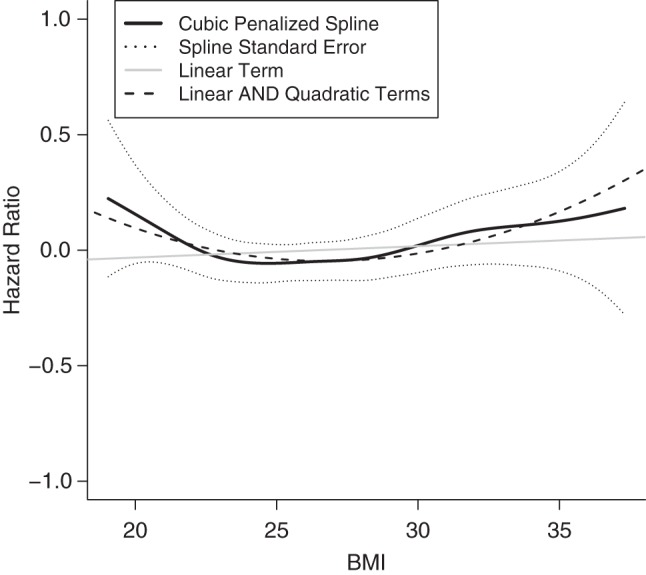
Various anthropometric measures, including height, have been associated with atrial fibrillation (AF). This raises questions about the appropriateness of using ratio measures such as body mass index (BMI), which contains height squared in its denominator, in the evaluation of AF risk. Among older adults, the optimal anthropometric approach to risk stratification of AF remains uncertain. Anthropometric and bioelectrical impedance measures were obtained from 4,276 participants (mean age = 72.4 years) free of cardiovascular disease in the Cardiovascular Health Study. During follow-up (1989-2008), 1,050 cases of AF occurred. BMI showed a U-shaped association, whereas height, weight, waist circumference, hip circumference, fat mass, and fat-free mass were linearly related to incident AF. The strongest adjusted association occurred for height (per each 1-standard-deviation increment, hazard ratio = 1.38, 95% confidence interval: 1.25, 1.51), which exceeded all other measures, including weight (hazard ratio = 1.21, 95% confidence interval: 1.13, 1.29). Combined assessment of log-transformed weight and height showed regression coefficients that departed from the 1 to -2 ratio inherent in BMI, indicating a loss of predictive information. Risk estimates for AF tended to be stronger for hip circumference than for waist circumference and for fat-free mass than for fat mass, which was explained largely by height. These findings highlight the prominent role of body size and the inadequacy of BMI as determinants of AF in older adults.
Keywords: aging; atrial fibrillation; body size; obesity.
© The Author 2016. Published by Oxford University Press on behalf of the Johns Hopkins Bloomberg School of Public Health. All rights reserved. For permissions, please e-mail: journals.permissions@oup.com.
Figures
References
-
- Trends in aging—United States and worldwide. MMWR Morb Mortal Wkly Rep. 2003;526:101–104, 106. - PubMed
-
- Wolf PA, Abbott RD, Kannel WB. Atrial fibrillation as an independent risk factor for stroke: the Framingham Study. Stroke. 1991;228:983–988. - PubMed
-
- Miyasaka Y, Barnes ME, Gersh BJ et al. Incidence and mortality risk of congestive heart failure in atrial fibrillation patients: a community-based study over two decades. Eur Heart J. 2006;278:936–941. - PubMed
Publication types
MeSH terms
Substances
Grants and funding
- N01 HC085080/HL/NHLBI NIH HHS/United States
- U01 HL080295/HL/NHLBI NIH HHS/United States
- N01 HC085082/HL/NHLBI NIH HHS/United States
- R01 HL094555/HL/NHLBI NIH HHS/United States
- HHSN268201200036C/HL/NHLBI NIH HHS/United States
- N01 HC055222/HL/NHLBI NIH HHS/United States
- R01 HL080295/HL/NHLBI NIH HHS/United States
- R01 AG023629/AG/NIA NIH HHS/United States
- R56 AG023629/AG/NIA NIH HHS/United States
- N01 HC085081/HL/NHLBI NIH HHS/United States
- HHSN268200800007C/HL/NHLBI NIH HHS/United States
- N01 HC085086/HL/NHLBI NIH HHS/United States
- N01 HC085083/HL/NHLBI NIH HHS/United States
- K23 HL127296/HL/NHLBI NIH HHS/United States
- N01 HC085079/HL/NHLBI NIH HHS/United States
LinkOut - more resources
Full Text Sources
Other Literature Sources
Medical
