Late mortality after sepsis: propensity matched cohort study
- PMID: 27189000
- PMCID: PMC4869794
- DOI: 10.1136/bmj.i2375
Late mortality after sepsis: propensity matched cohort study
Abstract
Objectives: To determine whether late mortality after sepsis is driven predominantly by pre-existing comorbid disease or is the result of sepsis itself.
Deign: Observational cohort study.
Setting: US Health and Retirement Study.
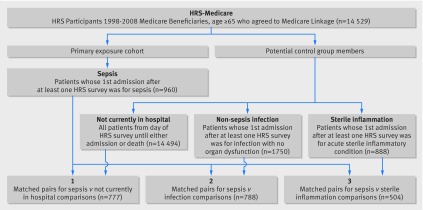
Participants: 960 patients aged ≥65 (1998-2010) with fee-for-service Medicare coverage who were admitted to hospital with sepsis. Patients were matched to 777 adults not currently in hospital, 788 patients admitted with non-sepsis infection, and 504 patients admitted with acute sterile inflammatory conditions.
Main outcome measures: Late (31 days to two years) mortality and odds of death at various intervals.
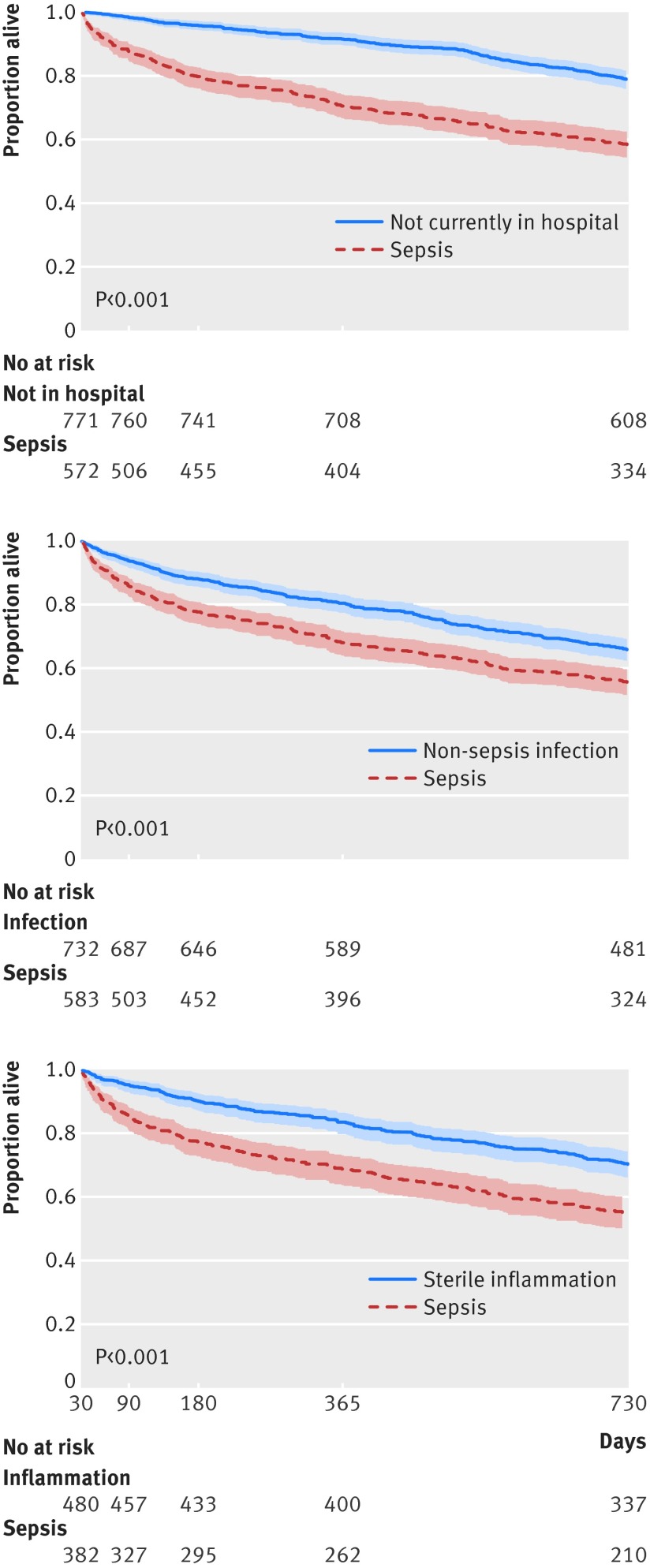
Results: Sepsis was associated with a 22.1% (95% confidence interval 17.5% to 26.7%) absolute increase in late mortality relative to adults not in hospital, a 10.4% (5.4% to 15.4%) absolute increase relative to patients admitted with non-sepsis infection, and a 16.2% (10.2% to 22.2%) absolute increase relative to patients admitted with sterile inflammatory conditions (P<0.001 for each comparison). Mortality remained higher for at least two years relative to adults not in hospital.
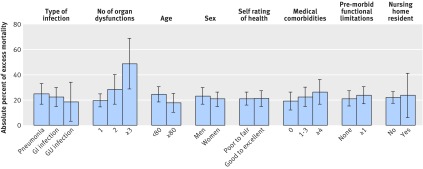
Conclusions: More than one in five patients who survives sepsis has a late death not explained by health status before sepsis.
Published by the BMJ Publishing Group Limited. For permission to use (where not already granted under a licence) please go to http://group.bmj.com/group/rights-licensing/permissions.
Conflict of interest statement
Competing interests: All authors have completed the ICMJE uniform disclosure form at
Figures
Comment in
-
Late mortality after sepsis.BMJ. 2016 May 17;353:i2735. doi: 10.1136/bmj.i2735. BMJ. 2016. PMID: 27189069 Free PMC article.
-
Long term mortality following sepsis.Ann Transl Med. 2016 Oct;4(19):387. doi: 10.21037/atm.2016.08.31. Ann Transl Med. 2016. PMID: 27827464 Free PMC article. No abstract available.
-
Role of sepsis in delayed mortality.Ann Transl Med. 2016 Oct;4(19):378. doi: 10.21037/atm.2016.08.24. Ann Transl Med. 2016. PMID: 27827468 Free PMC article. No abstract available.
References
-
- Angus DC, Linde-Zwirble WT, Lidicker J, Clermont G, Carcillo J, Pinsky MR. Epidemiology of severe sepsis in the United States: analysis of incidence, outcome, and associated costs of care. Crit Care Med 2001;29:1303-10. 10.1097/00003246-200107000-00002 pmid:11445675. - DOI - PubMed
-
- Kaukonen KM, Bailey M, Suzuki S, Pilcher D, Bellomo R. Mortality related to severe sepsis and septic shock among critically ill patients in Australia and New Zealand, 2000-2012. JAMA 2014;311:1308-16. 10.1001/jama.2014.2637. pmid:24638143. - DOI - PubMed
-
- Stevenson EK, Rubenstein AR, Radin GT, Wiener RS, Walkey AJ. Two decades of mortality trends among patients with severe sepsis: a comparative meta-analysis*. Crit Care Med 2014;42:625-31. 10.1097/CCM.0000000000000026. pmid:24201173. - DOI - PMC - PubMed
-
- Miller RR 3rd, , Dong L, Nelson NC, et al. Intermountain Healthcare Intensive Medicine Clinical Program. Multicenter implementation of a severe sepsis and septic shock treatment bundle. Am J Respir Crit Care Med 2013;188:77-82. 10.1164/rccm.201212-2199OC. pmid:23631750. - DOI - PMC - PubMed
-
- Prescott HC, Kepreos KM, Wiitala WL, Iwashyna TJ. Temporal Changes in the Influence of Hospitals and Regional Healthcare Networks on Severe Sepsis Mortality. Crit Care Med 2015;43:1368-74. 10.1097/CCM.0000000000000970. pmid:25803652. - DOI - PMC - PubMed
Publication types
MeSH terms
Grants and funding
LinkOut - more resources
Full Text Sources
Other Literature Sources
Medical