Vitamin D Repletion in Korean Postmenopausal Women with Osteoporosis
- PMID: 27189286
- PMCID: PMC4951469
- DOI: 10.3349/ymj.2016.57.4.923
Vitamin D Repletion in Korean Postmenopausal Women with Osteoporosis
Abstract
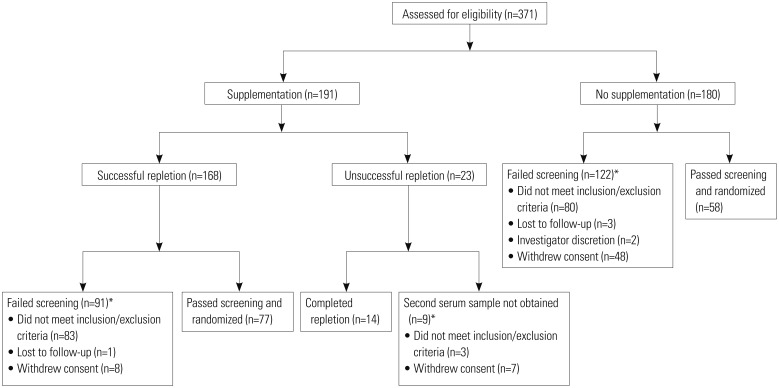
Purpose: Up to 71% of South Korean postmenopausal women have vitamin D deficiency {serum 25-hydroxyvitamin D [25(OH) D] level <50 nmol/L}. Data on vitamin D supplementation was collected during the screening phase of an efficacy/safety study of denosumab in Korean postmenopausal women with osteoporosis. This report describes the effect of vitamin D supplementation on repletion to 25(OH)D levels ≥50 nmol/L in Korean postmenopausal women with osteoporosis.
Materials and methods: Vitamin D levels of Korean postmenopausal women (60-90 years old) were measured by extracting 25(OH)D₂ and 25(OH)D₃ from serum samples via protein precipitation and using liquid chromatography with tandem mass spectrometry detection. Calibration curves were constructed from the mass chromatograms to obtain total vitamin D levels. Subjects with serum 25(OH)D levels <50 nmol/L were supplemented with 1000 IU of vitamin D tablets during the 2.5-month-long screening period. Dose, frequency, and duration were determined by the investigator. If repletion was achieved (≥50 nmol/L) on retest, subjects were eligible to be rescreened for study entry.
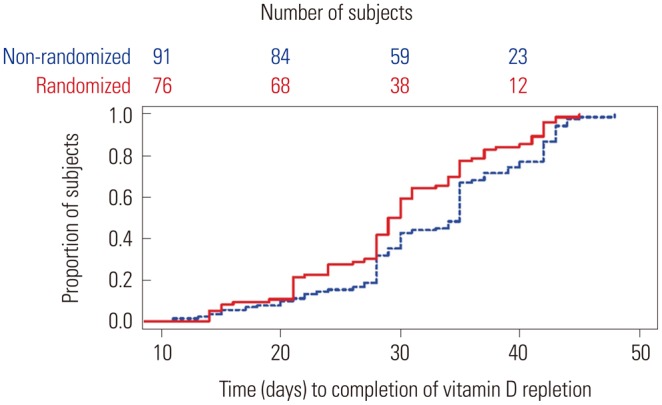
Results: Of 371 subjects screened, 191 (52%) required vitamin D supplementation, and 88% (168 of 191) were successfully repleted. More than half of the subjects (58%) who were successfully repleted received doses of 2000 IU daily. The mean time to successful repletion was 31 days (standard deviation 8.4 days; range 11-48 days).
Conclusion: Supplementation with daily median doses of 2000 IU vitamin D successfully repleted 88% of Korean postmenopausal women with osteoporosis within 48 days to a serum vitamin D level of 50 nmol/L.
Keywords: Korean; Vitamin D; osteoporosis; postmenopause.
Conflict of interest statement
The authors have no financial conflicts of interest.
Figures
References
-
- Bischoff-Ferrari HA, Willett WC, Orav EJ, Lips P, Meunier PJ, Lyons RA, et al. A pooled analysis of vitamin D dose requirements for fracture prevention. N Engl J Med. 2012;367:40–49. - PubMed
-
- Lips P, Hosking D, Lippuner K, Norquist JM, Wehren L, Maalouf G, et al. The prevalence of vitamin D inadequacy amongst women with osteoporosis: an international epidemiological investigation. J Intern Med. 2006;260:245–254. - PubMed
Publication types
MeSH terms
Substances
LinkOut - more resources
Full Text Sources
Other Literature Sources
Medical