. 2016 Aug;33(8):1889-901.
doi: 10.1093/molbev/msw070. Epub 2016 Apr 6.

Conservation and Innovation of APOBEC3A Restriction Functions during Primate Evolution

Affiliations

Conservation and Innovation of APOBEC3A Restriction Functions during Primate Evolution

Richard N McLaughlin Jr et al. Mol Biol Evol. 2016 Aug.

Abstract

LINE-1 (long interspersed element-1) retroelements are the only active autonomous endogenous retroelements in human genomes. Their retrotransposition activity has created close to 50% of the current human genome. Due to the apparent costs of this proliferation, host genomes have evolved multiple mechanisms to curb LINE-1 retrotransposition. Here, we investigate the evolution and function of the LINE-1 restriction factor APOBEC3A, a member of the APOBEC3 cytidine deaminase gene family. We find that APOBEC3A genes have evolved rapidly under diversifying selection in primates, suggesting changes in APOBEC3A have been recurrently selected in a host-pathogen "arms race." Nonetheless, in contrast to previous reports, we find that the LINE-1 restriction activity of APOBEC3A proteins has been strictly conserved throughout simian primate evolution in spite of its pervasive diversifying selection. Based on these results, we conclude that LINE-1s have not driven the rapid evolution of APOBEC3A in primates. In contrast to this conserved LINE-1 restriction, we find that a subset of primate APOBEC3A genes have enhanced antiviral restriction. We trace this gain of antiviral restriction in APOBEC3A to the common ancestor of a subset of Old World monkeys. Thus, APOBEC3A has not only maintained its LINE-1 restriction ability, but also evolved a gain of antiviral specificity against other pathogens. Our findings suggest that while APOBEC3A has evolved to restrict additional pathogens, only those adaptive amino acid changes that leave LINE-1 restriction unperturbed have been tolerated.

Keywords: APOBEC3A; LINE-1; innate immunity; positive selection; primates.; restriction factor; retroelements.


Figures

Fig. 1
Fig. 1
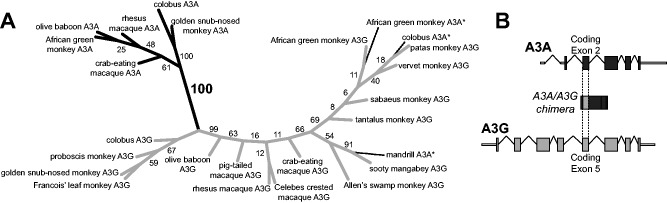
Primate A3A-A3G chimeras contain exon 5 of A3G in place of A3A exon 2. (A) We generated an unrooted maximum likelihood phylogeny using an alignment of A3A exon 2, and A3G exon 5 nucleotide sequences (see Materials and Methods for details). Branches leading to A3A, A3G, or chimeric sequences are shown in black, gray, and dotted lines, respectively. Bootstrap values represent percentages based on 1,000 iterations. The previously reported “alternative exon 2-containing” A3As from mandrill, AGM, colobus (marked *) group with A3Gs, whereas the newly sequenced, corrected A3A exon 2s group with the rest of the A3As. Although the phylogeny is not well resolved within the A3A and A3G clades, the bootstrap support for separation of these two clades is high, grouping the chimeric A3A* sequences with the A3Gs. (B) The chimeric A3A-A3Gs comprise A3G coding exon 5 swapped into A3A in place of the second coding exon of A3A. These chimeras resulted from sequence similarity between the introns on either side of these two exons.
Fig. 2
Fig. 2
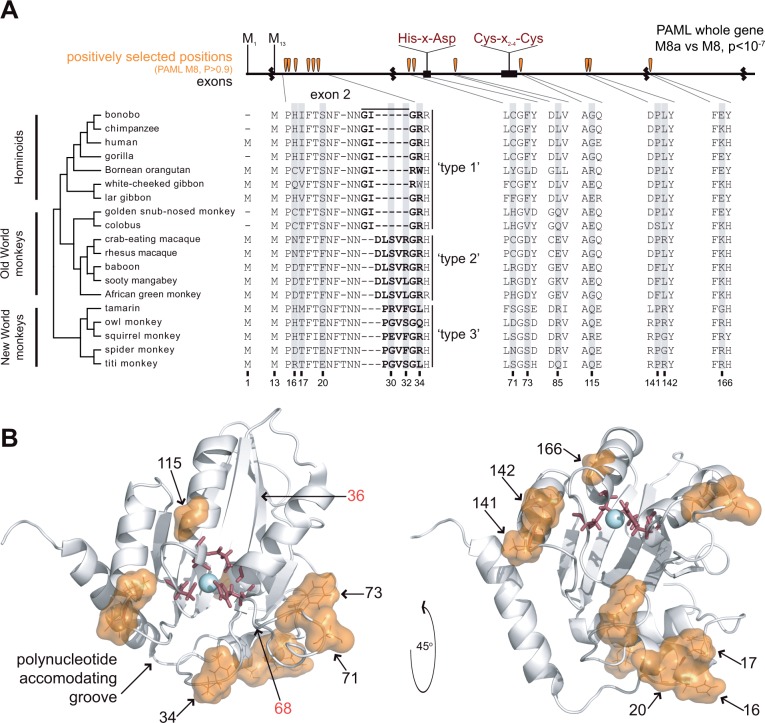
Sequence variation and positive selection in primate A3A. (A) We created an alignment of 19 A3A sequences spanning the hominoids, Old World monkeys, and New World monkeys using publicly available databases and sequencing. Several primates have lost the methionine at “position 1” and instead initiate translation using the methionine at “position 13”. Exon boundaries are denoted by black squiggly lines and the conserved deaminase motif is noted in red labels, top. The exon 2 sequence of A3A varies among primates, which we classify into three general “types.” We tested the signature of positive selection using PAML’s NSsites maximum likelihood method and observe a significant signature of gene-wide positive selection (PAML M8a vs. M8). We also identify 13 codons with statistically significant positive selection (PAML M8, BEB, P > 0.9, table 1), as indicated by shading in the protein alignment and orange teardrops in the exon diagram. (B) The positively selected positions are shown as orange space-filling spheres with positions numbered in black on the white ribbon diagram (A3A NMR structure, PDB ID 2M65 [Byeon et al. 2013]); active site residues are shown in red sticks. Positively selected positions cluster in secondary structure as well tertiary structure along the “polynucleotide accommodating groove” (Bulliard et al. 2011). Amino acid positions numbered in red were shown to increase restriction of LINE-1 by human A3G when swapped from A3A into A3G (Bulliard et al. 2011).
Fig. 3
Fig. 3
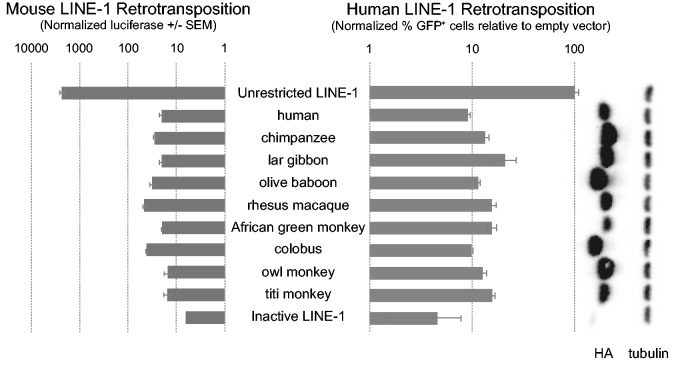
LINE-1 restriction is conserved across primate A3A genes. We synthesized 9 codon-optimized primate A3As and tested their ability to restrict mouse ORFeus_Mm (left bar graph) or human LRE3 LINE-1 (right bar graph) using in vitro retrotransposition assays in 293T cells (see Materials and Methods). The amount of transfected A3A plasmid was optimized for similar levels of protein production as measured by Western blot against each A3A’s HA-tag. The Western blot image, shown on the right, represents an independent transfection of 25,000 293T cells with the same mass of A3A-expressing or empty plasmid transfected for the mouse LINE-1 assay (for the human assay, the plasmid mass was scaled to transfect the same ng plasmid/cell, see Materials and Methods). Each A3A restricted mouse LINE-1 by around 100-fold and human LINE-1 by around 10-fold; data are shown on a log scale. The mouse LINE-1 restriction data points represent the mean ± standard error of at least eight independent transfected wells and the human LINE-1 restriction data points represent the mean ± standard error of at least three independent transfected wells.
Fig. 4
Fig. 4
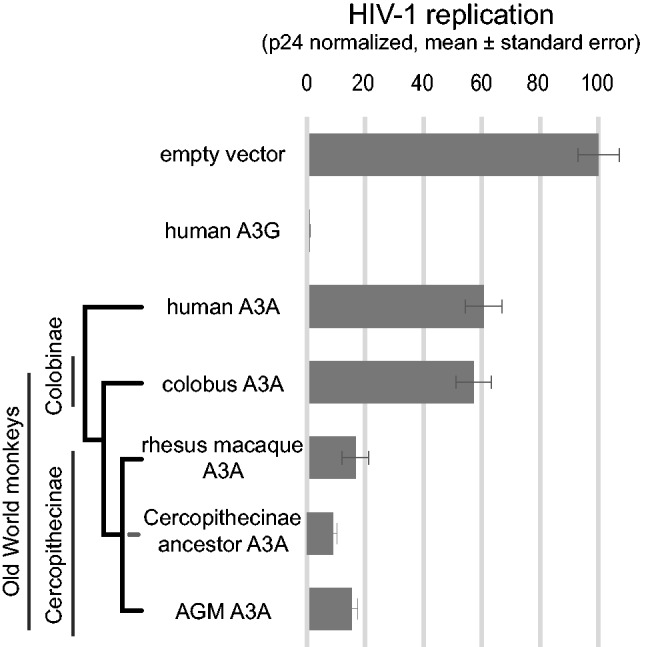
Some Old World monkey A3As restrict HIV-1. We tested the ability of selected A3A genes to restrict HIV-1 (pLai3ΔenvLuc2Δvif [OhAinle et al. 2006]) in single-cycle infectivity assays as detailed in the methods. Each bar represents the mean ± standard error of the luciferase measurement of at least three wells normalized to empty vector, each infected with the virus equivalent of 2 ng p24 gag. Human A3G restricts HIV-1 greater than 100-fold, whereas A3As from AGM, rhesus, and the reconstructed Cercopithecinae ancestor restrict approximately 10-fold compared with empty vector. In contrast, human and colobus A3A show less than 2-fold restriction.

References

    1. Aguiar RS, Lovsin N, Tanuri A, Peterlin BM. 2008. Vpr.A3A chimera inhibits HIV replication. J Biol Chem. 283:2518–2525. - PubMed
    1. Altschul SF, Madden TL, Schaffer AA, Zhang J, Zhang Z, Miller W, Lipman DJ. 1997. Gapped BLAST and PSI-BLAST: a new generation of protein database search programs. Nucleic Acids Res. 25:3389–3402. - PMC - PubMed
    1. An W, Dai L, Niewiadomska AM, Yetil A, O'Donnell KA, Han JS, Boeke JD. 2011. Characterization of a synthetic human LINE-1 retrotransposon ORFeus-Hs. Mob DNA. 2:2.. - PMC - PubMed
    1. An W, Han JS, Wheelan SJ, Davis ES, Coombes CE, Ye P, Triplett C, Boeke JD. 2006. Active retrotransposition by a synthetic L1 element in mice. Proc Natl Acad Sci U S A. 103:18662–18667. - PMC - PubMed
    1. Arias JF, Koyama T, Kinomoto M, Tokunaga K. 2012. Retroelements versus APOBEC3 family members: no great escape from the magnificent seven. Front Microbiol. 3:275.. - PMC - PubMed

Publication types

LinkOut - more resources