


Comment
doi: 10.1073/pnas.1605358113.
News Feature: Better models for brain disease
- PMID: 27190074
- PMCID: PMC4878480
- DOI: 10.1073/pnas.1605358113
Item in Clipboard
Comment
News Feature: Better models for brain disease
Proc Natl Acad Sci U S A.
.
No abstract available
Figures
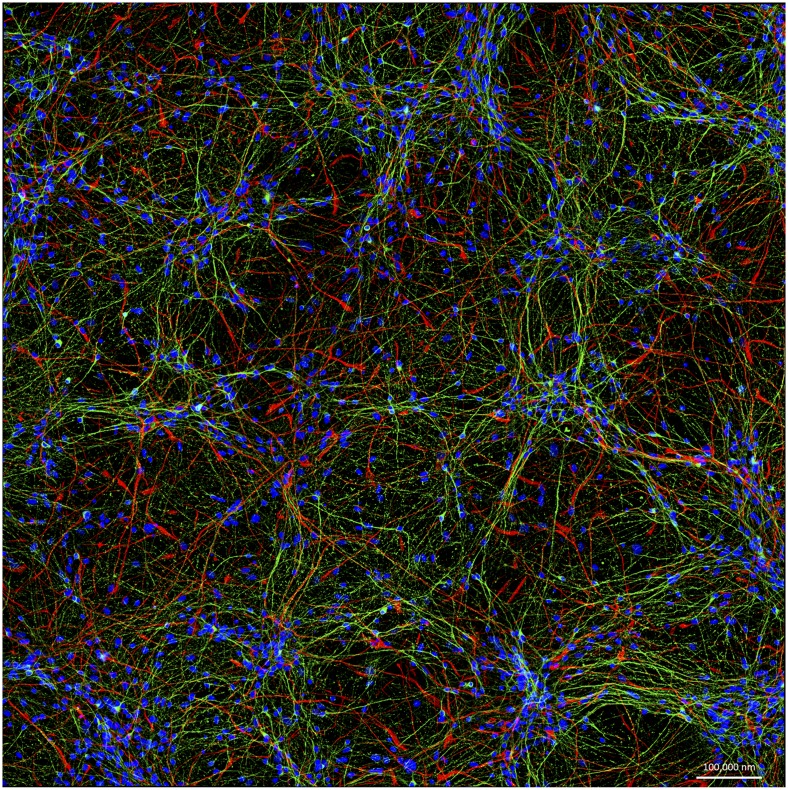
Neurons such as these, derived from the induced pluripotent stem cells of a Parkinson's disease patient, are on the forefront of efforts to improve models for brain disease. Image courtesy of Cedric Bardy and Fred H. Gage (The Salk Institute, La Jolla, CA).
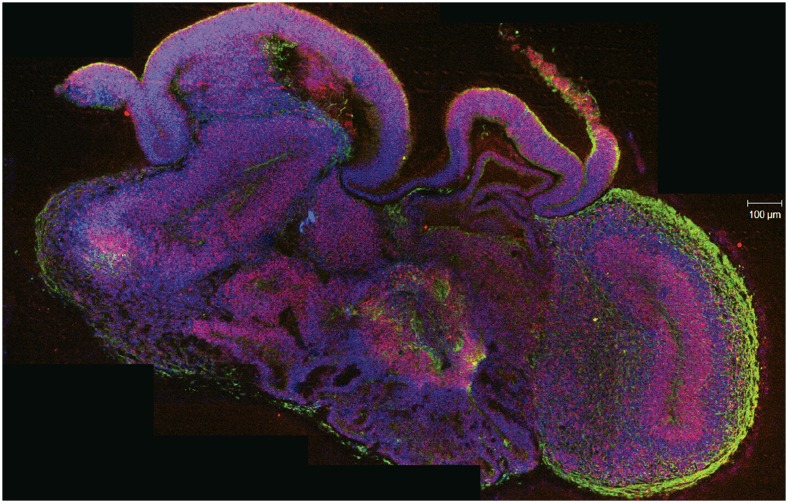
To study brain disorders in living human tissue, researchers grew this cerebral organoid from stem cells derived from a healthy donor's skin sample. In this cross-section, the neurons are green, progenitors are red, and nuclei are blue. Image courtesy of Madeline A. Lancaster and Juergen A. Knoblich. Reproduced from ref. , with permission from Macmillan Publishers: Nature, copyright (2013).
Comment on
-
Modeling psychiatric disorders for developing effective treatments.Nat Med. 2015 Sep;21(9):979-88. doi: 10.1038/nm.3935. Nat Med. 2015. PMID: 26340119 Free PMC article. Review.
-
Mice with Shank3 Mutations Associated with ASD and Schizophrenia Display Both Shared and Distinct Defects.Neuron. 2016 Jan 6;89(1):147-62. doi: 10.1016/j.neuron.2015.11.023. Epub 2015 Dec 10. Neuron. 2016. PMID: 26687841 Free PMC article.
References
Publication types
MeSH terms
LinkOut - more resources
Full Text Sources
Other Literature Sources
Medical
