Review
. 2016:2016:1203285.
doi: 10.1155/2016/1203285. Epub 2016 Apr 14.

Intracerebral Hemorrhage, Oxidative Stress, and Antioxidant Therapy

Affiliations
Review

Intracerebral Hemorrhage, Oxidative Stress, and Antioxidant Therapy

Xiaochun Duan et al. Oxid Med Cell Longev. 2016.

Abstract

Hemorrhagic stroke is a common and severe neurological disorder and is associated with high rates of mortality and morbidity, especially for intracerebral hemorrhage (ICH). Increasing evidence demonstrates that oxidative stress responses participate in the pathophysiological processes of secondary brain injury (SBI) following ICH. The mechanisms involved in interoperable systems include endoplasmic reticulum (ER) stress, neuronal apoptosis and necrosis, inflammation, and autophagy. In this review, we summarized some promising advances in the field of oxidative stress and ICH, including contained animal and human investigations. We also discussed the role of oxidative stress, systemic oxidative stress responses, and some research of potential therapeutic options aimed at reducing oxidative stress to protect the neuronal function after ICH, focusing on the challenges of translation between preclinical and clinical studies, and potential post-ICH antioxidative therapeutic approaches.


Figures
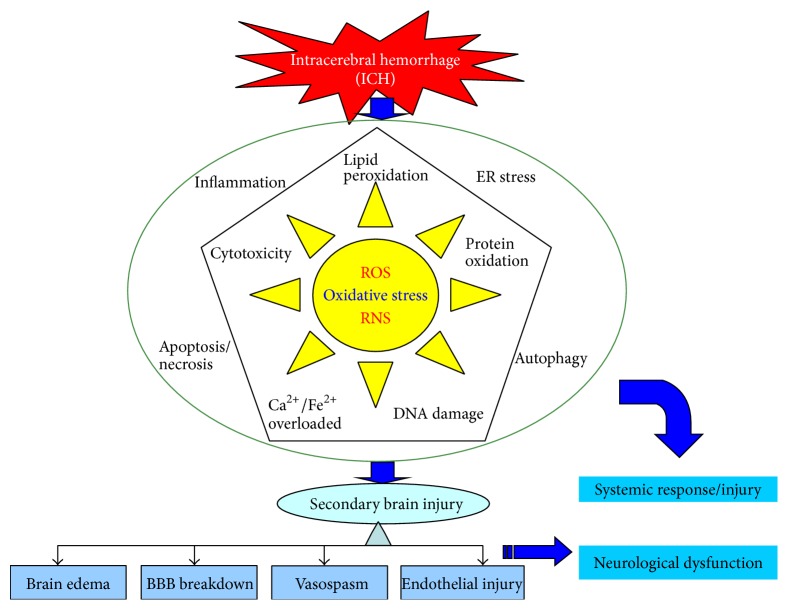
Figure 1
Figure 1
Schematic representation of major intracellular pathway in the role of reactive oxygen species radicals in hemorrhagic stroke. ROS: Reactive oxygen species; RNS: reactive nitrogen species; ICH: intracerebral hemorrhage; ER stress: endoplasmic reticulum stress; BBB: blood brain barrier.

References

    1. Qureshi A. I., Mendelow A. D., Hanley D. F. Intracerebral haemorrhage. The Lancet. 2009;373(9675):1632–1644. doi: 10.1016/S0140-6736(09)60371-8. - DOI - PMC - PubMed
    1. Meschia J. F., Bushnell C., Boden-Albala B., et al. Guidelines for the primary prevention of stroke: a statement for healthcare professionals from the American Heart Association/American Stroke Association. Stroke. 2014;45(12):3754–3832. doi: 10.1161/str.0000000000000046. - DOI - PMC - PubMed
    1. Gustavsson A., Svensson M., Jacobi F., et al. Cost of disorders of the brain in Europe 2010. European Neuropsychopharmacology. 2011;21(10):718–779. doi: 10.1016/j.euroneuro.2011.08.008. - DOI - PubMed
    1. Belur P. K., Chang J. J., He S., Emanuel B. A., Mack W. J. Emerging experimental therapies for intracerebral hemorrhage: targeting mechanisms of secondary brain injury. Neurosurgical Focus. 2013;34(5, article E9) doi: 10.3171/2013.2.focus1317. - DOI - PubMed
    1. Aronowski J., Zhao X. Molecular pathophysiology of cerebral hemorrhage: secondary brain injury. Stroke: A journal of cerebral circulation. 2011;42(6):1781–1786. doi: 10.1161/strokeaha.110.596718. - DOI - PMC - PubMed

MeSH terms
