. 2016 Aug;22(8):1395-402.
doi: 10.3201/eid2208.152015. Epub 2016 Aug 15.

Middle East Respiratory Syndrome Coronavirus Transmission in Extended Family, Saudi Arabia, 2014

Middle East Respiratory Syndrome Coronavirus Transmission in Extended Family, Saudi Arabia, 2014

M Allison Arwady et al. Emerg Infect Dis. 2016 Aug.

Abstract

Risk factors for human-to-human transmission of Middle East respiratory syndrome coronavirus (MERS-CoV) are largely unknown. After MERS-CoV infections occurred in an extended family in Saudi Arabia in 2014, relatives were tested by using real-time reverse transcription PCR (rRT-PCR) and serologic methods. Among 79 relatives, 19 (24%) were MERS-CoV positive; 11 were hospitalized, and 2 died. Eleven (58%) tested positive by rRT-PCR; 8 (42%) tested negative by rRT-PCR but positive by serology. Compared with MERS-CoV-negative adult relatives, MERS-CoV-positive adult relatives were older and more likely to be male and to have chronic medical conditions. Risk factors for household transmission included sleeping in an index patient's room and touching respiratory secretions from an index patient. Casual contact and simple proximity were not associated with transmission. Serology was more sensitive than standard rRT-PCR for identifying infected relatives, highlighting the value of including serology in future investigations.

Keywords: Middle East respiratory syndrome coronavirus; RT-PCR; Saudi Arabia; disease transmission; infectious; serologic tests; viruses.


Figures
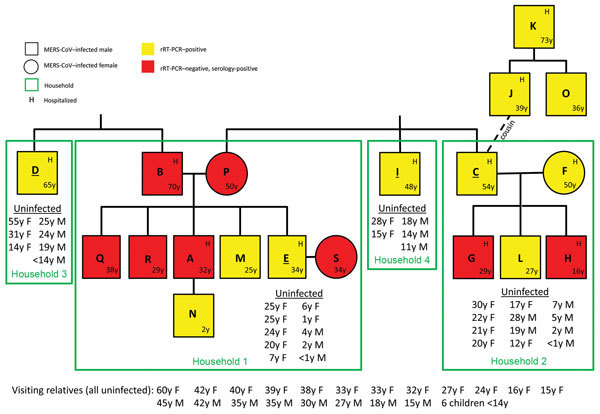
Figure 1
Figure 1
Family relationships and household distribution of persons infected with MERS-CoV, Al-Qouz, Saudi Arabia, 2014. Black lines denote standard family tree relationships. Patients are lettered in order of symptom onset or, if asymptomatic, by test date. Green boxes indicate households; all persons living in households 1–4 were tested, except for 2 adults living in household 4 (not shown). Index patient (person with earliest symptom onset diagnosed by rRT-PCR) in each household is underlined. Uninfected indicates person in household with negative rRT-PCR results and (if >14 years of age) negative serologic testing for MERS-CoV. Visiting relatives indicates extended family members who regularly visited the 4 households and were present in the households on the day of the field investigation. MERS-CoV, Middle East respiratory syndrome coronavirus; rRT-PCR, real-time reverse transcription PCR.
Figure 2
Figure 2
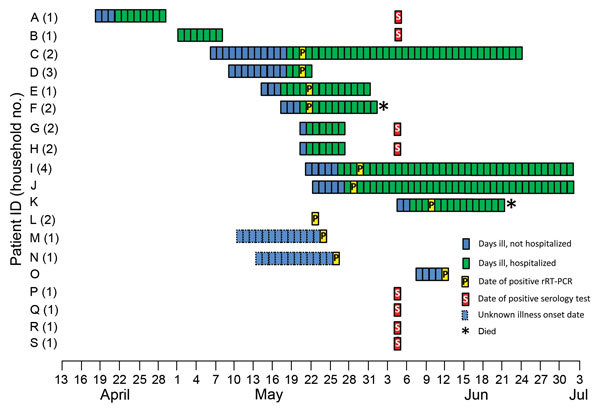
Timeline of illness onset and testing for MERS-CoV–positive family members, Al-Qouz, Saudi Arabia, 2014. Patients M and N had mild symptoms during 2 weeks before their rRT-PCR–positive results but did not identify a specific onset date; their illness dates are estimated. Patients R and S reported symptoms during the month preceding their positive serology tests but also without a specific onset date; their illness dates are not displayed. Patients L, P, and Q denied symptoms at any time. HH, household; MERS-CoV, Middle East respiratory syndrome coronavirus; Pt, patient; rRT-PCR, real-time reverse transcription PCR; S, positive serology date for rRT-PCR–negative persons.
Figure 3
Figure 3
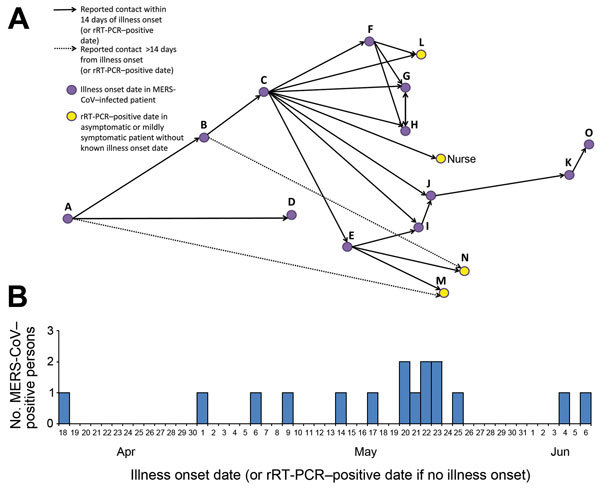
Reported contact among family members who received a MERS-CoV diagnosis and illness onset timeline, Al-Qouz, Saudi Arabia, 2014. Patients L, M, and N, as well as the infected nurse, reported no or mild symptoms and could not identify onset dates; for these 4 persons, the rRT-PCR–positive date is listed. All persons were questioned about ill family members with whom they had close contact during illness. Solid arrows indicate contact between persons within 14 days (MERS–CoV incubation period is <14 days) and indicate a likely infection source. Dashed arrows indicate contact after the 14-day incubation period; they are included for patients M and N because these patients could not identify their precise illness onset dates. MERS-CoV, Middle East respiratory syndrome coronavirus; rRT-PCR, reverse transcription PCR.

References

    1. Zaki AM. Novel coronavirus—Saudi Arabia: human isolate. ProMED. 2012. Sep 20 [cited 2016 May 1]. http://www.promedmail.org, archive no. 20120920.1302733.
    1. Zaki AM, van Boheemen S, Bestebroer TM, Osterhaus AD, Fouchier RA. Isolation of a novel coronavirus from a man with pneumonia in Saudi Arabia. N Engl J Med. 2012;367:1814–20. 10.1056/NEJMoa1211721 - DOI - PubMed
    1. Assiri A, McGeer A, Perl TM, Price CS, Al Rabeeah AA, Cummings DA, et al. Hospital outbreak of Middle East respiratory syndrome coronavirus. N Engl J Med. 2013;369:407–16. 10.1056/NEJMoa1306742 - DOI - PMC - PubMed
    1. World Health Organization. Middle East respiratory syndrome coronavirus (MERS-CoV) [cited 2016 May 1]. http://www.who.int/emergencies/mers-cov/en/
    1. World Health Organization. Middle East respiratory syndrome coronavirus (MERS-CoV): summary of current situation, literature update and risk assessment—7 July 2015. [cited 2016 Feb 28]. http://apps.who.int/iris/bitstream/10665/179184/2/WHO_MERS_RA_15.1_eng.pdf

Substances

LinkOut - more resources