


Gene-expression analysis of gleason grade 3 tumor glands embedded in low- and high-risk prostate cancer
- PMID: 27191985
- PMCID: PMC5122354
- DOI: 10.18632/oncotarget.9344
Gene-expression analysis of gleason grade 3 tumor glands embedded in low- and high-risk prostate cancer
Abstract
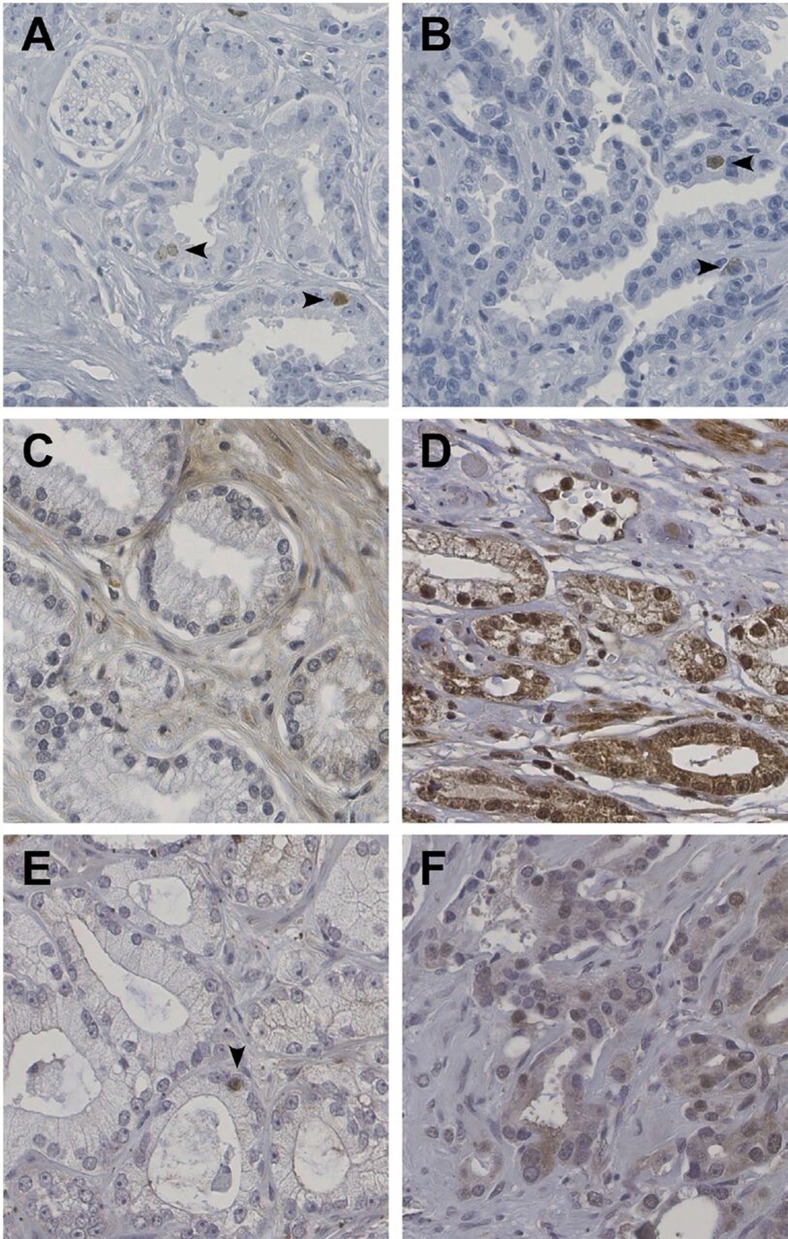
The Gleason score (GS) of prostate cancer on diagnostic biopsies is an important parameter for therapeutic decision-making. Biopsy GS under-estimates the actual GS at radical prostatectomy in a significant number of patients due to samplingartifact. The aim of this study was to identify markers that are differentially expressed in Gleason grade 3 (GG3) tumor glands embedded in GS 4 + 3 = 7 and GS 3 + 3 = 6 prostate cancer using laser capture microdissection and RNA sequencing.GG3 tumor glands embedded in nine GS 3 + 3 = 6 and nine GS 4 + 3 = 7 prostate cancers were isolated by laser capture microdissection of frozen radical prostatectomy specimens. After RNA amplification and RNA sequencing, differentially expressed genes in both GG3 components were identified by a 2log fold change > 1.0 and p-value < 0.05. We applied immunohistochemistry on a tissue micro-array representing 481 radical prostatectomy samples for further validation on protein level.A total of 501 genes were up-regulated and 421 down-regulated in GG3 glands embedded in GS 4 + 3 = 7 as compared to GS 3 + 3 = 6 prostate cancer. We selected HELLS, ZIC2 and ZIC5 genes for further validation. ZIC5 mRNA was up-regulated 17 fold (p = 8.4E-07), ZIC2 8 fold (p = 1.3E-05) and HELLS 2 fold (p = 0.006) in GG3 glands derived from GS 4 + 3 = 7. HELLS expression of ≥ 1% occurred in 10% GS < 7, 17% GS 7 and 43% GS >7 prostate cancer (p < 0.001). Using a cut-off of ≥ 1%, protein expression of ZIC5 was present in 28% GS < 7, 43% GS 7 and 57% GS > 7 cancer (p < 0.001). ZIC2 was neither associated with GS nor outcome in our validation set. HELLS was independently predictive for biochemical-recurrence after radical prostatectomy (HR 2.3; CI 1.5-3.6; p < 0.01).In conclusion, HELLS and ZIC5 might be promising candidate markers for selection of biopsy GS 6 prostate cancer being at risk for up-grading at prostatectomy.
Keywords: RNA sequencing; immunohistochemistry; laser capture microdissection; prostate cancer.
Conflict of interest statement
None to declare.
Figures
References
-
- Ferlay J, Soerjomataram I, Dikshit R, Eser S, Mathers C, Rebelo M, Parkin DM, Forman D, Bray F. Cancer incidence, mortality worldwide: sources, methods, major patterns in GLOBOCAN 2012. Int J Cancer. 2015;136:E359–86. - PubMed
-
- Malvezzi M, Bertuccio P, Rosso T, Rota M, Levi F, Vecchia La C, Negri E. European cancer mortality predictions for the year 2015: does lung cancer have the highest death rate in EU women? Ann Oncol. 2015;26:779–86. - PubMed
-
- Siegel RL, Miller KD, Jemal A. Cancer statistics, 2015. CA Cancer J Clin. 2015;65:5–29. - PubMed
-
- Epstein JI, Egevad L, Amin MB, Delahunt B, Srigley JR, Humphrey PA. The 2014 International Society of Urological Pathology (ISUP) Consensus Conference on Gleason Grading of Prostatic Carcinoma: Definition of Grading Patterns, Proposal for a New Grading System. Am J Surg Pathol. 2015 - PubMed
-
- Humphrey PA. Gleason grading, prognostic factors in carcinoma of the prostate. Mod Pathol. 2004;17:292–306. - PubMed
MeSH terms
Substances
LinkOut - more resources
Full Text Sources
Other Literature Sources
Medical
