


Factors Underlying Ebola Virus Infection Among Health Workers, Kenema, Sierra Leone, 2014-2015
- PMID: 27193749
- PMCID: PMC4967603
- DOI: 10.1093/cid/ciw327
Factors Underlying Ebola Virus Infection Among Health Workers, Kenema, Sierra Leone, 2014-2015
Abstract
Background: Ebola virus disease (EVD) in health workers (HWs) has been a major challenge during the 2014-2015 outbreak. We examined factors associated with Ebola virus exposure and mortality in HWs in Kenema District, Sierra Leone.
Methods: We analyzed data from the Sierra Leone National Viral Hemorrhagic Fever Database, contact tracing records, Kenema Government Hospital (KGH) staff and Ebola Treatment Unit (ETU) rosters, and burial logs.
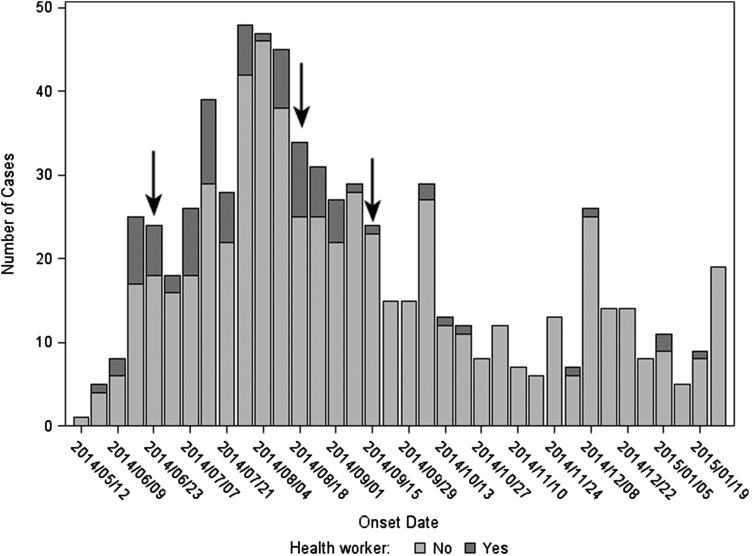
Results: From May 2014 through January 2015, 600 cases of EVD originated in Kenema District, including 92 (15%) HWs, 66 (72%) of whom worked at KGH. Among KGH medical staff and international volunteers, 18 of 62 (29%) who worked in the ETU developed EVD, compared with 48 of 83 (58%) who worked elsewhere in the hospital. Thirteen percent of HWs with EVD reported contact with EVD patients, while 27% reported contact with other infected HWs. The number of HW EVD cases at KGH declined roughly 1 month after implementation of a new triage system at KGH and the opening of a second ETU within the district. The case fatality ratio for HWs and non-HWs with EVD was 69% and 74%, respectively.
Conclusions: The cluster of HW EVD cases in Kenema District is one of the largest ever reported. Most HWs with EVD had potential virus exposure both inside and outside of hospitals. Prevention measures for HWs must address a spectrum of infection risks in both formal and informal care settings as well as in the community.
Keywords: Ebola; health worker; infection prevention and control; outbreak; viral hemorrhagic fever.
© 2016 World Health Organization; licensee Oxford Journals.
Figures
References
-
- Khan AS, Tshioko FK, Heymann DL et al. The reemergence of Ebola hemorrhagic fever, Democratic Republic of the Congo, 1995. Commission de Lutte contre les Epidemies a Kikwit. J Infect Dis 1999; 179(suppl 1):S76–86. - PubMed
-
- Muyembe-Tamfum JJ, Kipasa M, Kiyungu C, Colebunders R. Ebola outbreak in Kikwit, Democratic Republic of the Congo: discovery and control measures. J Infect Dis 1999; 179(suppl 1):S259–62. - PubMed
-
- World Health Organization. Outbreak of Ebola haemorrhagic fever, Uganda, August 2000 – January 2001. Wkly Epidemiol Rec 2001; 76:41–8. - PubMed
MeSH terms
Grants and funding
LinkOut - more resources
Full Text Sources
Other Literature Sources
Medical
