Review
. 2016 May 19;7(5):e2226.
doi: 10.1038/cddis.2016.132.

Fatty acid oxidation and carnitine palmitoyltransferase I: emerging therapeutic targets in cancer

Affiliations
Review

Fatty acid oxidation and carnitine palmitoyltransferase I: emerging therapeutic targets in cancer

Q Qu et al. Cell Death Dis. .

Abstract

Tumor cells exhibit unique metabolic adaptations that are increasingly viewed as potential targets for novel and specific cancer therapies. Among these targets, the carnitine palmitoyltransferase system is responsible for delivering the long-chain fatty acid (FA) from cytoplasm into mitochondria for oxidation, where carnitine palmitoyltransferase I (CPTI) catalyzes the rate-limiting step of fatty acid oxidation (FAO). With increasing understanding of the crucial role had by fatty acid oxidation in cancer, CPTI has received renewed attention as a pivotal mediator in cancer metabolic mechanism. CPTI activates FAO and fuels cancer growth via ATP and NADPH production, constituting an essential part of cancer metabolism adaptation. Moreover, CPTI also functionally intertwines with other key pathways and factors to regulate gene expression and apoptosis of cancer cell. Here, we summarize recent findings and update the current understanding of FAO and CPTI in cancer and provide theoretical basis for this enzyme as an emerging potential molecular target in cancer therapeutic intervention.


Figures
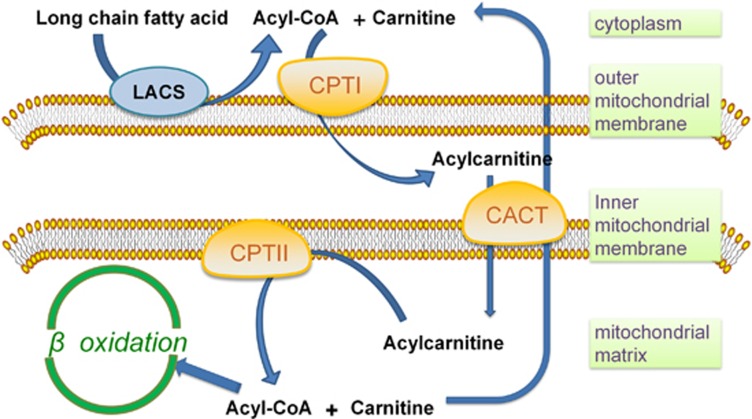
Figure 1
Figure 1
The regulation of FAO on the mitochondrial membrane. Long-chain fatty acid is transformed into acyl-CoA after the catalysis of long-chain acyl-CoA synthetase (LACS). The carnitine palmitoyltransferase system then transport acyl-CoA from cytoplasm into mitochondrial matrix for oxidation: CPTI converts acyl-CoAs into acylcarnitines. CACT exchanges acylcarnitine and carnitine between outer and inner membranes of mitochondrial and finally acylcarnitine is converted back into acyl-CoAs for oxidation by CPTII
Figure 2
Figure 2
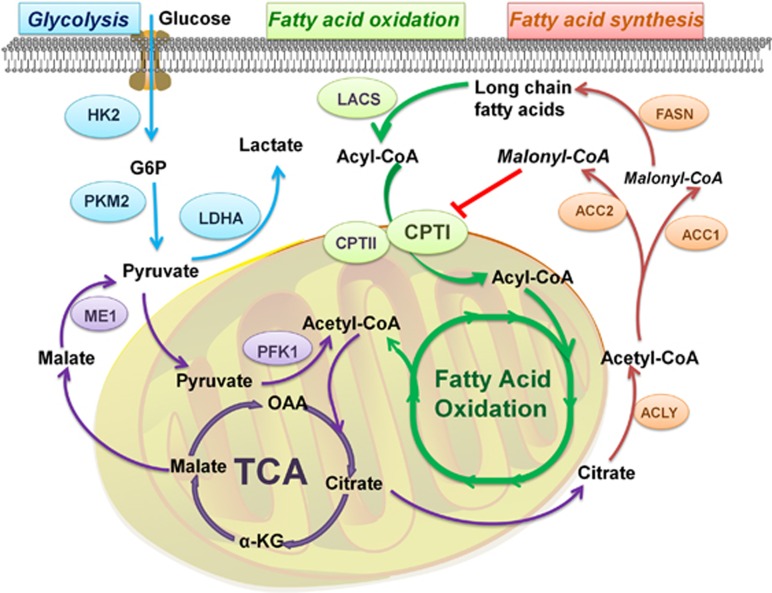
Metabolic pathway of aerobic glycolysis, FAS and FAO. CPTI can be inhibited directly by ACC2-generated malony-CoA, a crucial intermediate in FAS. This effect prevents FAS and FAO from being activated simultaneously. FAO also takes the long-chain fatty acids as raw materials, which are the products of FAS. FAO and aerobic glycolysis are both significant energy-supplying processes in cancer. Acetyl-CoA generated from FAO serves as an essential source of tricarboxylic acid cycle (TCA), which can finally produce malate to supplement pyruvate
Figure 3
Figure 3
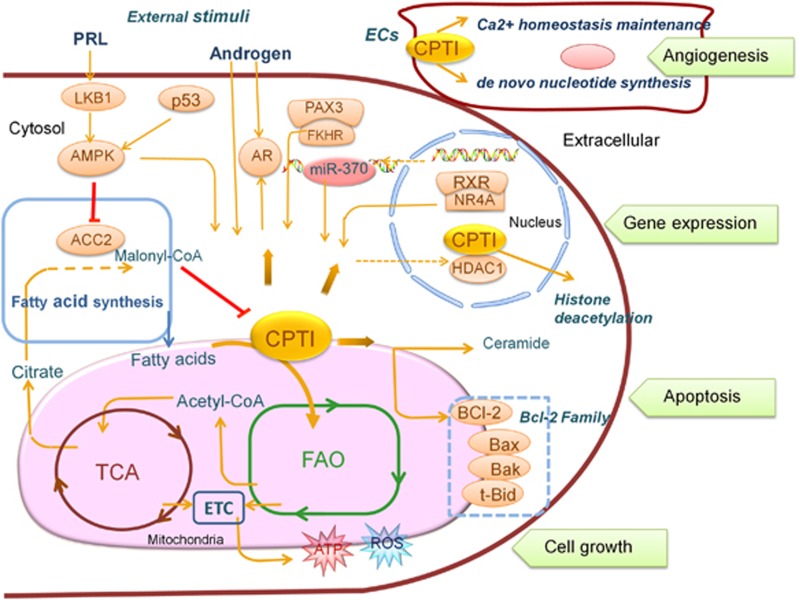
CPTI catalyzes the rate-limiting step of FAO and directly alters its intensity, supplying more ATP and ROS to facilitate cancer cell growth. CPTI also associates with other key regulatory pathways and factors such as aerobic glycolysis and FAS, p53/AMPK axis, PAX3-FKHR and external stimuli such as hormone (e.g., PRL, androgen). CPTI modulates apoptosis of cancer cells via interaction with BCL-2 family and cytotoxic lipids (e.g., ceramide). MiR-370 can regulate the expression of CPTI. The relations of CPTI with various nuclear proteins provided clues to its function in gene expression: transcriptional regulation by RXR/NR4A and deacetylation regulation by recruiting HDAC complexes. In the endothelial cells (ECs) outside the cancer cells, the high expression of CPTI can influence tumor neovascularization enormously

References

    1. Hanahan D, Weinberg RA. Hallmarks of cancer: the next generation. Cell 2011; 144: 646–674. - PubMed
    1. Zhao Y, Butler EB, Tan M. Targeting cellular metabolism to improve cancer therapeutics. Cell Death Dis 2013; 4: e532. - PMC - PubMed
    1. Bensinger SJ, Christofk HR. New aspects of the Warburg effect in cancer cell biology. Semin Cell Dev Biol 2012; 23: 352–361. - PubMed
    1. Santos CR, Schulze A. Lipid metabolism in cancer. FEBS J 2012; 279: 2610–2623. - PubMed
    1. Carracedo A, Cantley LC, Pandolfi PP. Cancer metabolism: fatty acid oxidation in the limelight. Nat Rev Cancer 2013; 13: 227–232. - PMC - PubMed

MeSH terms