


Disruption of Locomotion in Response to Hindlimb Muscle Stretch at Acute and Chronic Time Points after a Spinal Cord Injury in Rats
- PMID: 27196003
- PMCID: PMC5286548
- DOI: 10.1089/neu.2015.4227
Disruption of Locomotion in Response to Hindlimb Muscle Stretch at Acute and Chronic Time Points after a Spinal Cord Injury in Rats
Abstract
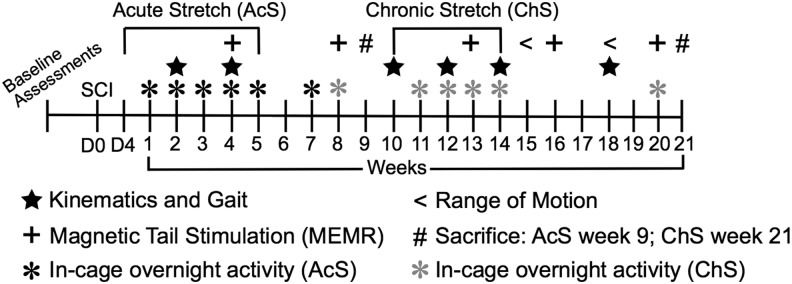
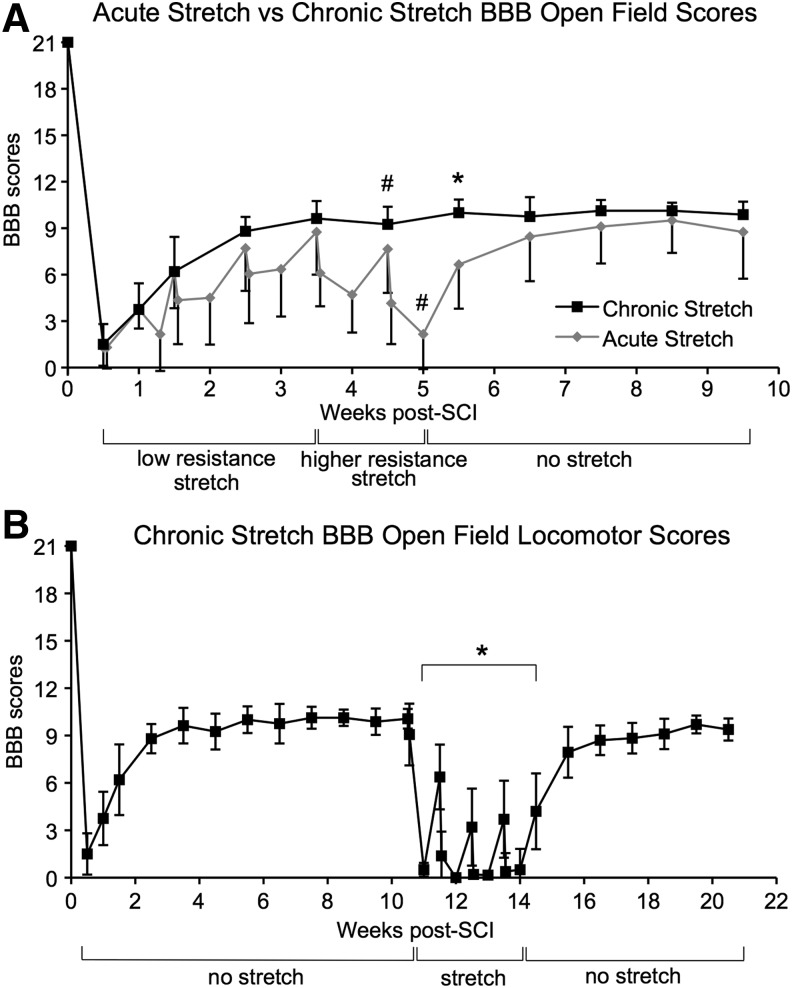
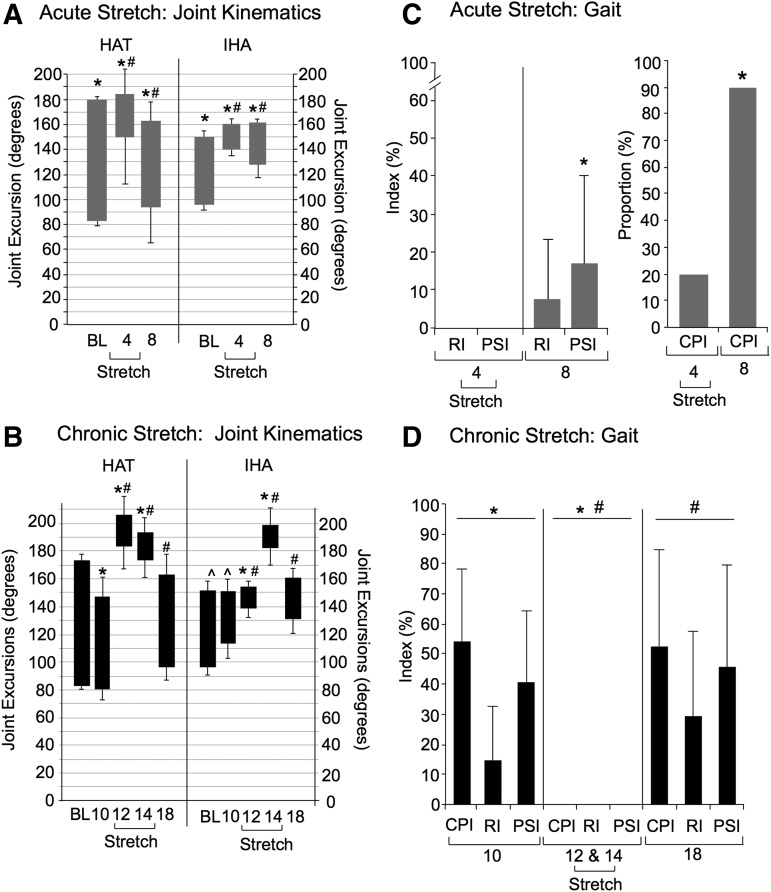
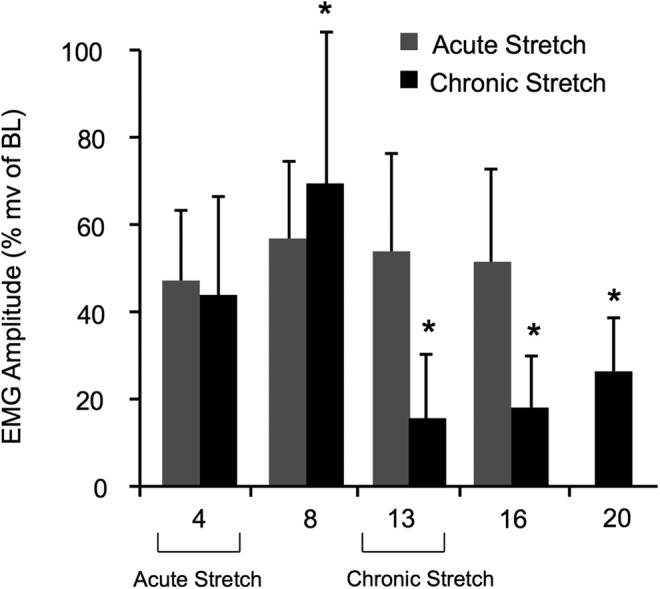
After spinal cord injury (SCI) muscle contractures develop in the plegic limbs of many patients. Physical therapists commonly use stretching as an approach to avoid contractures and to maintain the extensibility of soft tissues. We found previously that a daily stretching protocol has a negative effect on locomotor recovery in rats with mild thoracic SCI. The purpose of the current study was to determine the effects of stretching on locomotor function at acute and chronic time points after moderately severe contusive SCI. Female Sprague-Dawley rats with 25 g-cm T10 contusion injuries received our standard 24-min stretching protocol starting 4 days (acutely) or 10 weeks (chronically) post-injury (5 days/week for 5 or 4 weeks, respectively). Locomotor function was assessed using the BBB (Basso, Beattie, and Bresnahan) Open Field Locomotor Scale, video-based kinematics, and gait analysis. Locomotor deficits were evident in the acute animals after only 5 days of stretching and increasing the perceived intensity of stretching at week 4 resulted in greater impairment. Stretching initiated chronically resulted in dramatic decrements in locomotor function because most animals had BBB scores of 0-3 for weeks 2, 3, and 4 of stretching. Locomotor function recovered to control levels for both groups within 2 weeks once daily stretching ceased. Histological analysis revealed no apparent signs of overt and persistent damage to muscles undergoing stretching. The current study extends our observations of the stretching phenomenon to a more clinically relevant moderately severe SCI animal model. The results are in agreement with our previous findings and further demonstrate that spinal cord locomotor circuitry is especially vulnerable to the negative effects of stretching at chronic time points. While the clinical relevance of this phenomenon remains unknown, we speculate that stretching may contribute to the lack of locomotor recovery in some patients.
Keywords: locomotor function; rehabilitation; spinal cord injury.
Conflict of interest statement
Author Disclosure Statement No competing financial interests exist.
Figures

References
-
- Murray K.C., Nakae A., Stephens M.J., Rank M., D'Amico J., Harvey P.J., Li X., Harris R.L., Ballou E.W., Anelli R., Heckman C.J., Mashimo T., Vavrek R., Sanelli L., Gorassini M.A., Bennett D.J., and Fouad K. (2010). Recovery of motoneuron and locomotor function after spinal cord injury depends on constitutive activity in 5-HT2C receptors. Nat. Med. 16, 694–700 - PMC - PubMed
Publication types
MeSH terms
Grants and funding
LinkOut - more resources
Full Text Sources
Other Literature Sources
Medical
Research Materials
