


Serum Levels of Acyl-Carnitines along the Continuum from Normal to Alzheimer's Dementia
- PMID: 27196316
- PMCID: PMC4873244
- DOI: 10.1371/journal.pone.0155694
Serum Levels of Acyl-Carnitines along the Continuum from Normal to Alzheimer's Dementia
Abstract
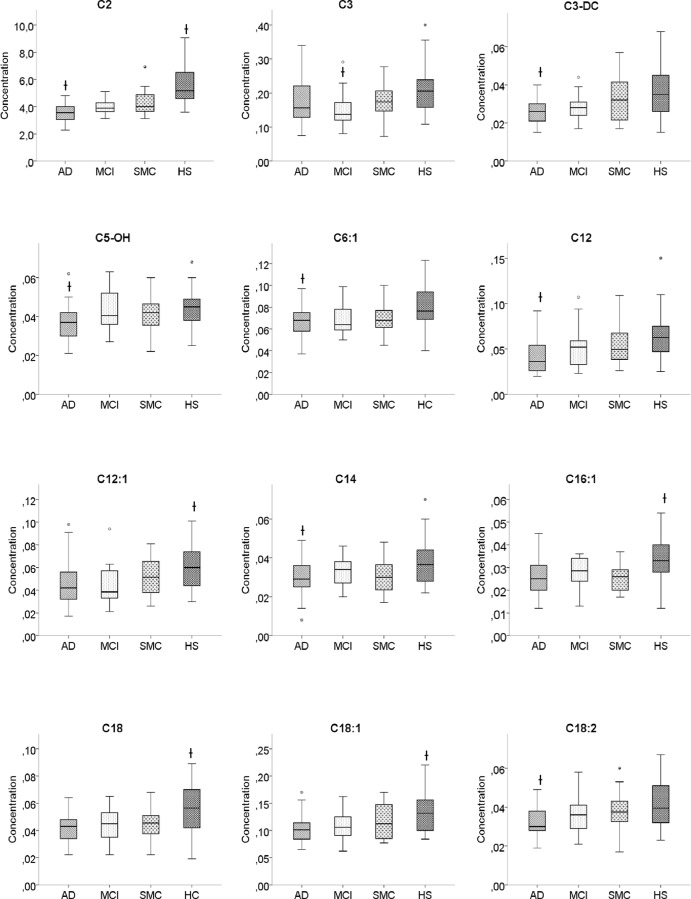
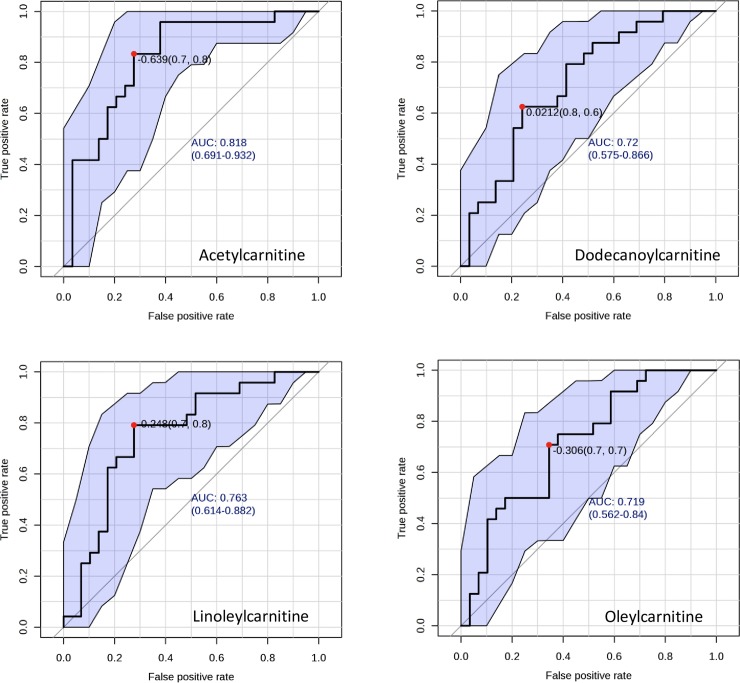
This study aimed to determine the serum levels of free L-carnitine, acetyl-L-carnitine and 34 acyl-L-carnitine in healthy subjects and in patients with or at risk of Alzheimer's disease. Twenty-nine patients with probable Alzheimer's disease, 18 with mild cognitive impairment of the amnestic type, 24 with subjective memory complaint and 46 healthy subjects were enrolled in the study, and the levels of carnitine and acyl-carnitines were measured by tandem mass spectrometry. The concentrations of acetyl-L-carnitine progressively decreased passing from healthy subjects group (mean±SD, 5.6±1.3 μmol/L) to subjective memory complaint (4.3±0.9 μmol/L), mild cognitive impairment (4.0±0.53 μmol/L), up to Alzheimer's disease (3.5±0.6 μmol/L) group (p<0.001). The differences were significant for the comparisons: healthy subjects vs. subjective memory complaint, mild cognitive impairment or Alzheimer's disease group; and subjective memory complaint vs. Alzheimer's disease group. Other acyl-carnitines, such as malonyl-, 3-hydroxyisovaleryl-, hexenoyl-, decanoyl-, dodecanoyl-, dodecenoyl-, myristoyl-, tetradecenoyl-, hexadecenoyl-, stearoyl-, oleyl- and linoleyl-L-carnitine, showed a similar decreasing trend, passing from healthy subjects to patients at risk of or with Alzheimer's disease. These results suggest that serum acetyl-L-carnitine and other acyl-L-carnitine levels decrease along the continuum from healthy subjects to subjective memory complaint and mild cognitive impairment subjects, up to patients with Alzheimer's disease, and that the metabolism of some acyl-carnitines is finely connected among them. These findings also suggest that the serum levels of acetyl-L-carnitine and other acyl-L-carnitines could help to identify the patients before the phenotype conversion to Alzheimer's disease and the patients who would benefit from the treatment with acetyl-L-carnitine. However, further validation on a larger number of samples in a longitudinal study is needed before application to clinical practice.
Conflict of interest statement
Figures


References
-
- Petersen RC. Mild cognitive impairment as a diagnostic entity. J Intern Med. 2004; 256: 183–194. - PubMed
Publication types
MeSH terms
Substances
LinkOut - more resources
Full Text Sources
Other Literature Sources
Medical
