


Midazolam for sedation before procedures
- PMID: 27198122
- PMCID: PMC6517181
- DOI: 10.1002/14651858.CD009491.pub2
Midazolam for sedation before procedures
Abstract
Background: Midazolam is used for sedation before diagnostic and therapeutic medical procedures. It is an imidazole benzodiazepine that has depressant effects on the central nervous system (CNS) with rapid onset of action and few adverse effects. The drug can be administered by several routes including oral, intravenous, intranasal and intramuscular.
Objectives: To determine the evidence on the effectiveness of midazolam for sedation when administered before a procedure (diagnostic or therapeutic).
Search methods: We searched the Cochrane Central Register of Controlled Trials (CENTRAL to January 2016), MEDLINE in Ovid (1966 to January 2016) and Ovid EMBASE (1980 to January 2016). We imposed no language restrictions.
Selection criteria: Randomized controlled trials in which midazolam, administered to participants of any age, by any route, at any dose or any time before any procedure (apart from dental procedures), was compared with placebo or other medications including sedatives and analgesics.
Data collection and analysis: Two authors extracted data and assessed risk of bias for each included study. We performed a separate analysis for each different drug comparison.
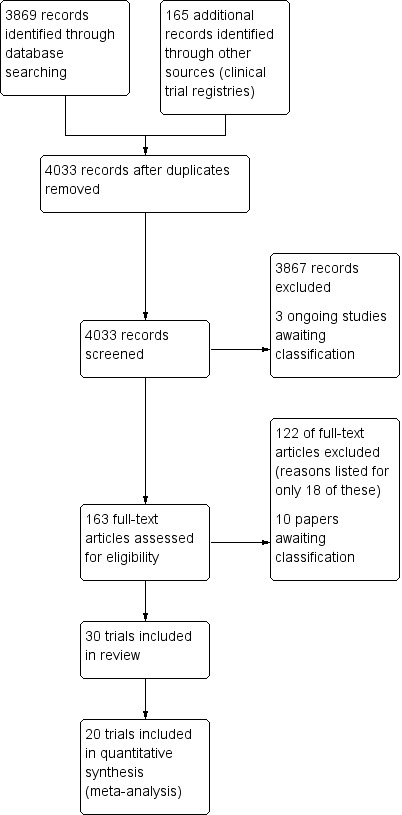
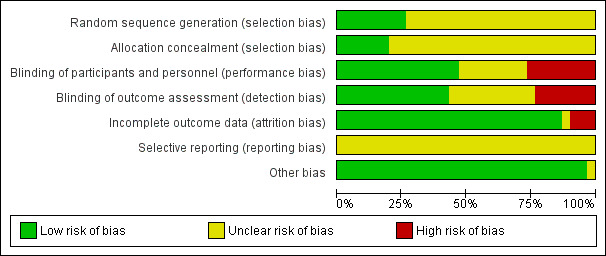
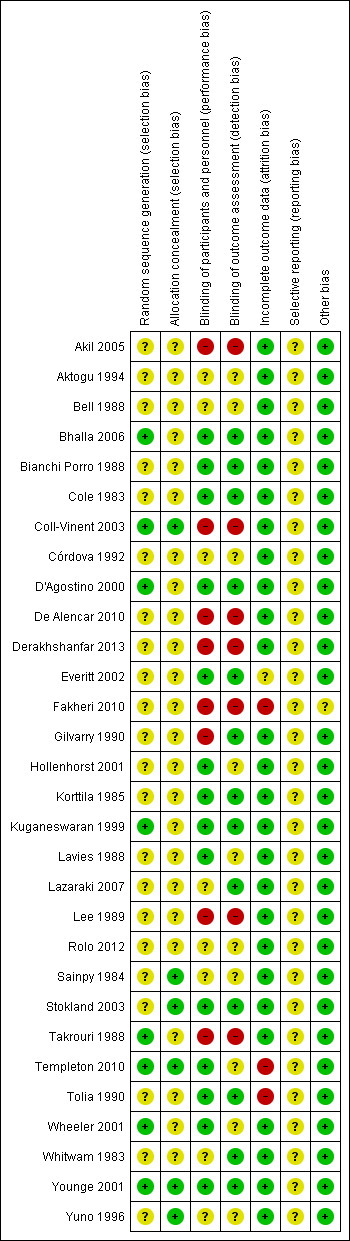
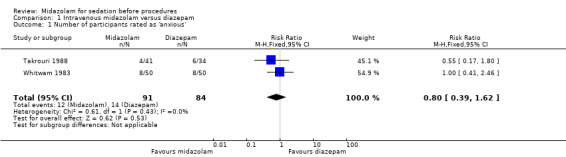
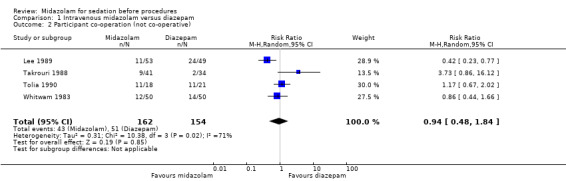
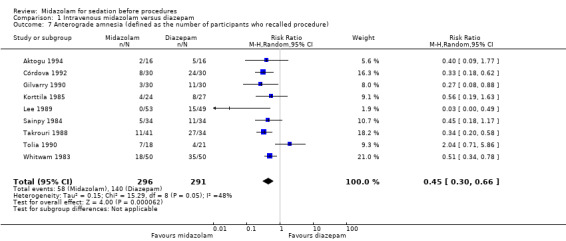
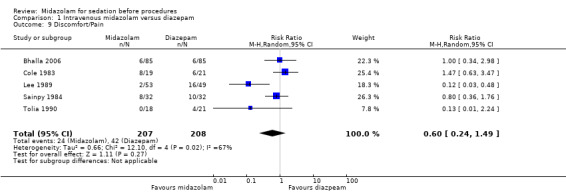
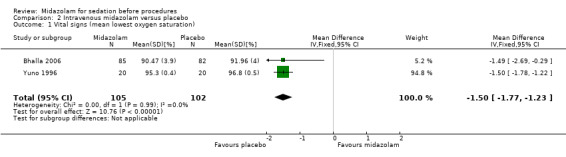
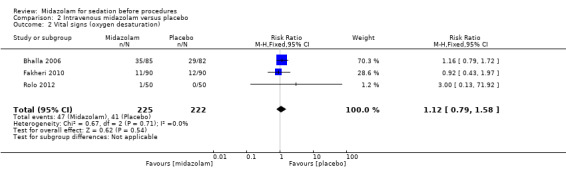
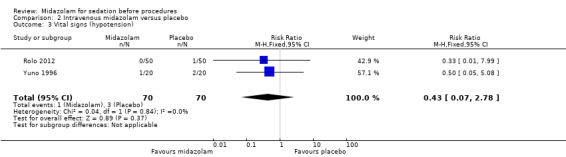
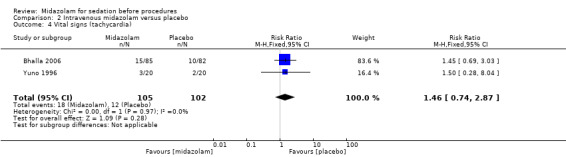
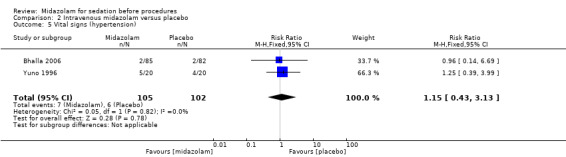
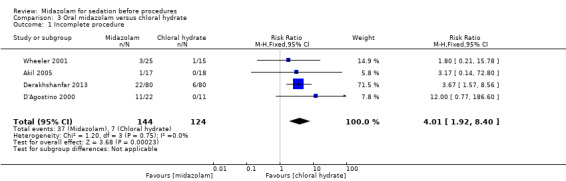
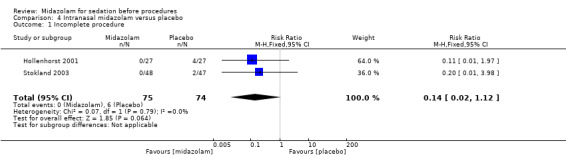
Main results: We included 30 trials (2319 participants) of midazolam for gastrointestinal endoscopy (16 trials), bronchoscopy (3), diagnostic imaging (5), cardioversion (1), minor plastic surgery (1), lumbar puncture (1), suturing (2) and Kirschner wire removal (1). Comparisons were: intravenous diazepam (14), placebo (5) etomidate (1) fentanyl (1), flunitrazepam (1) and propofol (1); oral chloral hydrate (4), diazepam (2), diazepam and clonidine (1); ketamine (1) and placebo (3); and intranasal placebo (2). There was a high risk of bias due to inadequate reporting about randomization (75% of trials). Effect estimates were imprecise due to small sample sizes. None of the trials reported on allergic or anaphylactoid reactions. Intravenous midazolam versus diazepam (14 trials; 1069 participants)There was no difference in anxiety (risk ratio (RR) 0.80, 95% confidence interval (CI) 0.39 to 1.62; 175 participants; 2 trials) or discomfort/pain (RR 0.60, 95% CI 0.24 to 1.49; 415 participants; 5 trials; I² = 67%). Midazolam produced greater anterograde amnesia (RR 0.45; 95% CI 0.30 to 0.66; 587 participants; 9 trials; low-quality evidence). Intravenous midazolam versus placebo (5 trials; 493 participants)One trial reported that fewer participants who received midazolam were anxious (3/47 versus 15/35; low-quality evidence). There was no difference in discomfort/pain identified in a further trial (3/85 in midazolam group; 4/82 in placebo group; P = 0.876; very low-quality evidence). Oral midazolam versus chloral hydrate (4 trials; 268 participants)Midazolam increased the risk of incomplete procedures (RR 4.01; 95% CI 1.92 to 8.40; moderate-quality evidence). Oral midazolam versus placebo (3 trials; 176 participants)Midazolam reduced pain (midazolam mean 2.56 (standard deviation (SD) 0.49); placebo mean 4.62 (SD 1.49); P < 0.005) and anxiety (midazolam mean 1.52 (SD 0.3); placebo mean 3.97 (SD 0.44); P < 0.0001) in one trial with 99 participants. Two other trials did not find a difference in numerical rating of anxiety (mean 1.7 (SD 2.4) for 20 participants randomized to midazolam; mean 2.6 (SD 2.9) for 22 participants randomized to placebo; P = 0.216; mean Spielberger's Trait Anxiety Inventory score 47.56 (SD 11.68) in the midazolam group; mean 52.78 (SD 9.61) in placebo group; P > 0.05). Intranasal midazolam versus placebo (2 trials; 149 participants)Midazolam induced sedation (midazolam mean 3.15 (SD 0.36); placebo mean 2.56 (SD 0.64); P < 0.001) and reduced the numerical rating of anxiety in one trial with 54 participants (midazolam mean 17.3 (SD 18.58); placebo mean 49.3 (SD 29.46); P < 0.001). There was no difference in meta-analysis of results from both trials for risk of incomplete procedures (RR 0.14, 95% CI 0.02 to 1.12; downgraded to low-quality evidence).
Authors' conclusions: We found no high-quality evidence to determine if midazolam, when administered as the sole sedative agent prior to a procedure, produces more or less effective sedation than placebo or other medications. There is low-quality evidence that intravenous midazolam reduced anxiety when compared with placebo. There is inconsistent evidence that oral midazolam decreased anxiety during procedures compared with placebo. Intranasal midazolam did not reduce the risk of incomplete procedures, although anxiolysis and sedation were observed. There is moderate-quality evidence suggesting that oral midazolam produces less effective sedation than chloral hydrate for completion of procedures for children undergoing non-invasive diagnostic procedures.
Conflict of interest statement
Aaron Conway: none known
John Rolley is currently researching aspects of pre‐procedural sedation and fasting for people undergoing diagnostic and interventional cardiac catheterization laboratory procedures. He has no relationships with any company providing drugs associated with this systematic review.
Joanna Sutherland was a member of the working party reviewing ANZCA PSO9 prior to 2014 and was the Clinical Lead for the NSW Agency for Clinical Innovation working party which developed the Minimum Standards for Safe Procedural Sedation.
Figures
Update of
References
References to studies included in this review
Akil 2005 {published data only}
-
- Akil I, Ozkol M, Ikizoglu O, Polat M, Tuncyurek O, Taskin O, et al. Premedication during micturating cystourethrogram to achieve sedation and anxiolysis. Pediatric Nephrology 2005;20(8):1106‐10. - PubMed
Aktogu 1994 {published data only}
-
- Aktogu S, Hasegeli L, Dereli M. Comparison of the sedative effects of midazolam and diazepam during fibreoptic bronchoscopy. Turk Anesteziyoloji ve Reanimasyon 1994;22:157‐60.
Bell 1988 {published data only}
Bhalla 2006 {published data only}
-
- Bhalla A, Sood A, Gupta V, Duseja A. Cardiorespiratory compromise under conscious sedation during upper gastrointestinal endoscopy. Journal of the College of Physicians and Surgeons 2006;16(9):585‐9. - PubMed
Bianchi Porro 1988 {published data only (unpublished sought but not used)}
-
- Bianchi Porro G, Baroni S, Parente F, Lazzaroni M. Midazolam versus diazepam as premedication for upper gastrointestinal endoscopy: a randomized, double‐blind, crossover study. Gastrointestinal Endoscopy 1988;34(3):252‐4. - PubMed
Cole 1983 {published data only}
-
- Cole SG, Brozinsky S, Isenberg JI. Midazolam, a new more potent benzodiazepine, compared with diazepam: a randomized, double‐blind study of preendoscopic sedatives. Gastrointestinal Endoscopy 1983;29(3):219‐22. - PubMed
Coll‐Vinent 2003 {published data only}
-
- Coll‐Vinent B, Sala X, Fernández C, Bragulat E, Espinosa G, Miró O, et al. Sedation for cardioversion in the emergency department: analysis of effectiveness in four protocols. Annals of Emergency Medicine 2003;42(6):767‐72. - PubMed
Córdova 1992 {published data only}
-
- Córdova Villalobos JA, Rojas Hernández R, Hernández Ortiz TM, Ramírez Barba EJ. Diazepam versus midazolam as pre‐endoscopic medication. Revista de Gastroenterología de México 1992;57(4):238‐41. - PubMed
D'Agostino 2000 {published data only}
-
- D'Agostino J, Terndrup T. Chloral hydrate versus midazolam for sedation of children for neuroimaging: A randomized clinical trial. Pediatric Emergency Care 2000;16(1):1‐4. - PubMed
De Alencar 2010 {published data only}
-
- Alencar VM, Gonçalves RD, Cruz AA. Oral medication with diazepam or midazolam associated or not with clonidine for oculoplastic office surgery under local anesthesia. Ophthalmic Plastic and Reconstructive Surgery 2010;26:269‐72. - PubMed
Derakhshanfar 2013 {published data only}
-
- Derakhshanfar H, Kordi MM, Amini A, Shojahee M. A comparative study on the sedative effect of oral midazolam and oral chloral hydrate medication in lumbar puncture. Acta Medica Croatica 2013;67(5):401‐5. - PubMed
Everitt 2002 {published data only}
-
- Everitt IJ, Barnett P. Comparison of two benzodiazepines used for sedation of children undergoing suturing of a laceration in an emergency department. Pediatric Emergency Care 2002;18(2):72‐4. - PubMed
Fakheri 2010 {published data only}
-
- Fakheri H, Kiasari A, Taghvaii T, Hosseini V, Mohammadpour R, Nasrollah A, et al. Assessment the effect of midazolam sedation on hypoxia during upper gastrointestinal endoscopy. Pakistan Journal of Biological Sciences 2010;13(4):152‐7. - PubMed
Gilvarry 1990 {published data only}
-
- Gilvarry JM, Craig M, Fielding JF. Short report: sedation for upper gastrointestinal endoscopy‐‐diazepam versus midazolam. Alimentary Pharmacology & Therapeutics 1990;4(4):423‐5. - PubMed
Hollenhorst 2001 {published data only}
-
- Hollenhorst J, Münte S, Friedrich L, Heine J, Leuwer M, Becker H, et al. Using intranasal midazolam spray to prevent claustrophobia induced by MR imaging. American Journal of Roentgenology 2001;176(4):865‐8. - PubMed
Korttila 1985 {published data only}
-
- Korttila K, Tarkkanen J. Comparison of diazepam and midazolam for sedation during local anaesthesia for bronchoscopy. British Journal of Anaesthesia 1985;57(6):581‐6. - PubMed
Kuganeswaran 1999 {published data only}
-
- Kuganeswaran E, Clarkston WK, Cuddy PG, Quiason SG, Pandya PK, Dierenfeldt WT, et al. A double‐blind placebo controlled trial of oral midazolam as premedication before flexible sigmoidoscopy. The American Journal of Gastroenterology 1999;94(11):3215‐9. - PubMed
Lavies 1988 {published data only}
-
- Lavies NG, Creasy T, Harris K, Hanning CD. Arterial oxygen saturation during upper gastrointestinal endoscopy: influence of sedation and operator experience. The American Journal of Gastroenterology 1988;83(6):618‐22. - PubMed
Lazaraki 2007 {published data only}
-
- Lazaraki G, Kountouras J, Metallidis S, Dokas S, Bakaloudis T, Chatzopoulos D, et al. Single use of fentanyl in colonoscopy is safe and effective and significantly shortens recovery time. Surgical Endoscopy 2007;21(9):1631‐6. - PubMed
Lee 1989 {published data only}
-
- Lee MG, Hanna W, Harding H. Sedation for upper gastrointestinal endoscopy: a comparative study of midazolam and diazepam. Gastrointestinal Endoscopy 1989;35(2):82‐4. - PubMed
Rolo 2012 {published data only}
-
- Rolo R, Mota PC, Coelho F, Alves D, Fernandes G, Cunha J, et al. Sedation with midazolam in flexible bronchoscopy ‐ a prospective study. Revista Portugesa de Pneumologia 2012;18(5):226‐32. - PubMed
Sainpy 1984 {published data only}
-
- Sainpy D, Boileau S, Vicari F. Comparative study of intravenous midazolam and diazepam used as sedative agents during gastroscopy. Annales Françaises d Anesthèsie et de Rèanimation 1984;3(3):177‐80. - PubMed
Stokland 2003 {published data only}
-
- Stokland E, Andréasson S, Jacobsson B, Jodal U, Ljung B. Sedation with midazolam for voiding cystourethrography in children: a randomised double‐blind study. Pediatric Radiology 2003;33(4):247‐9. - PubMed
Takrouri 1988 {published data only}
-
- Takrouri MS, Toukan A, Badran I, Sbeih Z, Hunjul N. Diazepam, flunitrazepam and midazolam for elective endoscopy‐‐a comparative study. Middle East Journal of Anaesthesiology 1988;9(6):529‐36. - PubMed
Templeton 2010 {published data only}
-
- Templeton P, Burton D, Cullen E, Lewis H, Allgar V, Wilson R. Oral midazolam for removal of Kirschner wires in the children's orthopaedic outpatient department: A randomized controlled trial. Journal of Pediatric Orthopedics 2010;30(2):130‐4. - PubMed
Tolia 1990 {published data only}
-
- Tolia V, Fleming SL, Kauffman RE. Randomized, double‐blind trial of midazolam and diazepam for endoscopic sedation in children. Developmental Pharmacology and Therapeutics 1990;14(3):141‐7. - PubMed
Wheeler 2001 {published data only}
-
- Wheeler DS, Jensen RA, Poss WB. A randomized, blinded comparison of chloral hydrate and midazolam sedation in children undergoing echocardiography. Clinical Pediatrics 2001;40(7):381‐7. - PubMed
Whitwam 1983 {published data only}
-
- Whitwam JG, Al‐Khudhairi D, McCloy RF. Comparison of midazolam and diazepam in doses of comparable potency during gastroscopy. British Journal of Anaesthesia 1983;55(8):773‐7. - PubMed
Younge 2001 {published data only}
Yuno 1996 {published data only}
-
- Yuno K, Iishi H, Tatsuta M, Hifumi K, Omori M. Intravenous midazolam as a sedative for colonoscopy: a randomized, double‐blind clinical trial. Alimentary Pharmacology & Therapeutics 1996;10(6):981‐4. - PubMed
References to studies excluded from this review
Bonta 2003 {published data only}
-
- Bonta PI, Kok MF, Bergman JJ, Brink GR, Lemkes JS, Tytgat GN, et al. Conscious sedation for EUS of the esophagus and stomach: a double‐blind, randomized, controlled trial comparing midazolam with placebo. Gastrointestinal Endoscopy 2003;57(7):842‐7. - PubMed
Brouillette 1989 {published data only}
-
- Brouillette D, Leventhal R, Kumar S, Berman D, Kajani M, Yoo Y, et al. Midazolam versus diazepam for combined esophogastroduodenoscopy and colonoscopy. Digestive Diseases and Sciences 1989;34(8):1265‐71. - PubMed
Dere 2010 {published data only}
-
- Dere K, Sucullu I, Budak ET, Yeyen S, Filiz AI, Ozkan S, et al. A comparison of dexmedetomidine versus midazolam for sedation, pain and hemodynamic control, during colonoscopy under conscious sedation. European Journal of Anaesthesiology 2010;27(7):648‐52. - PubMed
Mui 2005 {published data only}
-
- Mui LM, Teoh AY, Ng EK, Lee YT, Au Yeung AC, Chan YL, et al. Premedication with orally administered midazolam in adults undergoing diagnostic upper endoscopy: a double‐blind placebo‐controlled randomized trial. Gastrointestinal Endoscopy 2005;61(2):195‐200. - PubMed
Muttu 2005 {published data only}
-
- Muttu S, Liu EH, Ang SB, Chew PT, Lee TL, Ti LK. Comparison of dexmedetomidine and midazolam sedation for cataract surgery under topical anesthesia. Journal of Cataract and Refractive Surgery 2005;31(9):1845‐6. - PubMed
Nascimento 2007 {published data only}
-
- Nascimento Jdos S, Modolo NS, Silva RC, Santos KP, Carvalho HG. Sedative and cardiovascular effects of midazolam and diazepam alone or combined with clonidine in patients undergoing hemodynamic studies for suspected coronary artery disease. Arquivos Brasileiros de Cardiologia 2007;89(6):403‐8. - PubMed
Ristikankare 1999 {published data only}
-
- Ristikankare M, Hartikainen J, Heikkinen M, Janatuinen E, Julkunen R. Is routinely given conscious sedation of benefit during colonoscopy?. Gastrointestinal Endoscopy 1999;49(5):566‐72. - PubMed
Ristikankare 2000a {published data only}
-
- Ristikankare M, Julkunen R, Laitinen T, Wang SX, Heikkinen M, Janatuinen E, et al. Effect of conscious sedation on cardiac autonomic regulation during colonoscopy. Scandinavian Journal of Gastroenterology 2000;35(9):990‐6. - PubMed
Ristikankare 2000b {published data only}
-
- Ristikankare M, Julkunen R, Mattila M, Laitinen T, Wang SX, Heikkinen M, et al. Conscious sedation and cardiorespiratory safety during colonoscopy. Gastrointestinal Endoscopy 2000;52:48‐54. - PubMed
Sajedi 2006 {published data only}
-
- Sajedi P, Yaraghi A, Niareisy L. A single dose of propofol can produce excellent sedation and comparable amnesia with midazolam in cystoscopic examination. Journal of Research in Medical Sciences 2006;11:160‐3.
Salmon 1992 {published data only}
Sandler 1992 {published data only}
-
- Sandler ES, Weyman C, Conner K, Reilly K, Dickson N, Luzins J, et al. Midazolam versus fentanyl as premedication for painful procedures in children with cancer. Pediatrics 1992;89(4 Pt 1):631‐4. - PubMed
Sherry 1989 {published data only}
-
- Sherry E, Henderson A, Cotton J. Comparison of midazolam and diazepam for the reduction of shoulder dislocations and Colles' fractures in skiers on an outpatient basis. Australian Journal of Science and Medicine in Sport 1989;21:23‐7.
Tamayo 1993 {published data only}
-
- Tamayo E, Llorente A, Munoz R, Alvarez F J. Cardiorespiratory evaluation of midazolam and thiopental during their use in patients undergoing translumbar aortography in decubitus prone position. Revista Española de Anestesiología y Reanimación 1993;40(3):119‐24. - PubMed
Tesoro 2007 {published data only}
-
- Tesoro S, Vicchio N, Marchesini L, Aldo Peduto V. Sedation of children with ADHD: trazodone or midazolam?. Paediatric anaesthesia 2007;17(10):1008‐9. - PubMed
Uygur‐Bayramiçli 2002 {published data only}
-
- Bayramicli OU, Dabak R, Kuzucuoglu T, Kavakli B, Yayla A. Endoscopy 2000, 32:E32. Premedication with intranasal midazolam in adults undergoing upper gastrointestinal endoscopy. [abstract].. Endoscopy 2000;32(e32). - PubMed
-
- Uygur‐Bayramiçli O, Dabak R, Kuzucuoglu T, Kavakli B. Sedation with intranasal midazolam in adults undergoing upper gastrointestinal endoscopy. Journal of Clinical Gastroenterology 2002;35(2):133‐7. - PubMed
Weinstein 2010 {published data only}
-
- Weinstein M, Russell L, Kesler J, Niklewski P. Level of sedation and patient / clinician satisfaction. Gastrointestinal Endoscopy 2010;71:AB211.
Yildirim 2006 {published data only}
-
- Yildirim S, Guc B, Bozdogan N, Tokel K. Oral versus intranasal midazolam premedication for infants during echocardiographic study. Advances in Therapy 2006;23(5):719‐24. - PubMed
References to studies awaiting assessment
Bardhan 1984 {published data only}
Frisancho 1996 {published data only}
-
- Frisancho Velarde O, Contardo Zambrano C. Comparative study between midazolam and diazepam in upper gastrointestinal endoscopy premedication. Revista de Gastroenterología del Perú 1996;16(3):222‐7. - PubMed
Green 1984 {published data only}
Mendes 1986 {published data only}
-
- Mendes de Leon C, Bezel R, Karrer W, Brändli O. Premedication in fiber optic bronchoscopy from the patient's and the physician's viewpoint‐‐a randomized study for the comparison of midazolam and hydrocodone. Schweizerische Medizinsche Wochenschrifte 1986;116(37):1267‐72. - PubMed
Mignonsin 1994 {published data only}
-
- Mignonsin D, Kouame K, Camara B, Bondurand M. Comparative study of intravenous midazolam and diazepam used as sedative agents in upper digestive endoscopy. Cahiers d'Anesthésiologie 1994;42(1):25‐30. - PubMed
Münte 2002 {published data only}
-
- Münte S, Hollenhorst J, Friedrich L, Heine J, Leuwer M, Piepenbrock S, et al. Intranasal midazolam‐application for anxiolysis during MR imaging. Klinische Neuroradiologie 2002;12:82‐7.
Ogden 1993 {published data only}
-
- Ogden A, Kennedy L, Glass N. Oral midazolam versus oral ketamine for sedation of children with cancer for painful procedures [abstract]. Proceedings of the American Society of Clinical Oncology 1993;12:436, Abstract 1503.
Thakur 2003 {published data only}
-
- Thakur M, Salgaonkar S, Nyayadhish P Y, Sinhal A, Thakkar BM, Choudhari L, et al. Comparison of triclofos sodium and midazolam as oral sedative agents for echocardiography in children [abstract]. Indian Heart Journal 2003;55:Abstract no:264.
Theroux 1993 {published data only}
-
- Theroux M, West D, Corddry D, Hyde P, Bachrach S, Cronan K, et al. Efficacy of intranasal midazolam in facilitating suturing of lacerations in preschool children in the emergency department. Pediatrics 1993;91(3):624‐7. - PubMed
Wild 1988 {published data only}
-
- Wild A, Bertolaso E. Is there a risk of global respiratory insufficiency with the use of intramuscular midazolam as premedication for bronchoscopy?. Schweizerische Medizinische Wochenschrift 1988;118(38):1375‐7. - PubMed
References to ongoing studies
NCT00563069 {unpublished data only}
-
- Premedication with oral midazolam in patients undergoing rigid cystoscopy: a randomized, double‐blind, placebo‐controlled trial. Ongoing study September 2005.
NCT01925898 {unpublished data only}
-
- A randomized, clinical trial of oral midazolam versus oral ketamine for sedation during laceration repair. Ongoing study August 2013.
Puttapitakpong 2015 {unpublished data only}
-
- Oral midazolam for sedation in esophagogastroduodenoscopy(EGD). Ongoing study October 2013.
Additional references
ANZCA PSO9
-
- ANZCA Guidelines on Sedation and/or Analgesia for Diagnostic and Interventional Medical, Dental or Surgical Procedures. Users/JCRA0002/Downloads/ps09‐2014‐guidelines‐on‐sedation‐and‐or‐analgesia‐for‐diagnostic‐and‐interventional‐medical‐dental‐or‐surgical‐procedures.pdf (accessed September 11 2015).
Cohen 2006
-
- Cohen L, Wecsler J, Gaetano J, Benson A, Miller K, Durkalski V, et al. Endoscopic sedation in the United States: results from a nationwide survey. The American Journal of Gastroenterology 2006;101(5):967‐74. - PubMed
Guyatt 2008
Higgins 2002
-
- Higgins JP, Thomson SG. Quantifying heterogeneity in a meta‐analysis. Statistics in Medicine 2002;21(11):1539‐58. [MEDLINE: ] - PubMed
Higgins 2011
-
- Higgins JPT, Green S (editors). Cochrane Handbook for Systematic Reviews of Interventions Version 5.1.0 [updated March 2011]. The Cochrane Collaboration, 2011 Available from www.cochrane‐handbook.org.
Jüni 2001
Lourenço‐Matharu 2012
McQuaid 2008
-
- McQuaid KR, Laine L. A systematic review and meta‐analysis of randomized, controlled trials of moderate sedation for routine endoscopic procedures. Gastrointestinal Endoscopy 2008;67(6):910‐23. - PubMed
NICE 2010
-
- National Institue of Health and Clinical Excellence. Sedation in children and young people. www.rcpch.ac.uk/sites/default/files/asset_library/Research/Clinical%20Ef.... London, UK: National Clinical Guideline Centre, 2010 (accessed May 2016).
Qadeer 2005
-
- Qadeer MA, Vargo JJ, Khandwala F, Lopez R, Zuccaro G. Propofol versus traditional sedative agents for gastrointestinal endoscopy: a meta‐analysis. Clinical Gastroenterology and Hepatology 2005;3(11):1049‐56. - PubMed
Review Manager 2014 [Computer program]
-
- The Nordic Cochrane Centre. The Cochrane Collaboration. Review Manager (RevMan) Version 5.3. Copenhagen: The Nordic Cochrane Centre. The Cochrane Collaboration, 2014; Vol. .:..
Riss 2008
-
- Riss J, Cloyd J, Gates J, Collins S. Benzodiazepines in epilepsy: pharmacology and pharmacokinetics. Acta Neurologica Scandinavica 2008;118(2):69‐86. - PubMed
Shailaja 2013
-
- Shailaja S, Ray A, Ray S, Kirubakaran R. Dexmedetomidine for procedural sedation in children. Cochrane Database of Systematic Reviews 2013, Issue 12. [DOI: 10.1002/14651858.CD010886] - DOI
Thomson 2010
-
- Thomson A, Andrew G, Jones B. Optimal sedation for gastrointestinal endoscopy: review and recommendations. Journal of Gastroenterology and Hepatology 2010;25(3):469‐78. - PubMed
References to other published versions of this review
Morão 2011
-
- Morão S, Ratilal BO, Santos H, Sampaio C. Midazolam for sedation before procedures. Cochrane Database of Systematic Reviews 2011, Issue 12. [DOI: 10.1002/14651858.CD009491] - DOI
Publication types
MeSH terms
Substances
LinkOut - more resources
Full Text Sources
Other Literature Sources
Medical
