


Planning to make economic decisions in the future, but choosing impulsively now: are preference reversals related to symptoms of ADHD and depression?
- PMID: 27199170
- PMCID: PMC6877171
- DOI: 10.1002/mpr.1511
Planning to make economic decisions in the future, but choosing impulsively now: are preference reversals related to symptoms of ADHD and depression?
Abstract
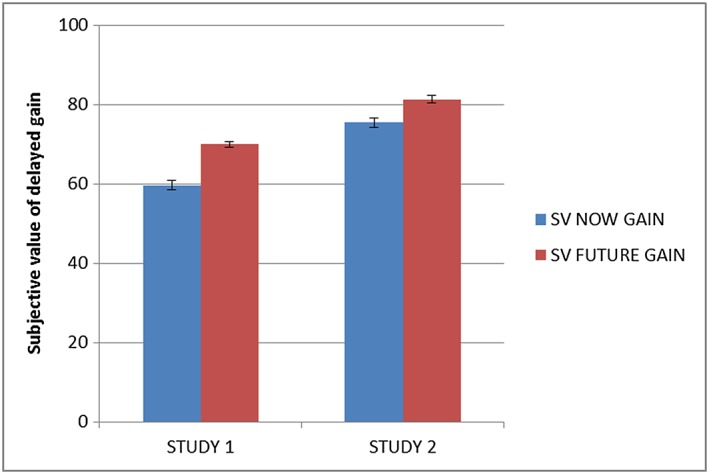
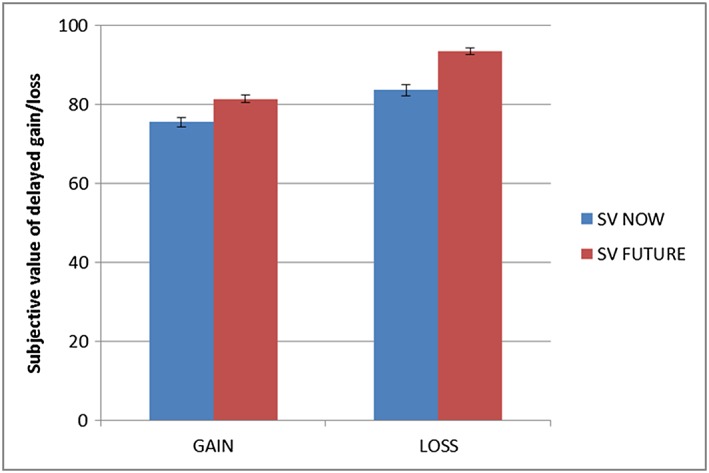
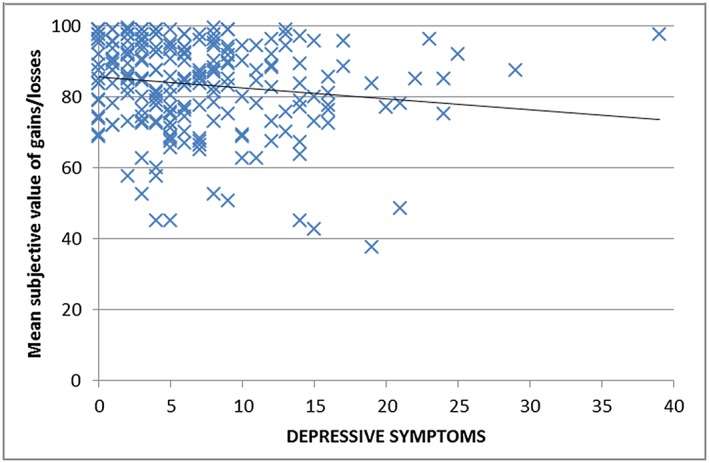
A preference for smaller immediate rewards over larger delayed rewards (delay discounting, DD) is common in attention deficit hyperactivity disorder (ADHD), but rarely investigated in depression. Whether this preference is due to sensitivity to reward immediacy or delay aversion remains unclear. To investigate this, we examined whether ADHD and depressive symptoms are associated with preference reversals: a switch from smaller immediate rewards to larger delayed rewards when smaller rewards are also delayed. We also examined whether these symptoms differentially affect DD of losses. In Study 1 undergraduates completed a questionnaire about ADHD symptoms, and performed a hypothetical DD task. In the NOW condition, participants were presented with choices between a small reward available today and a large reward available after one year. In the FUTURE condition both rewards were delayed with +1 year. In Study 2 undergraduates completed questionnaires about ADHD and depressive symptoms and performed a DD task with gains and losses. Participants showed preference reversals in both studies and tasks. Losses were less steeply discounted than gains. ADHD and depressive symptoms did not influence these effects. Depressive symptoms, but not ADHD symptoms, were associated with less economic choices in general. These findings suggest that impulsive choice in depression is not explained by sensitivity to reward immediacy. Copyright © 2016 John Wiley & Sons, Ltd.
Keywords: ADHD; delay discounting; depression; gains and losses; preference reversals.
Copyright © 2016 John Wiley & Sons, Ltd.
Figures
Similar articles
-
Waiting and working for rewards: Attention-Deficit/Hyperactivity Disorder is associated with steeper delay discounting linked to amygdala activation, but not with steeper effort discounting.Cortex. 2018 Sep;106:164-173. doi: 10.1016/j.cortex.2018.05.018. Epub 2018 Jun 7. Cortex. 2018. PMID: 30005368
-
Delay discounting of monetary gains and losses in adolescents with ADHD: Contribution of delay aversion to choice.Child Neuropsychol. 2019 May;25(4):528-547. doi: 10.1080/09297049.2018.1508563. Epub 2018 Aug 15. Child Neuropsychol. 2019. PMID: 30111229
-
Preference for Smaller Sooner Over Larger Later Rewards in ADHD: Contribution of Delay Duration and Paradigm Type.J Atten Disord. 2018 Aug;22(10):984-993. doi: 10.1177/1087054715570390. Epub 2015 Feb 11. J Atten Disord. 2018. PMID: 25672671
-
Steep Discounting of Future Rewards as an Impulsivity Phenotype: A Concise Review.Curr Top Behav Neurosci. 2020;47:113-138. doi: 10.1007/7854_2020_128. Curr Top Behav Neurosci. 2020. PMID: 32236897 Review.
-
Choice-impulsivity in children and adolescents with attention-deficit/hyperactivity disorder (ADHD): A meta-analytic review.Clin Psychol Rev. 2016 Feb;43:162-74. doi: 10.1016/j.cpr.2015.11.001. Epub 2015 Nov 11. Clin Psychol Rev. 2016. PMID: 26602954 Review.
Cited by
-
Discounting of Future Rewards and Punishments in Rats.eNeuro. 2022 Nov 30;9(6):ENEURO.0452-21.2022. doi: 10.1523/ENEURO.0452-21.2022. Print 2022 Nov-Dec. eNeuro. 2022. PMID: 36411053 Free PMC article.
-
Heterogeneous appetite patterns in depression: computational modeling of nutritional interoception, reward processing, and decision-making.Front Hum Neurosci. 2024 Dec 16;18:1502508. doi: 10.3389/fnhum.2024.1502508. eCollection 2024. Front Hum Neurosci. 2024. PMID: 39736895 Free PMC article.
-
A Behavioral Economic Model of Help-Seeking for Depression.Perspect Behav Sci. 2021 Aug 2;44(4):541-560. doi: 10.1007/s40614-021-00308-9. eCollection 2021 Dec. Perspect Behav Sci. 2021. PMID: 35098024 Free PMC article.
-
A multinational analysis of how emotions relate to economic decisions regarding time or risk.Nat Hum Behav. 2024 Nov;8(11):2139-2155. doi: 10.1038/s41562-024-01927-3. Epub 2024 Aug 29. Nat Hum Behav. 2024. PMID: 39210027
References
-
- Barkley R.A., Edwards G., Laneri M., Fletcher K., Metevia L. (2001) Executive functioning, temporal discounting, and sense of time in adolescents with attention deficit hyperactivity disorder (ADHD) and oppositional defiant disorder (ODD). Journal of Abnormal Child Psychology, 29(6), 541–556. - PubMed
-
- Beck A.T., Ward C.H., Mendelson M., Mock J., Erbaugh J. (1961) An inventory for measuring depression. Archives of General Psychiatry, 4, 561–571. - PubMed
-
- Bouman T.K., Luteyn F., Albersnagel F.A., Van der Ploeg F.A.E. (1985) Enige ervaringen met de Beck Depression Inventory (BDI). Gedrag, Tijdschrift Voor Psychologie, 13, 13–24.
Publication types
MeSH terms
LinkOut - more resources
Full Text Sources
Other Literature Sources
Medical
