. 2016 May 3:10:168.
doi: 10.3389/fnins.2016.00168. eCollection 2016.

DNA Methylation Profiling at Single-Base Resolution Reveals Gestational Folic Acid Supplementation Influences the Epigenome of Mouse Offspring Cerebellum

Affiliations

DNA Methylation Profiling at Single-Base Resolution Reveals Gestational Folic Acid Supplementation Influences the Epigenome of Mouse Offspring Cerebellum

Subit Barua et al. Front Neurosci. .

Abstract

It is becoming increasingly more evident that lifestyle, environmental factors, and maternal nutrition during gestation can influence the epigenome of the developing fetus and thus modulate the physiological outcome. Variations in the intake of maternal nutrients affecting one-carbon metabolism may influence brain development and exert long-term effects on the health of the progeny. In this study, we investigated whether supplementation with high maternal folic acid during gestation alters DNA methylation and gene expression in the cerebellum of mouse offspring. We used reduced representation bisulfite sequencing to analyze the DNA methylation profile at the single-base resolution level. The genome-wide DNA methylation analysis revealed that supplementation with higher maternal folic acid resulted in distinct methylation patterns (P < 0.05) of CpG and non-CpG sites in the cerebellum of offspring. Such variations of methylation and gene expression in the cerebellum of offspring were highly sex-specific, including several genes of the neuronal pathways. These findings demonstrate that alterations in the level of maternal folic acid during gestation can influence methylation and gene expression in the cerebellum of offspring. Such changes in the offspring epigenome may alter neurodevelopment and influence the functional outcome of neurologic and psychiatric diseases.

Keywords: DNA methylation; brain development; cerebellum; folic acid; gestational development; psychiatric disease.


Figures
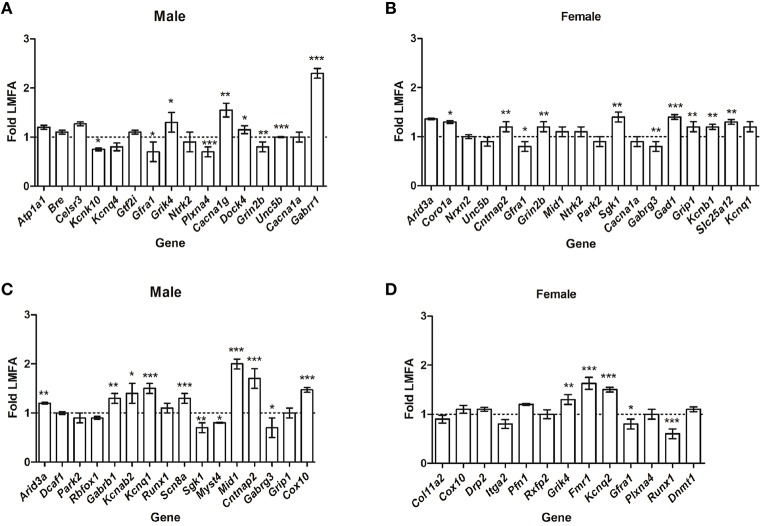
Figure 1
Figure 1
Relative expression of the genes that exhibited hyper-methylation (A,B) and hypo-methylation (C,D). The results were normalized to Hprt transcript expression and were expressed as relative values in comparison with corresponding transcripts from low maternal folic acid (LMFA). Results represent mean ± standard deviation (SD); asterisks denote statistically significant change (*P < 0.05, **P < 0.01, ***P < 0.001).
Figure 2
Figure 2
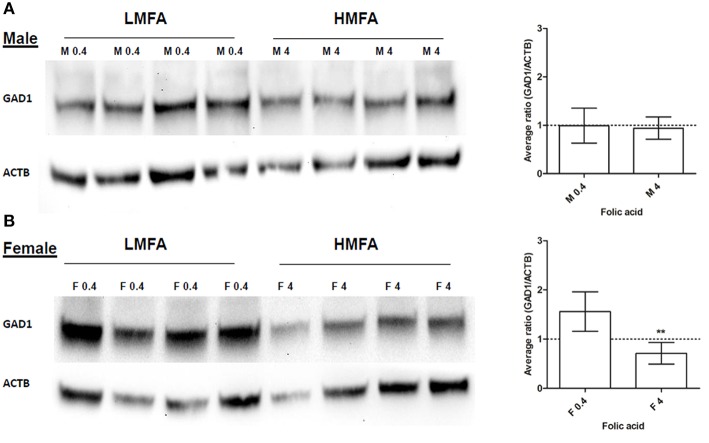
Western blot analysis showing the expression of Gad1p in the cerebellum of (A) male (M) and (B) female (F) pups from LMFA (0.4 mg/kg diet) and HMFA (4 mg/kg diet) groups. The left panel shows one representative blot, and the right panel shows the mean densitometric evaluation. The error bar ± SD represents the inter-variability among independent samples (n = 4). Asterisks denote statistically significant change (**P < 0.05) by unpaired T-test.
Figure 3
Figure 3
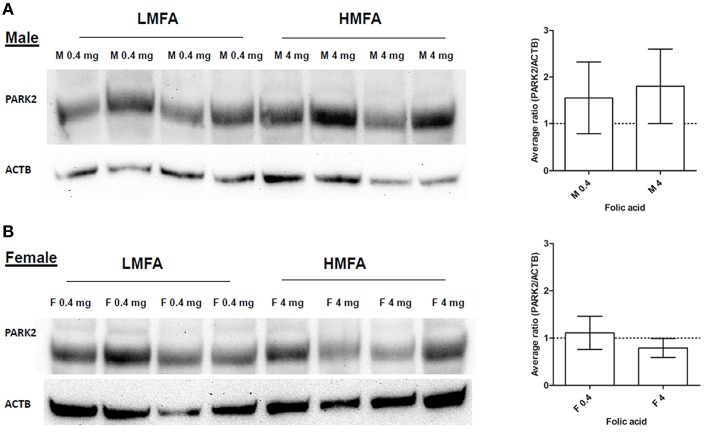
Western blot analysis showing the expression of Park2p in the CB of (A) male and (B) female pups from LMFA (0.4 mg/kg diet) and HMFA (4 mg/kg diet). The left panel represents one representative blot, and the right panel shows the mean densitometric evaluation. The error bar ± SD represents the inter-variability among independent samples (n = 4).
Figure 4
Figure 4
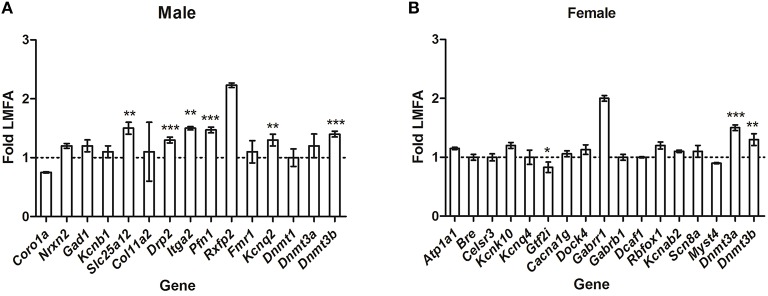
Quantitative real time reverse transcription-polymerase chain reaction (qRT-PCR) showing relative expression of the transcripts of genes in (A) male pups and (B) female pups from the HMFA group that exhibited no alterations in the methylation profile in promoter and gene body in the cerebellum compared with the LMFA. The results were normalized to Hprt transcript expression and were expressed as relative values in comparison with corresponding transcripts from LMFA. Results represent mean ± standard deviation (SD); asterisks denote statistically significant change (*P < 0.05, **P < 0.01, ***P < 0.001).

References

    1. Antonow-Schlorke I., Schwab M., Cox L. A., Li C., Stuchlik K., Witte O. W., et al. (2011). Vulnerability of the fetal primate brain to moderate reduction in maternal global nutrient availability. Proc. Natl. Acad. Sci. U.S.A. 108, 3011–3016. 10.1073/pnas.1009838108 - DOI - PMC - PubMed
    1. Bailey S. W., Ayling J. E. (2009). The extremely slow and variable activity of dihydrofolate reductase in human liver and its implications for high folic acid intake. Proc. Natl. Acad. Sci. U.S.A. 106, 15424–15429. 10.1073/pnas.0902072106 - DOI - PMC - PubMed
    1. Ball M. P., Li J. B., Gao Y., Lee J. H., LeProust E. M., Park I. H., et al. (2009). Targeted and genome-scale strategies reveal gene-body methylation signatures in human cells. Nat. Biotechnol. 27, 361–368. 10.1038/nbt.1533 - DOI - PMC - PubMed
    1. Barua S., Chadman K. K., Kuizon S., Buenaventura D., Stapley N. W., Ruocco F., et al. (2014a). Increasing maternal or post-weaning folic acid alters gene expression and moderately changes behavior in the offspring. PLoS ONE 9:e101674. 10.1371/journal.pone.0101674 - DOI - PMC - PubMed
    1. Barua S., Junaid M. A. (2015). Lifestyle, pregnancy and epigenetic effects. Epigenomics 7, 85–102. 10.2217/epi.14.71 - DOI - PubMed

LinkOut - more resources