. 2016 Apr 28:7:563.
doi: 10.3389/fpls.2016.00563. eCollection 2016.

Phloem Proteomics Reveals New Lipid-Binding Proteins with a Putative Role in Lipid-Mediated Signaling

Affiliations

Phloem Proteomics Reveals New Lipid-Binding Proteins with a Putative Role in Lipid-Mediated Signaling

Allison M Barbaglia et al. Front Plant Sci. .

Abstract

Global climate changes inversely affect our ability to grow the food required for an increasing world population. To combat future crop loss due to abiotic stress, we need to understand the signals responsible for changes in plant development and the resulting adaptations, especially the signaling molecules traveling long-distance through the plant phloem. Using a proteomics approach, we had identified several putative lipid-binding proteins in the phloem exudates. Simultaneously, we identified several complex lipids as well as jasmonates. These findings prompted us to propose that phloem (phospho-) lipids could act as long-distance developmental signals in response to abiotic stress, and that they are released, sensed, and moved by phloem lipid-binding proteins (Benning et al., 2012). Indeed, the proteins we identified include lipases that could release a signaling lipid into the phloem, putative receptor components, and proteins that could mediate lipid-movement. To test this possible protein-based lipid-signaling pathway, three of the proteins, which could potentially act in a relay, are characterized here: (I) a putative GDSL-motif lipase (II) a PIG-P-like protein, with a possible receptor-like function; (III) and PLAFP (phloem lipid-associated family protein), a predicted lipid-binding protein of unknown function. Here we show that all three proteins bind lipids, in particular phosphatidic acid (PtdOH), which is known to participate in intracellular stress signaling. Genes encoding these proteins are expressed in the vasculature, a prerequisite for phloem transport. Cellular localization studies show that the proteins are not retained in the endoplasmic reticulum but surround the cell in a spotted pattern that has been previously observed with receptors and plasmodesmatal proteins. Abiotic signals that induce the production of PtdOH also regulate the expression of GDSL-lipase and PLAFP, albeit in opposite patterns. Our findings suggest that while all three proteins are indeed lipid-binding and act in the vasculature possibly in a function related to long-distance signaling, the three proteins do not act in the same but rather in distinct pathways. It also points toward PLAFP as a prime candidate to investigate long-distance lipid signaling in the plant drought response.

Keywords: abiotic stress; lipid signaling; lipid-binding proteins; phloem; phospholipids.


Figures
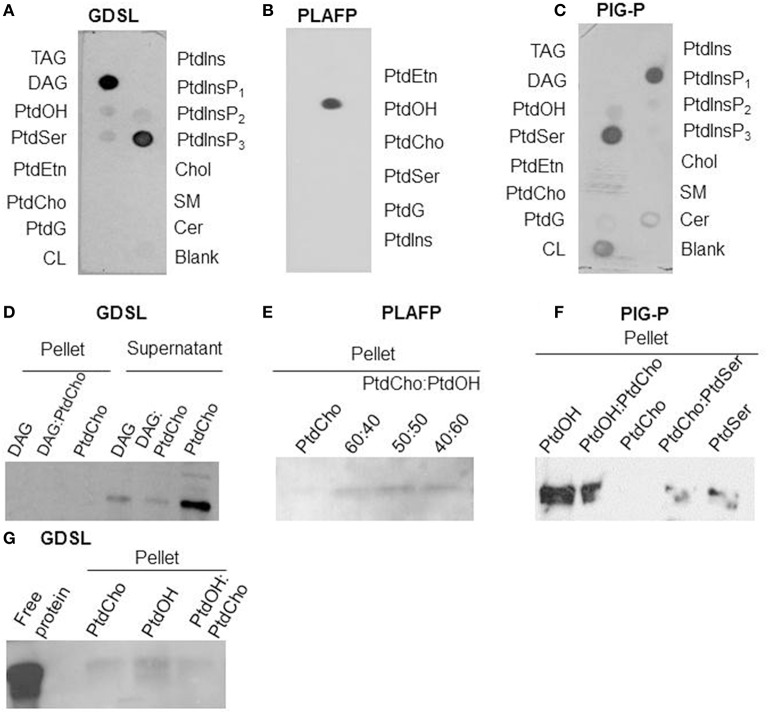
Figure 1
Figure 1
Lipid-binding properties of the putative GDSL-lipase (A/D/G), the PLAFP (B/E; modified from Benning et al., 2012), and the PIG-P like protein (C/F): Lipid-binding was examined using protein-lipid overlay assays (A–C) and confirmed by liposome-binding assays (D–G). (D, G) shows the presence of GDSL-lipase in either pellet or supernatant after incubation with liposomes containing either PtdCho (negative control), DAG, or a mixture. Presence of a band in the pellet indicates binding of the protein to the lipids. E and F show the presence of PLAFP and PIG-P, respectively, in the pellets of liposomes containing PtdOH (PLAFP and PIG-P) and PtdSer (PIG-P) but not if liposomes contain PtdCho alone. TAG, triacylglyceride; DAG, diacylglycerol; PtdOH, phosphatidic acid; PtdSer, phosphatidylserine, PtdEtn, phosphatidylethanolamine; PtdCho, phosphatidyl-choline; PtdG, phosphatidylglycerol, CL, cardiolipin; PtdIns, phosphatidylinositol, PtdInsP1, phosphatidylinositol-4-phosphate, PtdInsP2, phosphatidylinositol-4,5-phosphate, PtdInsP3, phosphatidylinositol-3,4,5- phosphate; Chol, cholesterol; SM, sphingomyelin; Cer, 3-sulfogalactosyl ceramide.
Figure 2
Figure 2
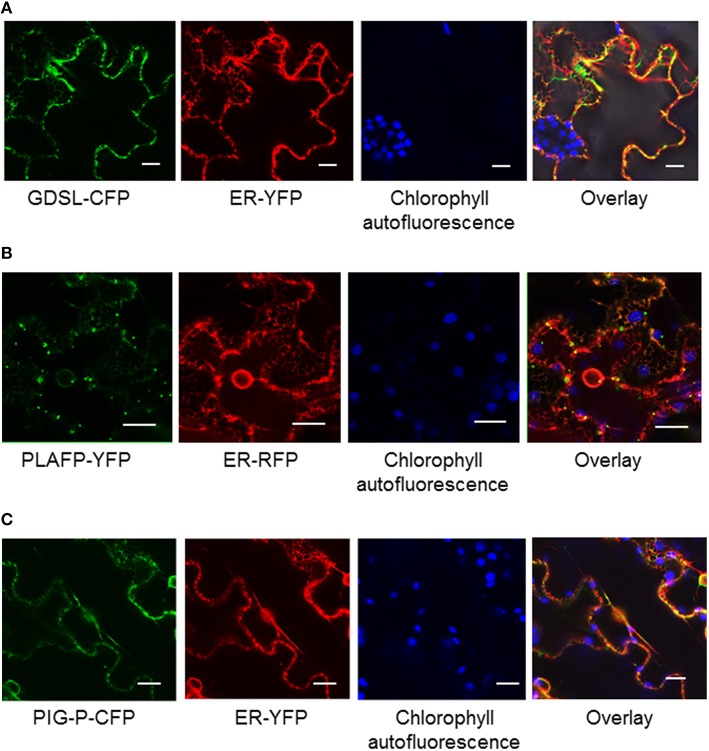
Localization of GDSL-lipase (A), PLAFP (B), and the PIG-P like protein (C) using C-terminal fluorescent tags and transient expression in tobacco. Localization of the fusion proteins was determined using confocal microscopy. Chlorophyll fluorescence and a fluorescent ER marker were used as controls. The size marker indicates 20 μm.
Figure 3
Figure 3
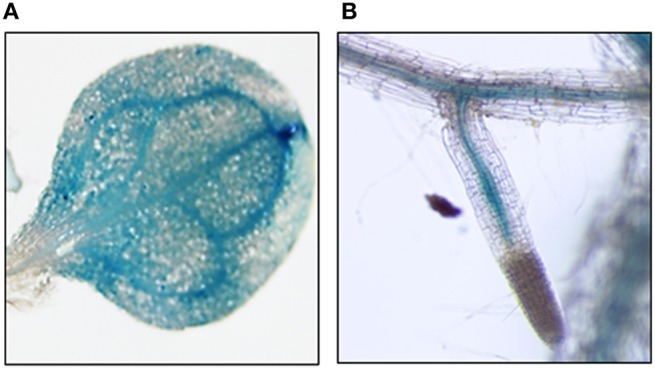
Promoter Activity via GUS Reporter. Two-week old Arabidopsis seedlings containing the 1 kb region upstream of the transcription initiation site of PLAFP were generated. Gene expression was visualized using a GUS-reporter staining. PLAFP was identified within the leaf vasculature (A) as well as the vasculature of root (B) of 3 week-old seedlings.
Figure 4
Figure 4
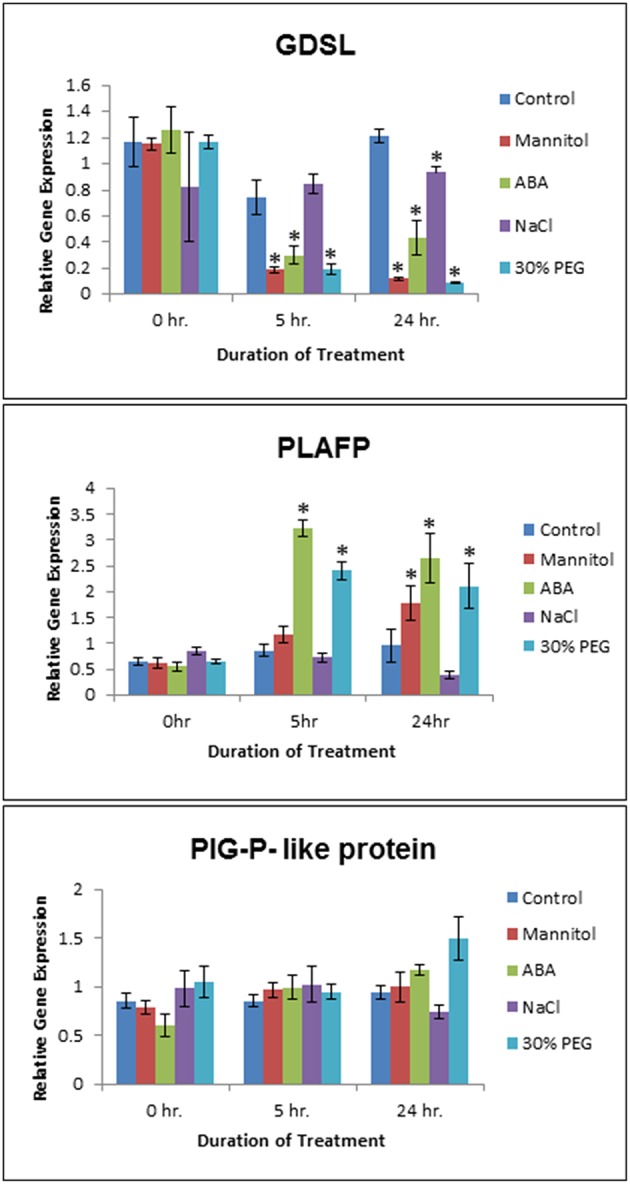
Effect of Abiotic Stress on GDSL, PLAFP, and PIG-P expression. Two week old Arabidopsis seedlings were submitted to osmotic (300 mM Mannitol) and salt (150 mM NaCl) stress, a water stress mimic (30% PEG 6000), and ABA (100 μM). Values represent mean and standard error of 3–6 biological replicates as determined using qPCR (three technical replicates per biological replicate). The asterisks indicate significance of p < 0.01 (Student's t-test).

References

    1. Aki T., Shigyo M., Nakano R., Yoneyama T., Yanagisawa T. (2008). Nano scale proteomics revealed the presence of regulatory proteins including three FT-like proteins in phloem and xylem saps from rice. Plant Cell Physiol. 49, 767–790. 10.1093/pcp/pcn049 - DOI - PubMed
    1. Akoh C. C., Lee G.-C., Liaw Y.-C., Huang T.-H., Shaw J. F. (2004). GDSL family of serine esterases/lipases. Prog. Lipid Res. 43, 534–552. 10.1016/j.plipres.2004.09.002 - DOI - PubMed
    1. Anstead J. A., Hartson S. D., Thompson G. A. (2013). The broccoli (Brassica oleracea) phloem tissue proteome. BMC Genomics 14:764. 10.1186/1471-2164-14-764 - DOI - PMC - PubMed
    1. Arisz S. A., van Wijk R., Roels W., Zhu J.-K., Haring M. A., Munnik T. (2013). Rapid phosphatidic acid accumulation in response to low temperature stress in Arabidopsis generated through diacylglycerol kinase. Front. Plant Sci. 4:1. 10.3389/fpls.2013.00001 - DOI - PMC - PubMed
    1. Awai K., Xu C., Tamot B., Benning C. (2006). A phosphatidic acid-binding protein of the chloroplast inner envelope membrane involved in lipid trafficking. Proc. Natl. Acad. Sci. U.S.A. 103, 10817–10822. 10.1073/pnas.0602754103 - DOI - PMC - PubMed

LinkOut - more resources