Review
. 2016 Dec;4(1):11.
doi: 10.1186/s40635-016-0085-2. Epub 2016 May 20.

The 30-year evolution of airway pressure release ventilation (APRV)

Affiliations
Review

The 30-year evolution of airway pressure release ventilation (APRV)

Sumeet V Jain et al. Intensive Care Med Exp. 2016 Dec.

Abstract

Airway pressure release ventilation (APRV) was first described in 1987 and defined as continuous positive airway pressure (CPAP) with a brief release while allowing the patient to spontaneously breathe throughout the respiratory cycle. The current understanding of the optimal strategy to minimize ventilator-induced lung injury is to "open the lung and keep it open". APRV should be ideal for this strategy with the prolonged CPAP duration recruiting the lung and the minimal release duration preventing lung collapse. However, APRV is inconsistently defined with significant variation in the settings used in experimental studies and in clinical practice. The goal of this review was to analyze the published literature and determine APRV efficacy as a lung-protective strategy. We reviewed all original articles in which the authors stated that APRV was used. The primary analysis was to correlate APRV settings with physiologic and clinical outcomes. Results showed that there was tremendous variation in settings that were all defined as APRV, particularly CPAP and release phase duration and the parameters used to guide these settings. Thus, it was impossible to assess efficacy of a single strategy since almost none of the APRV settings were identical. Therefore, we divided all APRV studies divided into two basic categories: (1) fixed-setting APRV (F-APRV) in which the release phase is set and left constant; and (2) personalized-APRV (P-APRV) in which the release phase is set based on changes in lung mechanics using the slope of the expiratory flow curve. Results showed that in no study was there a statistically significant worse outcome with APRV, regardless of the settings (F-ARPV or P-APRV). Multiple studies demonstrated that P-APRV stabilizes alveoli and reduces the incidence of acute respiratory distress syndrome (ARDS) in clinically relevant animal models and in trauma patients. In conclusion, over the 30 years since the mode's inception there have been no strict criteria in defining a mechanical breath as being APRV. P-APRV has shown great promise as a highly lung-protective ventilation strategy.

Keywords: APRV; ARDS; Lung protection; Ventilator-induced lung injury.


Figures
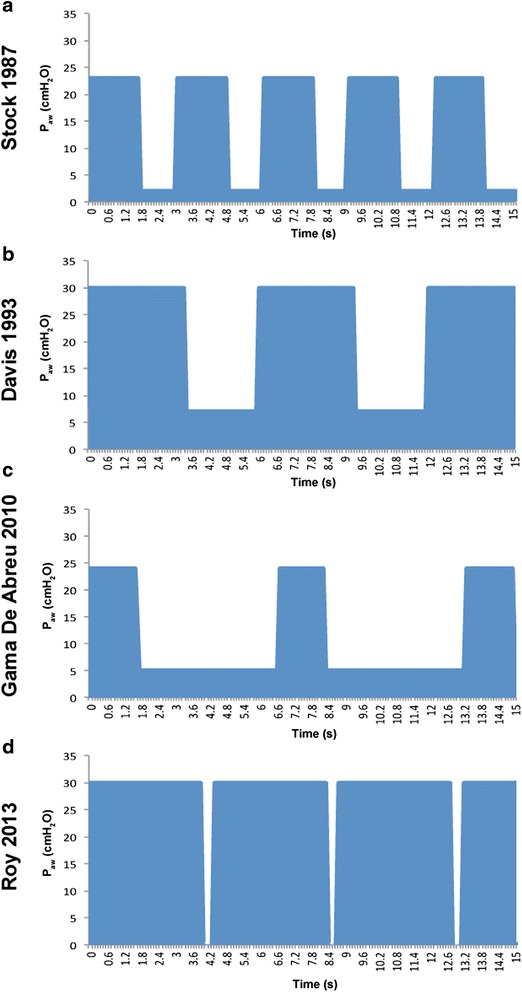
Fig. 1
Fig. 1
Comparison of APRV pressure waveforms. Artistic depiction of airway pressure waveforms, all of which were defined as APRV, illustrating the significant variability in what has been defined as an APRV breath. Stock in 1987 used 60 % CPAP with TLow of 1.27 s and a respiratory rate (RR) of 20 [2]. Davis in 1993 used a similar %CPAP, but decreased the RR by prolonging THigh and TLow [3]. Gama de Abreau in 2010 simulated conventional ventilation with a prolonged TLow and short THigh [4]. Finally, Roy in 2013 used a very brief adaptive TLow and large THigh with 90 % CPAP [5]. Of note, though the ventilator pressure is set at zero, this does not reflect true pressure as the brief TLow prevents full deflation of the lung, and thus prevents end-expiratory pressure from reaching zero. Figures ac are examples of fixed-APRV (F-APRV) and figure d of personalized APRV (P-APRV)
Fig. 2
Fig. 2
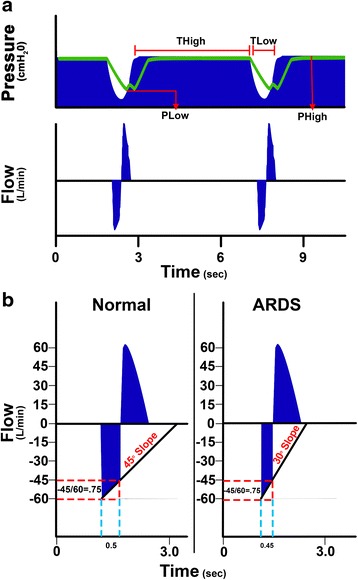
Method of setting expiratory duration (TLow). a Typical personalized airway pressure release ventilation (P-APRV) airway pressure and flow curves. Correctly set P-APRV has a very brief release phase (time at low pressure—TLow) and CPAP phase (time at high pressure—THigh) [6]. The THigh is ~90 % of each breath. The two other P-ARPV settings are the pressure at inspiration (PHigh) and at expiration (PLow). TLow is sufficiently brief such that end-expiratory pressure (PLow) never reaches 0 cmH2O measured by the tracheal pressure (green line). b Maintain alveolar stability by adaptively adjusting the expiratory duration as directed by the expiratory flow curve. The rate of lung collapse is seen in the normal (slope 45°) and acutely injured lung (ARDS, slope 30°). ARDS causes a more rapid lung collapse due to decreased lung compliance. Our preliminary studies have shown that if the end-expiratory flow (EEF; −45 L/min) to the peak expiratory flow (PEF; −60 L/min) ratio is equal to 0.75, the resultant TLow (0.5 s) is sufficient to stabilize alveoli [54, 55]. The lung with ARDS collapses more rapidly such that the EEF/PEF ratio of 75 % identifies an expiratory duration of 0.45 s as necessary to stabilize alveoli. Thus, this method of setting expiratory duration is adaptive to changes in lung pathophysiology and personalizes the mechanical breath to each individual patient

References

    1. Downs JB, Stock MC. Airway pressure release ventilation: a new concept in ventilatory support. Crit Care Med. 1987;15:459–461. doi: 10.1097/00003246-198701000-00018. - DOI - PubMed
    1. Stock MC, Downs JB, Frolicher DA. Airway pressure release ventilation. Crit Care Med. 1987;15:462–466. doi: 10.1097/00003246-198705000-00002. - DOI - PubMed
    1. Davis K, Jr, Johnson DJ, Branson RD, Campbell RS, Johannigman JA, Porembka D. Airway pressure release ventilation. Arch Surg. 1993;128:1348–1352. doi: 10.1001/archsurg.1993.01420240056010. - DOI - PubMed
    1. Gama de Abreu M, Cuevas M, Spieth PM, Carvalho AR, Hietschold V, Stroszczynski C, Wiedemann B, Koch T, Pelosi P, Koch E. Regional lung aeration and ventilation during pressure support and biphasic positive airway pressure ventilation in experimental lung injury. Crit Care. 2010;14:R34. doi: 10.1186/cc8912. - DOI - PMC - PubMed
    1. Roy S, Habashi N, Sadowitz B, Andrews P, Ge L, Wang G, Roy P, Ghosh A, Kuhn M, Satalin J, Gatto LA, Lin X, Dean DA, Vodovotz Y, Nieman G. Early airway pressure release ventilation prevents ARDS—a novel preventive approach to lung injury. Shock. 2013;39:28–38. - PMC - PubMed

LinkOut - more resources