


Text Messaging-Based Interventions for Smoking Cessation: A Systematic Review and Meta-Analysis
- PMID: 27207211
- PMCID: PMC4893152
- DOI: 10.2196/mhealth.5436
Text Messaging-Based Interventions for Smoking Cessation: A Systematic Review and Meta-Analysis
Abstract
Background: Tobacco use is one of the leading preventable global health problems producing nearly 6 million smoking-related deaths per year. Interventions delivered via text messaging (short message service, SMS) may increase access to educational and support services that promote smoking cessation across diverse populations.
Objective: The purpose of this meta-analysis is to (1) evaluate the efficacy of text messaging interventions on smoking outcomes, (2) determine the robustness of the evidence, and (3) identify moderators of intervention efficacy.
Methods: Electronic bibliographic databases were searched for records with relevant key terms. Studies were included if they used a randomized controlled trial (RCT) to examine a text messaging intervention focusing on smoking cessation. Raters coded sample and design characteristics, and intervention content. Summary effect sizes, using random-effects models, were calculated and potential moderators were examined.
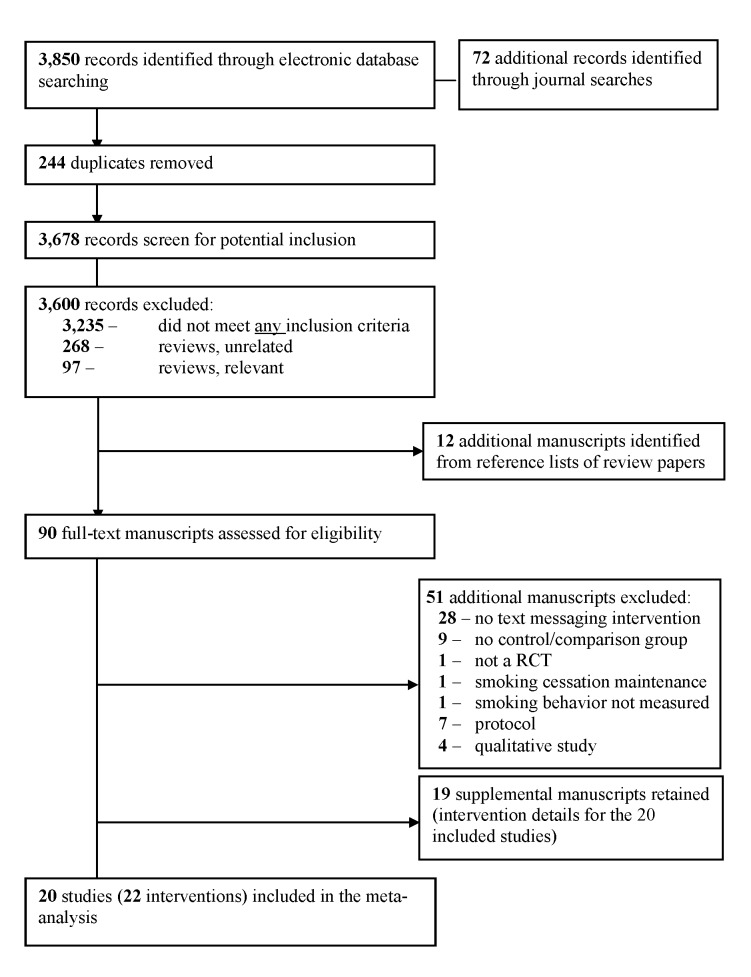
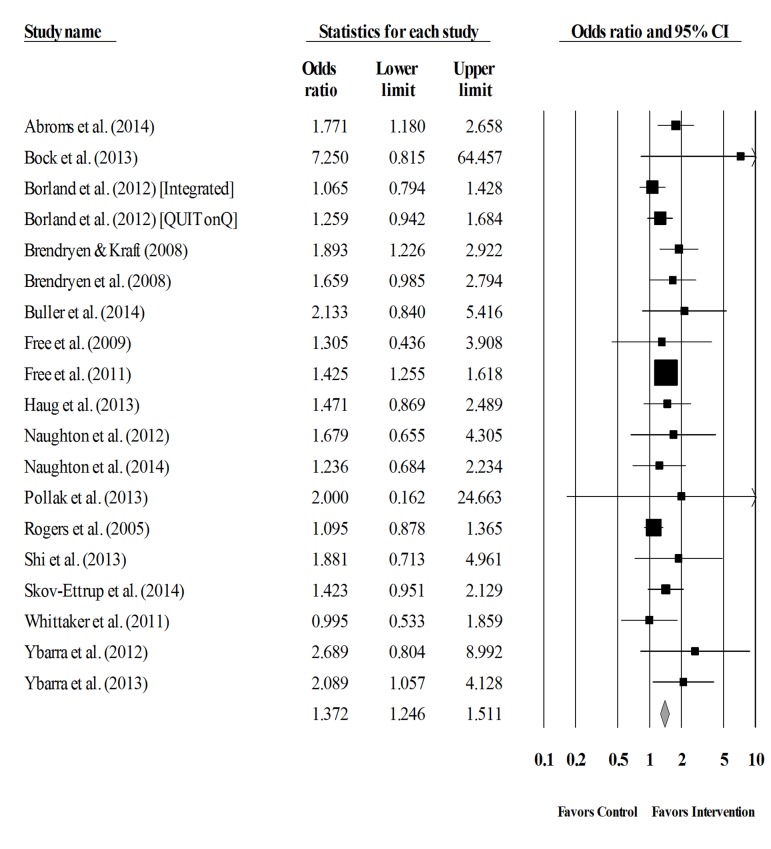
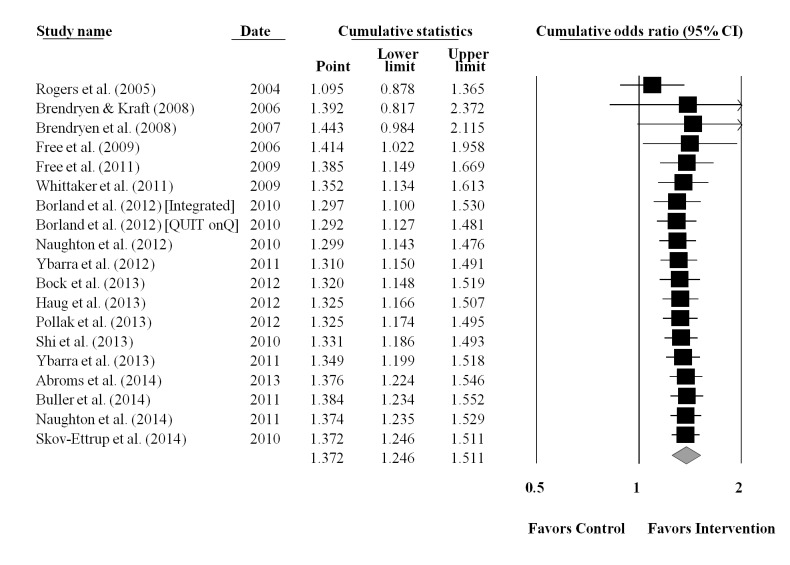
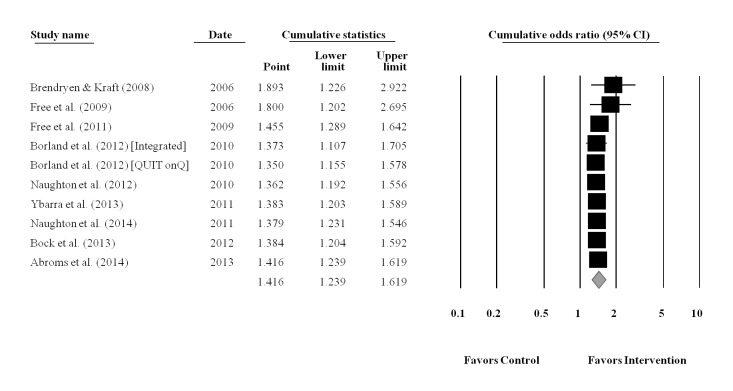
Results: The meta-analysis included 20 manuscripts with 22 interventions (N=15,593; 8128 (54%) women; mean age=29) from 10 countries. Smokers who received a text messaging intervention were more likely to abstain from smoking relative to controls across a number of measures of smoking abstinence including 7-day point prevalence (odds ratio (OR)=1.38, 95% confidence interval (CI)=1.22, 1.55, k=16) and continuous abstinence (OR=1.63, 95% CI=1.19, 2.24, k=7). Text messaging interventions were also more successful in reducing cigarette consumption relative to controls (d+=0.14, 95% CI=0.05, 0.23, k=9). The effect size estimates were biased when participants who were lost to follow-up were excluded from the analyses. Cumulative meta-analysis using the 18 studies (k=19) measuring abstinence revealed that the benefits of using text message interventions were established only after only five RCTs (k=5) involving 8383 smokers (OR=1.39, 95% CI=1.15, 1.67, P<.001). The inclusion of the subsequent 13 RCTs (k=14) with 6870 smokers did not change the established efficacy of text message interventions for smoking abstinence (OR=1.37, 95% CI=1.25, 1.51, P<.001). Smoking abstinence rates were stronger when text messaging interventions (1) were conducted in Asia, North America, or Europe, (2) sampled fewer women, and (3) recruited participants via the Internet.
Conclusions: The evidence for the efficacy of text messaging interventions to reduce smoking behavior is well-established. Using text messaging to support quitting behavior, and ultimately long-term smoking abstinence, should be a public health priority.
Keywords: cigarette smoking; intervention; meta-analysis; smoking cessation; text messaging.
Conflict of interest statement
Conflicts of Interest: None declared.
Figures
References
-
- World Health Organization. 2013. [2016-04-08]. WHO Report on the Global Tobacco Epidemic, 2013: Enforcing Bans on Tobacco Advertising, Promotion, and Sponsorship http://apps.who.int/iris/bitstream/10665/85380/1/9789241505871_eng.pdf?ua=1 . - PubMed
-
- Eriksen M, Mackay J, Schluger N, Islami F, Droper J. The Tobacco Atlas. [2015-12-29]. http://3pk43x313ggr4cy0lh3tctjh.wpengine.netdna-cdn.com/wp-content/uploa... .
-
- U.S. Department of Health and Human Services . The Health Consequences of Smoking--50 Years of Progress: A Report of the Surgeon General. Atlanta: U.S. Department of Health and Human Services, Centers for Disease Control and Prevention, National Center for Chronic Disease Prevention and Health Promotion, Office on Smoking and Health; 2014. [2016-04-08]. http://www.surgeongeneral.gov/library/reports/50-years-of-progress/
-
- Centers for Disease ControlPrevention (CDC) Smoking-attributable mortality, years of potential life lost, and productivity losses--United States, 2000-2004. MMWR Morb Mortal Wkly Rep. 2008;57:1226–1228. http://www.cdc.gov/mmwr/preview/mmwrhtml/mm5745a3.htm mm5745a3 - PubMed
Publication types
Grants and funding
LinkOut - more resources
Full Text Sources
Other Literature Sources
Medical
