


Unexpected arterial wall and cellular inflammation in patients with rheumatoid arthritis in remission using biological therapy: a cross-sectional study
- PMID: 27209093
- PMCID: PMC4875657
- DOI: 10.1186/s13075-016-1008-z
Unexpected arterial wall and cellular inflammation in patients with rheumatoid arthritis in remission using biological therapy: a cross-sectional study
Erratum in
-
Erratum to: Unexpected arterial wall and cellular inflammation in patients with rheumatoid arthritis in remission using biological therapy: a cross-sectional study.Arthritis Res Ther. 2016 Dec 13;18(1):298. doi: 10.1186/s13075-016-1198-4. Arthritis Res Ther. 2016. PMID: 27964741 Free PMC article. No abstract available.
Abstract
Background: Increasing numbers of patients (up to 40 %) with rheumatoid arthritis (RA) achieve remission, yet it remains to be elucidated whether this also normalizes their cardiovascular risk. Short-term treatment with TNF inhibitors lowers arterial wall inflammation, but not to levels of healthy controls. We investigated whether RA patients in long-term remission are characterized by normalized inflammatory activity of the arterial wall and if this is dependent on type of medication used (TNF-inhibitor versus nonbiological disease-modifying antirheumatic drugs (DMARDs)).
Methods: Arterial wall inflammation, bone marrow and splenic activity (index of progenitor cell activity) was assessed with (18)F-fluorodeoxyglucose ((18)F-FDG) positron emission tomography/computed tomography (PET/CT) in RA patients in remission (disease activity score (DAS28) <2.6 for >6 months) and healthy controls. We performed ex vivo characterization of monocytes using flow cytometry and a transendothelial migration assay.
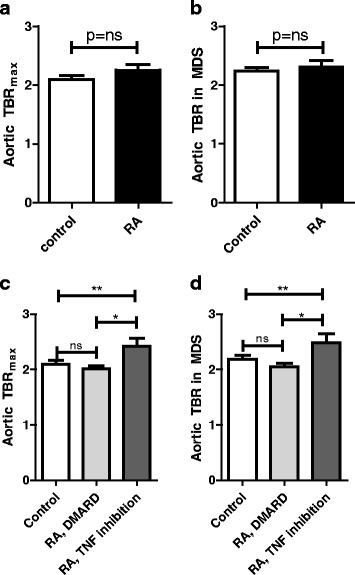
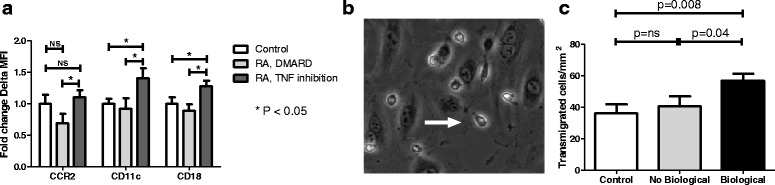
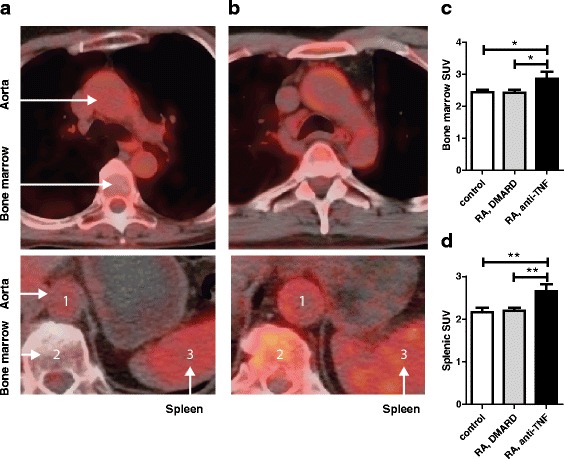
Results: Overall, arterial wall inflammation was comparable in RA patients (n = 23) in long-term remission and controls (n = 17). However, RA subjects using current anti-TNF therapy (n = 13, disease activity score 1.98[1.8-2.2]) have an almost 1.2-fold higher (18)F-FDG uptake in the arterial wall compared to those using DMARDs (but with previous anti-TNF therapy) (n = 10, disease activity score 2.24[1.3-2.5]), which seemed to be predominantly explained by longer duration of their rheumatic disease in a multivariate linear regression analysis. This coincided with increased expression of pro-adhesive (CCR2) and migratory (CD11c, CD18) surface markers on monocytes and a concomitant increased migratory capacity. Finally, we found increased activity in bone marrow and spleen in RA patients using anti-TNF therapy compared to those with DMARDs and controls.
Conclusions: A subset of patients with RA in clinical remission have activated monocytes and increased inflammation in the arterial wall, despite the use of potent TNF blocking therapies. In these subjects, RA disease duration was the most important contributor to the level of arterial wall inflammation. This increased inflammatory state implies higher cardiovascular risk in these patients, who thus may require more stringent CV risk management.
Keywords: Cardiovascular disease; Imaging; Inflammation; Rheumatoid arthritis.
Figures
References
Publication types
MeSH terms
Substances
LinkOut - more resources
Full Text Sources
Other Literature Sources
Medical
Research Materials
