


doi: 10.1039/c6ob00824k.
Epub 2016 May 23.
Synthesis of tumor necrosis factor α for use as a mirror-image phage display target
Affiliations
- PMID: 27211891
- PMCID: PMC4900166
- DOI: 10.1039/c6ob00824k
Item in Clipboard
Synthesis of tumor necrosis factor α for use as a mirror-image phage display target
Org Biomol Chem.
.
Abstract
Tumor Necrosis Factor alpha (TNFα) is an inflammatory cytokine that plays a central role in the pathogenesis of chronic inflammatory disease. Here we describe the chemical synthesis of l-TNFα along with the mirror-image d-protein for use as a phage display target. The synthetic strategy utilized native chemical ligation and desulfurization to unite three peptide segments, followed by oxidative folding to assemble the 52 kDa homotrimeric protein. This synthesis represents the foundational step for discovering an inhibitory d-peptide with the potential to improve current anti-TNFα therapeutic strategies.
Figures

Synthesis of TNFα by native chemical ligation. (A) Sequence of soluble ectodomain using full-length sequence numbering. N-terminal, middle, and C-terminal segments are red, green and blue, respectively. Native cysteine residues are depicted in bold, and ligation junctions are bold and underlined. X is hydrogen (unprotected N-terminus) in l -TNF or Biotin-PEG2 in d -TNF. (B) Assembly strategy for the three segments; NCL includes oxidation (hydrazide to azide), conversion to MPAA thioester, and ligation to an N-terminal Cys-containing peptide.

Deconvoluted mass spectrum of the crude TNFα C-terminal segment (185-233) synthesized with (blue) and without (red) 0.1 M Oxyma Pure added to the Fmoc deprotection solution (20% piperidine).

HPLC retention and MS charge states of reduced and oxidized synthetic biotin- d -TNFα. (A) The oxidation reaction was monitored by a shift in RP-HPLC retention (2 h time point). (B) Formation of the disulfide bond results in a shift to lower charge states and a 2 Da shift in the deconvoluted mass.
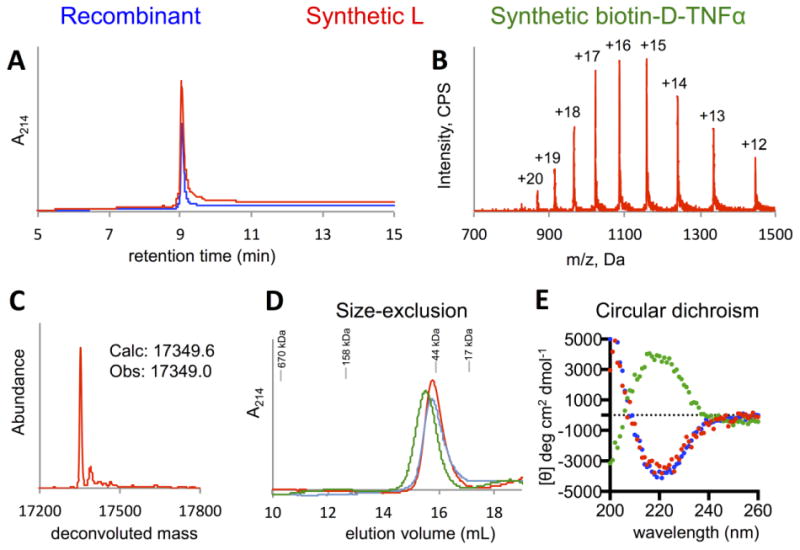
Biophysical characterization of folded synthetic l -TNFα (red) and biotin- d -TNFα (green). (A) RP-HPLC comparison of synthetic l -TNFα with recombinant TNFα (blue) shows that both proteins elute at ∼9.1 min (Phenomenex C4 Aeris column). (B) Mass spectrum of oxidized, folded, and SEC-purified synthetic l -TNFα. (C) Deconvoluted mass spectrum of synthetic l -TNFα matches the expected values. (D) Analytical SEC traces show that recombinant TNFα, synthetic l -TNFα, and synthetic biotin- d -TNFα show elution volumes on a Superdex 200 column consistent with trimeric protein. (E) Circular dichroism indicates a minimum at 218 nm and maximum around 200 nm consistent with the primarily β-sheet structure of TNFα (<3% α–helix). The mirror-image d -protein has an equivalent, but inverse, spectrum to the synthetic l - and recombinant proteins.

L929 cells were treated for 20 h with a serial 3-fold dilution of either synthetic or recombinant l -TNFα, with a maximum dose of 10 ng/mL (measured by quantitative SDS-PAGE, see supplemental information). Cell viability was measured using the CellTiter 96® AQueous One Solution Cell Proliferation Assay (Promega) visualized at 490 nm, 4 h post treatment.
References
MeSH terms
Substances
Grants and funding
LinkOut - more resources
Full Text Sources
Other Literature Sources
