


The Lancet Weight Determines Wheal Diameter in Response to Skin Prick Testing with Histamine
- PMID: 27213613
- PMCID: PMC4877047
- DOI: 10.1371/journal.pone.0156211
The Lancet Weight Determines Wheal Diameter in Response to Skin Prick Testing with Histamine
Abstract
Background: Skin prick test (SPT) is a common test for diagnosing immunoglobulin E-mediated allergies. In clinical routine, technicalities, human errors or patient-related biases, occasionally results in suboptimal diagnosis of sensitization.
Objective: Although not previously assessed qualitatively, lancet weight is hypothesized to be important when performing SPT to minimize the frequency of false positives, false negatives, and unwanted discomfort.
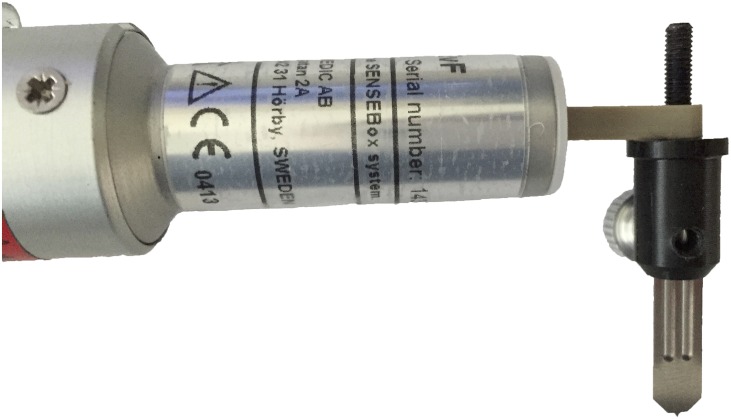
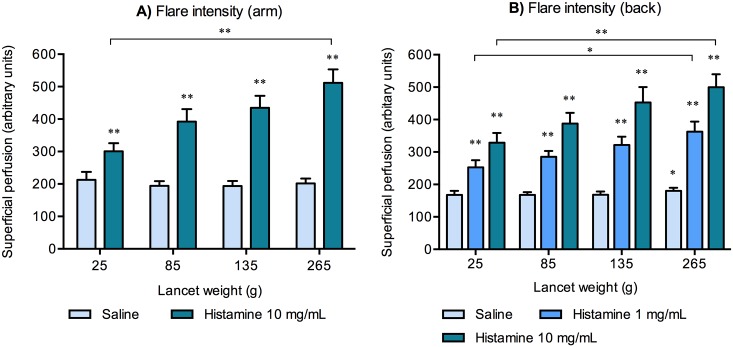
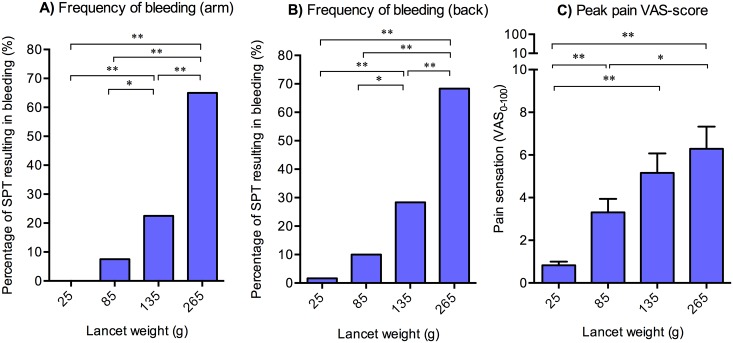
Methods: Accurate weight-controlled SPT was performed on the volar forearms and backs of 20 healthy subjects. Four predetermined lancet weights were applied (25 g, 85 g, 135 g and 265 g) using two positive control histamine solutions (1 mg/mL and 10 mg/mL) and one negative control (saline). A total of 400 SPTs were conducted. The outcome parameters were: wheal size, neurogenic inflammation (measured by superficial blood perfusion), frequency of bleeding, and the lancet provoked pain response.
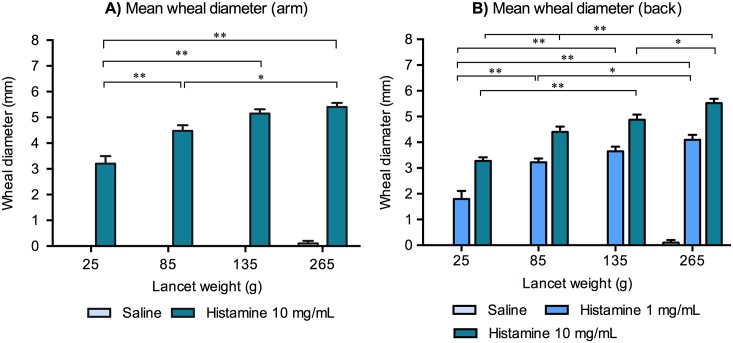
Results: The mean wheal diameter increased significantly as higher weights were applied to the SPT lancet, e.g. from 3.2 ± 0.28 mm at 25 g to 5.4 ± 1.7 mm at 265 g (p<0.01). Similarly, the frequency of bleeding, the provoked pain, and the neurogenic inflammatory response increased significantly. At 265 g saline evoked two wheal responses (/160 pricks) below 3 mm.
Conclusion and clinical relevance: The applied weight of the lancet during the SPT-procedure is an important factor. Higher lancet weights precipitate significantly larger wheal reactions with potential diagnostic implications. This warrants additional research of the optimal lancet weight in relation to SPT-guidelines to improve the specificity and sensitivity of the procedure.
Conflict of interest statement
Figures
References
-
- Gergen PJ, Turkeltaub PC, Kovar MG. The prevalence of allergic skin test reactivity to eight common aeroallergens in the U.S. population: results from the second National Health and Nutrition Examination Survey. J Allergy Clin Immunol. 1987;80: 669–679. - PubMed
-
- Charlotte G. Mortz and Andersen Klaus E. Allergic contact dermatitis in children and. Contact Dermatitis, 1999,. 1999; 121–130. - PubMed
-
- Gomes ER, Demoly P. Epidemiology of hypersensitivity drug reactions. Curr Opin Allergy Clin Immunol. 2005;5: 309–316. - PubMed
Publication types
MeSH terms
Substances
LinkOut - more resources
Full Text Sources
Other Literature Sources
