


Effectiveness of simulation-based nursing education depending on fidelity: a meta-analysis
- PMID: 27215280
- PMCID: PMC4877810
- DOI: 10.1186/s12909-016-0672-7
Effectiveness of simulation-based nursing education depending on fidelity: a meta-analysis
Abstract
Background: Simulation-based nursing education is an increasingly popular pedagogical approach. It provides students with opportunities to practice their clinical and decision-making skills through various real-life situational experiences. However, simulation approaches fall along a continuum ranging from low-fidelity to high-fidelity simulation. The purpose of this study was to determine the effect size of simulation-based educational interventions in nursing and compare effect sizes according to the fidelity level of the simulators through a meta-analysis.
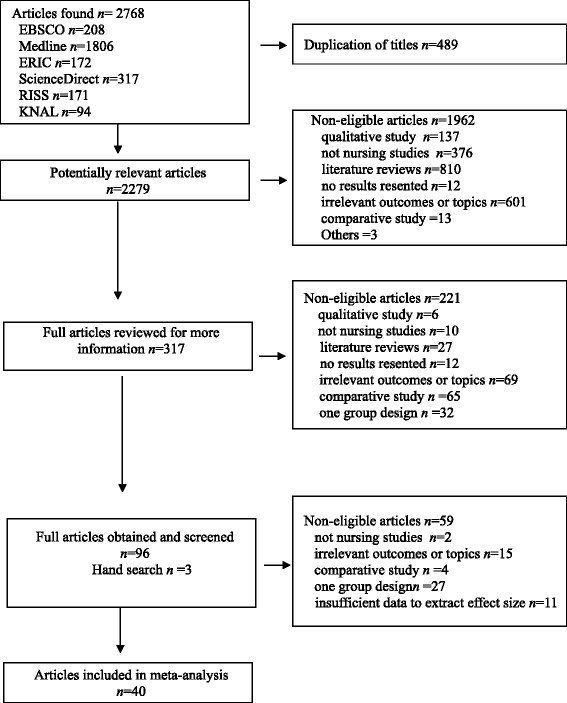
Method: This study explores the quantitative evidence published in the electronic databases EBSCO, Medline, ScienceDirect, ERIC, RISS, and the National Assembly Library of Korea database. Using a search strategy including the search terms "nursing," "simulation," "human patient," and "simulator," we identified 2279 potentially relevant articles. Forty studies met the inclusion criteria and were retained in the analysis.
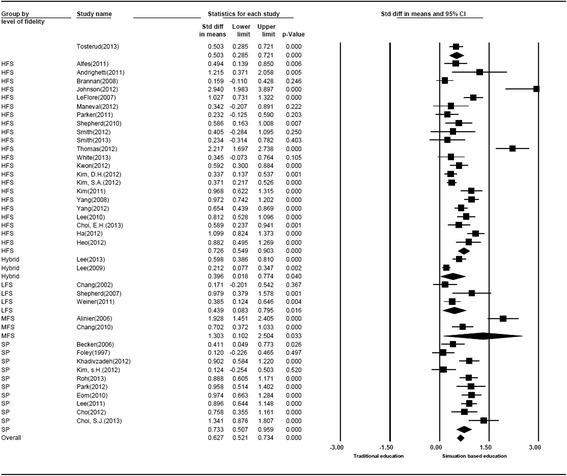
Results: This meta-analysis showed that simulation-based nursing education was effective in various learning domains, with a pooled random-effects standardized mean difference of 0.70. Subgroup analysis revealed that effect sizes were larger for high-fidelity simulation (0.86), medium-fidelity simulation (1.03), and standardized patients (0.86) than they were for low-fidelity and hybrid simulations. In terms of cognitive outcomes, the effect size was the largest for high-fidelity simulation (0.50). Regarding affective outcome, high-fidelity simulation (0.80) and standardized patients (0.73) had the largest effect sizes.
Conclusions: These results suggest that simulation-based nursing educational interventions have strong educational effects, with particularly large effects in the psychomotor domain. Since the effect is not proportional to fidelity level, it is important to use a variety of educational interventions to meet all of the educational goals.
Keywords: Educational models; Meta-analysis; Nursing education; Patient simulation.
Figures
References
-
- Hovancsek MT. Using simulations in nursing education. In: Jeffries PR, editor. Simulation in nursing education: from conceptualization to evaluation. New York: National League for Nursing; 2007. pp. 1–9.
-
- Dieckmann P. Simulation settings for learning in acute medical care. In: Dieckmann P, editor. Using simulations for education, training and research. Lengerich: Pabst; 2009. pp. 40–138.
-
- Laschinger S, Medves J, Pulling C, McGraw R, Waytuck B, Harrison MB, et al. Effectiveness of simulation on health profession students’ knowledge, skills, confidence and satisfaction. Int J Evid Based Healthc. 2008;6:278–302. - PubMed
Publication types
MeSH terms
LinkOut - more resources
Full Text Sources
Other Literature Sources
Medical
Miscellaneous
