Review
. 2016 Aug;27(7-8):421-9.
doi: 10.1007/s00335-016-9641-z. Epub 2016 May 23.

Cellular ageing mechanisms in osteoarthritis

Affiliations
Review

Cellular ageing mechanisms in osteoarthritis

P K Sacitharan et al. Mamm Genome. 2016 Aug.

Abstract

Age is the strongest independent risk factor for the development of osteoarthritis (OA) and for many years this was assumed to be due to repetitive microtrauma of the joint surface over time, the so-called 'wear and tear' arthritis. As our understanding of OA pathogenesis has become more refined, it has changed our appreciation of the role of ageing on disease. Cartilage breakdown in disease is not a passive process but one involving induction and activation of specific matrix-degrading enzymes; chondrocytes are exquisitely sensitive to changes in the mechanical, inflammatory and metabolic environment of the joint; cartilage is continuously adapting to these changes by altering its matrix. Ageing influences all of these processes. In this review, we will discuss how ageing affects tissue structure, joint use and the cellular metabolism. We describe what is known about pathways implicated in ageing in other model systems and discuss the potential value of targeting these pathways in OA.


Figures

Fig. 1
Fig. 1
OA pathogenesis. Proteolytic matrix breakdown is a key feature of cartilage breakdown in OA. This is influenced by risk factors such as age, inflammation and mechanical injury. The ability of cartilage to repair is controversial but is also likely to be influenced by similar classes of modulators that may hinder or aid repair
Fig. 2
Fig. 2
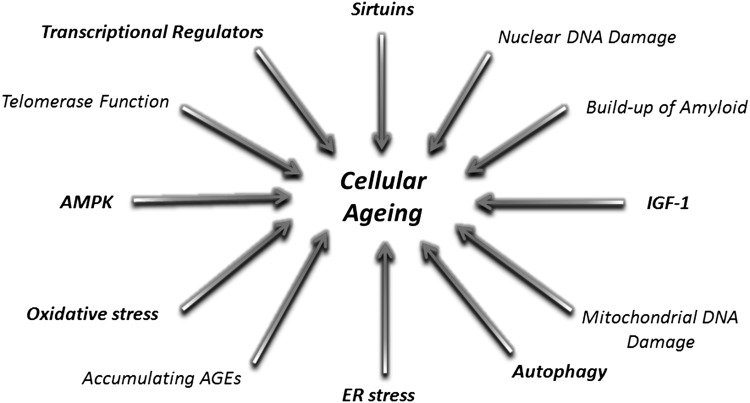
Cellular ageing mechanisms. Many cellular signalling mechanisms have been implicated in the regulation of ageing in mammals. This review will discuss the metabolic cellular mechanisms (in bold) described to be important in chondrocytes, cartilage and the OA joint
Fig. 3
Fig. 3
Ageing processes affecting joint health. Age-related changes to the extracellular matrix result in increased stiffness, which changes the mechano-responsiveness of chondrocytes and brittleness of the tissue. Environmental influences include neuromuscular decline, changing hormonal status, activity levels and diet. There is a dynamic interplay between these influences and cellular metabolic mechanisms in chondrocytes to regulate cartilage ageing

References

    1. Aigner T, Fundel K, Saas J, et al. Large-scale gene expression profiling reveals major pathogenetic pathways of cartilage degeneration in osteoarthritis. Arthritis Rheum. 2006;54:3533–3544. doi: 10.1002/art.22174. - DOI - PubMed
    1. Ailixiding M, Aibibula Z, Iwata M, et al. Pivotal role of Sirt6 in the crosstalk among ageing, metabolic syndrome and osteoarthritis. Biochem Biophys Res Commun. 2015;466:319–326. doi: 10.1016/j.bbrc.2015.09.019. - DOI - PubMed
    1. Akasaki Y, Alvarez-Garcia O, Saito M, et al. FOXO transcription factors support oxidative stress resistance in human chondrocytes. Arthritis Rheumatol (Hoboken, NJ) 2014 - PMC - PubMed
    1. Akasaki Y, Hasegawa A, Saito M, et al. Dysregulated FOXO transcription factors in articular cartilage in ageing and osteoarthritis. Osteoarthr Cartil. 2014;22:162–170. doi: 10.1016/j.joca.2013.11.004. - DOI - PMC - PubMed
    1. Baker MS, Feigan JLD. Chondrocyte antioxidant defences: the roles of catalase and glutathione peroxidase in protection against H2O2 dependent inhibition of proteoglycan biosynthesis. J Rheumatol. 1988;15:670–677. - PubMed