Review
. 2017 May 4;14(5):460-470.
doi: 10.1080/15476286.2016.1189069. Epub 2016 May 24.

RNA- and protein-mediated control of Listeria monocytogenes virulence gene expression

Affiliations
Review

RNA- and protein-mediated control of Listeria monocytogenes virulence gene expression

Alice Lebreton et al. RNA Biol. .

Abstract

The model opportunistic pathogen Listeria monocytogenes has been the object of extensive research, aiming at understanding its ability to colonize diverse environmental niches and animal hosts. Bacterial transcriptomes in various conditions reflect this efficient adaptability. We review here our current knowledge of the mechanisms allowing L. monocytogenes to respond to environmental changes and trigger pathogenicity, with a special focus on RNA-mediated control of gene expression. We highlight how these studies have brought novel concepts in prokaryotic gene regulation, such as the 'excludon' where the 5'-UTR of a messenger also acts as an antisense regulator of an operon transcribed in opposite orientation, or the notion that riboswitches can regulate non-coding RNAs to integrate complex metabolic stimuli into regulatory networks. Overall, the Listeria model exemplifies that fine RNA tuners act together with master regulatory proteins to orchestrate appropriate transcriptional programmes.

Keywords: CRISPR; excludon; non-coding RNA; riboswitch; thermosensor; transcriptome.


Figures
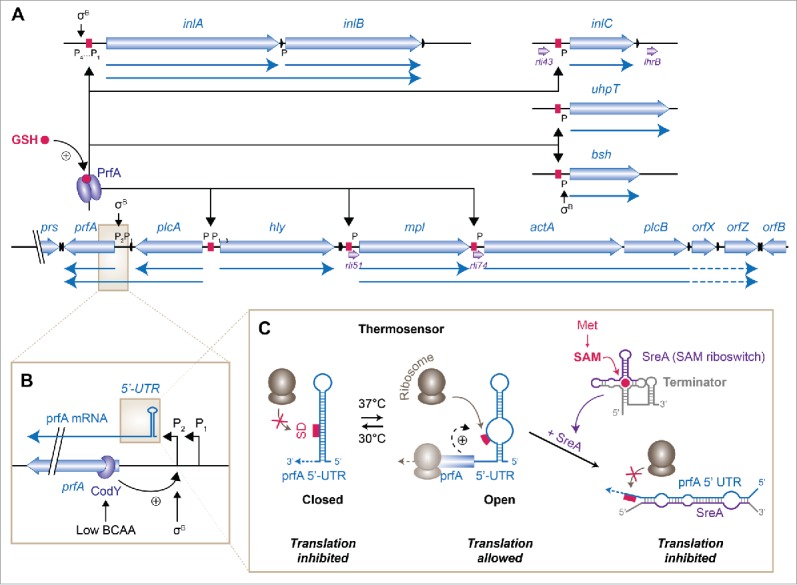
Figure 1.
Figure 1.
The PrfA regulon and its multiple control mechanisms. (A) Diagram of the main virulence cluster in L. monocytogenes and other PrfA-dependent genes, inspired from Kreft and Vázquez-Boland and de las Heras et al. Open reading frames (ORF) are highlighted in thick blue arrows, small RNAs in purple, terminators in black. The main transcriptional units are displayed with plain blue arrows. PrfA binding sites are boxed in magenta. Positive or negative regulators are shown. P, promoter; GSH, glutathione. (B) Transcriptional control of prfA. In addition to σB-dependent regulation, transcription is enhanced by binding of CodY in the coding sequence, in response to low availability of branched-chain amino-acids (BCAA). UTR, untranslated region. (C) Control of prfA translation initiation, adapted from Cossart and Lebreton. At 30°C, the Shine-Dalgarno (SD) sequence of prfA mRNA is masked from ribosomes by a closed stem-loop structure. At 37°C, a change in the conformation of the 5′-UTR liberates the SD and allows translation initiation. Binding of ribosomes to the SD is further stabilised by the 20 first codons of the ORF. The SreA small RNA, which is the product of a S-adenosylmethionine (SAM) riboswitch, can also base-pair with prfA 5′-UTR and block access of ribosomes to the SD sequence.
Figure 2.
Figure 2.
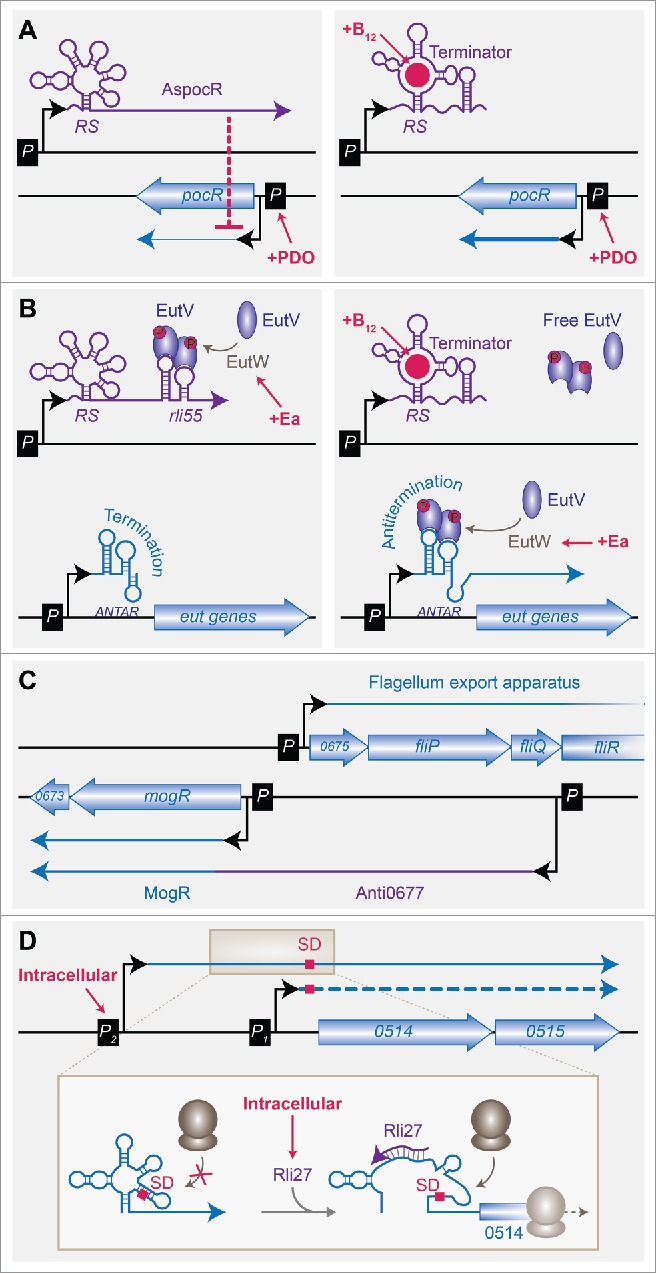
Novel RNA-mediated regulations of L. monocytogenes gene expression. (A) Control of AsPocR by a B12 riboswitch, adapted from Cossart and Lebreton. (Left) In absence of B12, full-length AspocR is produced and inhibits pocR expression. (Right) In presence of B12, the transcription of AsPocR is terminated prematurely by the B12 riboswitch (RS), and transcription of pocR is allowed, provided that propanediol (PDO) is also present in the medium. (B) Sequestration of an antiterminator by a B12 riboswitch, inspired from Mellin et al. In presence of Ethanolamine (Ea), the antiterminator EutV is phosphorylated by EutW and activated. (Left) In absence of B12, full-length Rli55 is produced and sequesters active EutV. The transcription of eut genes is prevented by early termination at the ANTAR elements. (Right) In presence of B12, the transcription of Rli55 is terminated prematurely by the B12 riboswitch. Free phosphorylated EutV dimers can then bind the ANTAR element and mediate antitermination, allowing the expression of eut genes. (C) The mogR-fli locus excludon, adapted from Cossart and Lebreton. mogR is encompassed by 2 transcripts. In the longest one, the 5′-UTR of upstream of MogR coding sequence also acts as an antisense RNA, Anti0677, overlapping the fli operon. The two divergent transcriptional units encode proteins of opposite functions: MogR is a transcriptional repressor of flagellum genes, whereas Fli proteins participate in the flagellum export apparatus. (D) Rli27 allows the intracellular-specific translation of an alternative transcript, inspired from Quereda et al. Extracellular bacteria express mainly lmo0514-lmo0515 from the constitutive P1 promoter. An alternative, long mRNA is produced in low amounts from P2, but ribosomes cannot access the Shine-Dalgarno sequence (SD). In cells, the P2 promoter is activated, and Rli27 is expressed. Base-pairing of Rli27 with the 5′-UTR of the long transcript allows ribosome binding and translation to proceed.

References

    1. Membré J-M, Leporq B, Vialette M, Mettler E, Perrier L, Thuault D, Zwietering M. Temperature effect on bacterial growth rate: quantitative microbiology approach including cardinal values and variability estimates to perform growth simulations on/in food. Int J Food Microbiol 2005; 100:179-86; PMID:15854703; http://dx.doi.org/15302931 10.1016/j.ijfoodmicro.2004.10.015 - DOI - PubMed
    1. Grundling A, Burrack LS, Bouwer HGA, Higgins DE. Listeria monocytogenes regulates flagellar motility gene expression through MogR, a transcriptional repressor required for virulence. Proc Natl Acad Sci USA 2004; 101:12318-23; PMID:15302931; http://dx.doi.org/ 10.1073/pnas.0404924101 - DOI - PMC - PubMed
    1. Cossart P, Kocks C. The actin-based motility of the facultative intracellular pathogen Listeria monocytogenes. Mol Microbiol 1994; 13:395-402; PMID:7997157; http://dx.doi.org/ 10.1111/j.1365-2958.1994.tb00434.x - DOI - PubMed
    1. Glaser P, Frangeul L, Buchrieser C, Rusniok C, Amend A, Baquero F, Berche P, Bloecker H, Brandt P, Chakraborty T, et al.. Comparative genomics of Listeria species. Science 2001; 294:849-52; PMID:11679669; http://dx.doi.org/ 10.1126/science.1063447 - DOI - PubMed
    1. Cossart P, Archambaud C. The bacterial pathogen Listeria monocytogenes: an emerging model in prokaryotic transcriptomics. J Biol 2009; 8:107; PMID:20053304; http://dx.doi.org/ 10.1186/jbiol202 - DOI - PMC - PubMed

Publication types

MeSH terms