


EFFECT OF TRANEXAMIC ACID ON BLEEDING CONTROL IN TOTAL KNEE ARTHROPLASTY
- PMID: 27217813
- PMCID: PMC4863860
- DOI: 10.1590/1413-785220162403149200
EFFECT OF TRANEXAMIC ACID ON BLEEDING CONTROL IN TOTAL KNEE ARTHROPLASTY
Abstract
Objectives: To analyze the effectiveness of intravenous (IV) tranexamic acid (TA) in reducing blood loss in total knee arthroplasty (TKA).
Method: The population sample was composed of patients with a diagnosis of primary knee osteoarthritis. The patients undergoing TKA were divided in two groups. Group A: comprised patients who used IV TA and B group, formed by patients who did not use TA in the intra or post-operative period. For descriptive analysis, quantitative variables were represented by mean and standard deviations when their distribution was normal and interquartile ranges and medians for non-normal variables.
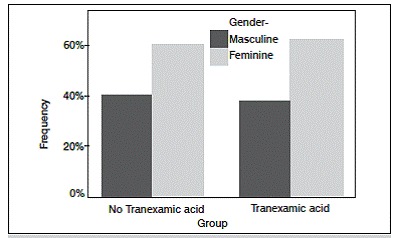
Results: The mean age of patients was 68 years old, most of them were female and with involvement of the left knee. Postoperatively patients who had used IV TA showed less bleeding rate and less hemoglobin rate reduction.
Conclusion: The use of IV TA in TKA reduces blood loss in peri- and postoperative periods. Regarding total blood loss reduction, hemoglobin rate and need for blood transfusions, IV TA should be used routinely during TKA since it has been shown to be safe with no increase in side effects as thromboembolic events. Level of Evidence III. Retrospective Comparative Study.
Keywords: Artrhoplasty, replacement, knee; Hemorrhage; Knee; Tranexamic acid.
Conflict of interest statement
All the authors declare that there is no potential conflict of interest referring to this article.
Figures



References
-
- Karam JA, Bloomfield MR, DiIorio TM, Irizarry AM, Sharkey PF. Evaluation of the efficacy and safety of tranexamic acid for reducing blood loss in bilateraltotal knee arthroplasty. J Arthroplasty. 2014;29(3):501–503. - PubMed
-
- Camarasa MA, Ollé G, Serra-Prat M, Martín A, Sánchez M, Ricós P. Efficacy of aminocaproic, tranexamic acids in the control of bleeding during total knee replacement a randomized clinical trial. Br J Anaesth. 2006;96(5):576–582. - PubMed
-
- Tanaka N, Sakahashi H, Sato E, Hirose K, Ishima T, Ishii S. Timing of the administration of tranexamic acid for maximum reduction in blood loss in arthroplasty of the knee. J Bone Joint Surg Br. 2001;83(5):702–705. - PubMed
-
- Wind TC, Barfield WR, Moskal JT. The effect of tranexamic acid on blood loss and transfusion rate in primary total knee arthroplasty. J Arthroplasty. 2013;28(7):1080–1083. - PubMed
LinkOut - more resources
Full Text Sources
Other Literature Sources