An official website of the United States government
The .gov means it’s official.
Federal government websites often end in .gov or .mil. Before
sharing sensitive information, make sure you’re on a federal
government site.
The site is secure.
The https:// ensures that you are connecting to the
official website and that any information you provide is encrypted
and transmitted securely.
1 1. Department of Chemical and Biomolecular Engineering, and Institute for NanoBioTechnology, The Johns Hopkins University, 3400 North Charles Street, Baltimore, Maryland 21218, United States; 2. Department of Oncology and Sidney Kimmel Comprehensive Cancer Center, Johns Hopkins University School of Medicine, Baltimore, Maryland 21205, United States; 3. Center for Nanomedicine, The Wilmer Eye Institute, Johns Hopkins University School of Medicine, 400 North Broadway, Baltimore, Maryland 21231, United States.
2 4. Hefei National Laboratory for Physical Sciences at the Microscale, University of Science and Technology of China, Hefei Anhui 230027, PR China; 5. CAS Center for Excellence in Nanoscience, School of Life Sciences and Medical Center, University of Science and Technology of China, Hefei Anhui 230027, PR China; 6. Innovation Center for Cell Signaling Network, University of Science and Technology of China, Hefei, Anhui 230027, PR China.
1 1. Department of Chemical and Biomolecular Engineering, and Institute for NanoBioTechnology, The Johns Hopkins University, 3400 North Charles Street, Baltimore, Maryland 21218, United States; 2. Department of Oncology and Sidney Kimmel Comprehensive Cancer Center, Johns Hopkins University School of Medicine, Baltimore, Maryland 21205, United States; 3. Center for Nanomedicine, The Wilmer Eye Institute, Johns Hopkins University School of Medicine, 400 North Broadway, Baltimore, Maryland 21231, United States.
2 4. Hefei National Laboratory for Physical Sciences at the Microscale, University of Science and Technology of China, Hefei Anhui 230027, PR China; 5. CAS Center for Excellence in Nanoscience, School of Life Sciences and Medical Center, University of Science and Technology of China, Hefei Anhui 230027, PR China; 6. Innovation Center for Cell Signaling Network, University of Science and Technology of China, Hefei, Anhui 230027, PR China.
This thematic issue includes both review and research articles and is intended to provide an overview on the recent progress in the development of nanostructure-based therapeutic, diagnostic, and theranostic systems.
Competing Interests: The authors have declared that no competing interest exists.
Figures
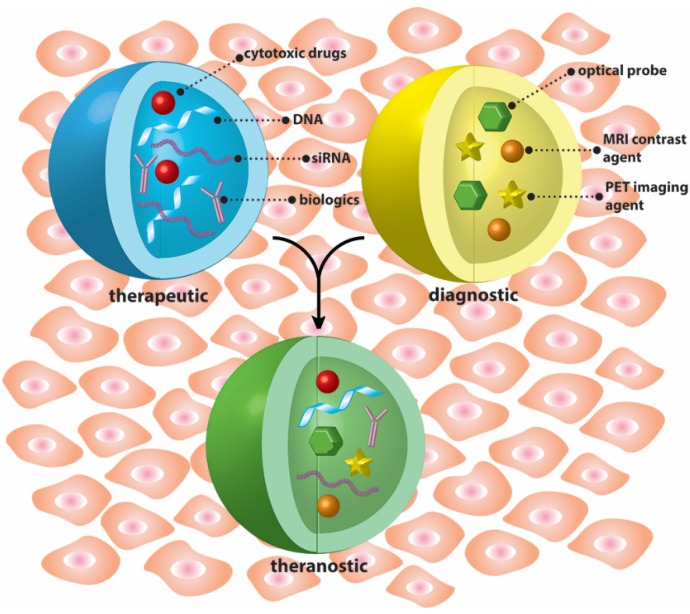
Figure 1
Nanoparticles are uniquely suited for…
Figure 1
Nanoparticles are uniquely suited for constructing theranostic systems with either tandem (Blue +…
Figure 1
Nanoparticles are uniquely suited for constructing theranostic systems with either tandem (Blue + Yellow) or concomitant (Green) use of therapeutic and diagnostic agents.
Satterlee AB, Huang L. Current and future theranostic applications of the lipid-calcium-phosphate nanoparticle platform. Theranostics. 2016;6:918–29. doi:10.7150/thno.14689.
-
PMC
-
PubMed
Ma Y, Mou QB, Wang DL, Zhu XY, Yan DY. Dendritic polymers for theranostics. Theranostics. 2016;6:930–47. doi:10.7150/thno.14855.
-
PMC
-
PubMed
Zhang PC, Hu CH, Ran W, Meng J, Yin Q, Li YP. Recent progress in light-triggered nanotheranostics for cancer treatment. Theranostics. 2016;6:948–68. doi:10.7150/thno.15217.
-
PMC
-
PubMed
Opoku-Damoah Y, Wang RN, Zhou JP, Ding Y. Versatile nanosystem-based cancer theranostics: design inspiration and predetermined routing. Theranostics. 2016;6:986–1003. doi:10.7150/thno.14860.
-
PMC
-
PubMed