


Comment
doi: 10.1016/j.tig.2016.05.002.
Epub 2016 May 21.
Fishing for Function in the Human Gene Pool
Affiliations
- PMID: 27220646
- PMCID: PMC4912909
- DOI: 10.1016/j.tig.2016.05.002
Item in Clipboard
Comment
Fishing for Function in the Human Gene Pool
Trends Genet.
2016 Jul.
Abstract
Identification and characterization of causal non-coding variants in human genomes is challenging and requires substantial experimental resources. A new study by Tehranchi et al. describes a cost-effective approach for accurate mapping of molecular quantitative trait loci (QTLs) from pooled samples, a powerful way to link disease-associated changes to molecular functions.
Keywords: GWAS; QTL; cis-regulation; non-coding DNA.
Copyright © 2016 Elsevier Ltd. All rights reserved.
Conflict of interest statement
The authors declare no conflicts of interests.
Figures
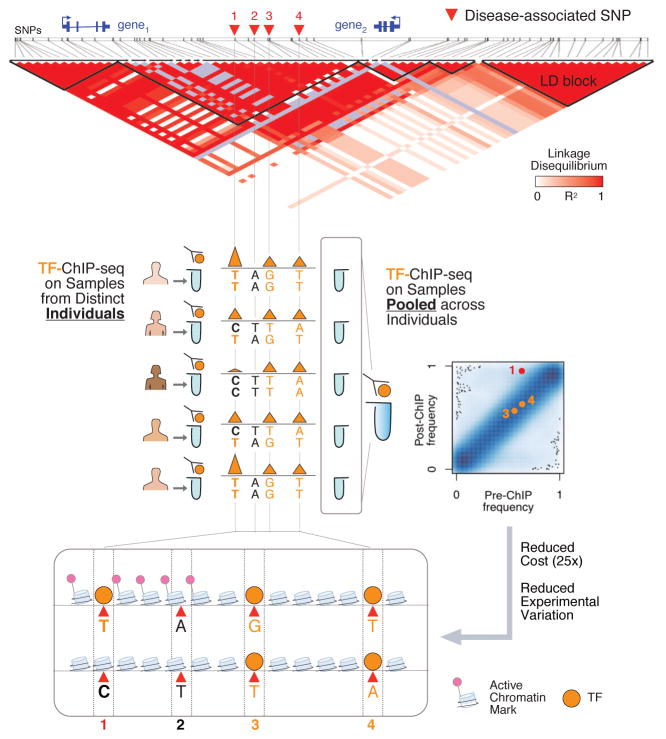
The figure shows a hypothetical scenario of using bQTL mapping to identify functional SNPs at a disease-associated locus. Traditional bQTL mapping makes use of ChIP-seq performed on different individuals to infer allele-specific binding separately for each sample (middle panel, left side). In contrast, in the pooling-based strategy introduced by Tehranchi et al. ChIP is performed on a pool of samples (middle panel, right side). The frequency of each allele in the input material (pre-ChIP) is then compared to its frequency in the enriched material (post-ChIP). Under this scenario, the traditional mapping shows that SNP #1 is bound by the transcription factor (TF) in individuals with genotype TT, while in individuals with genotype CC the site is barely bound; consistently, heterozygotes display intermediate levels of binding. The same result is obtained with the pooling-based strategy (see SNP #1 in the scatterplot), albeit at a much lower cost and reduced experimental variation. The lower panel shows the potential results. Out of the four linked variants previously associated with disease susceptibility, only #1 strongly affects the binding of the TF in the cell.
Comment on
-
Pooled ChIP-Seq Links Variation in Transcription Factor Binding to Complex Disease Risk.Cell. 2016 Apr 21;165(3):730-41. doi: 10.1016/j.cell.2016.03.041. Epub 2016 Apr 14. Cell. 2016. PMID: 27087447 Free PMC article.
References
Publication types
MeSH terms
Grants and funding
LinkOut - more resources
Full Text Sources
Other Literature Sources
Medical
