


The Multifaceted Roles of Adipose Tissue-Therapeutic Targets for Diabetes and Beyond: The 2015 Banting Lecture
- PMID: 27222389
- PMCID: PMC4878420
- DOI: 10.2337/db16-0339
The Multifaceted Roles of Adipose Tissue-Therapeutic Targets for Diabetes and Beyond: The 2015 Banting Lecture
Abstract
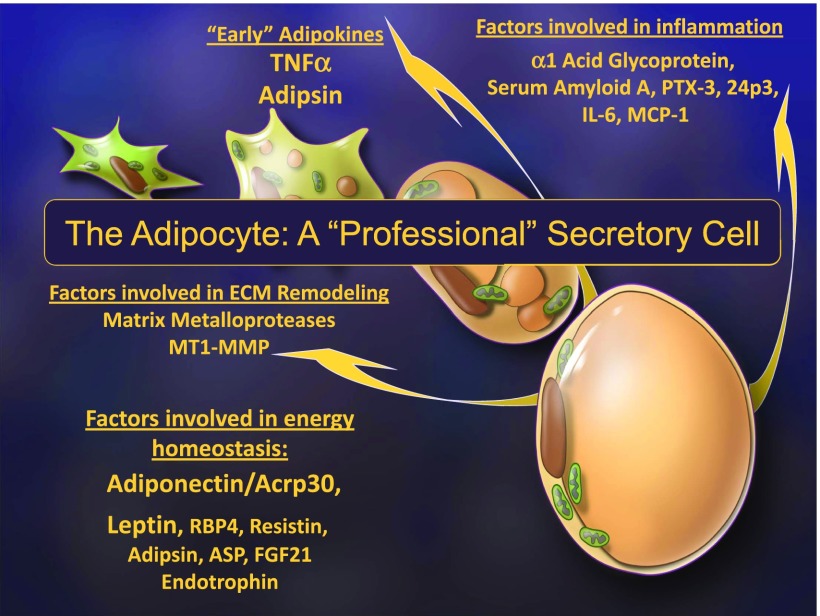
The Banting Medal for Scientific Achievement is the highest scientific award of the American Diabetes Association (ADA). Given in memory of Sir Frederick Banting, one of the key investigators in the discovery of insulin, the Banting Medal is awarded annually for scientific excellence, recognizing significant long-term contributions to the understanding, treatment, or prevention of diabetes. Philipp E. Scherer, PhD, of the Touchstone Diabetes Center, The University of Texas Southwestern Medical Center, Dallas, TX, received the prestigious award at the ADA's 75th Scientific Sessions, 5-9 June 2015, in Boston, MA. He presented the Banting Lecture, "The Multifaceted Roles of Adipose Tissue-Therapeutic Targets for Diabetes and Beyond," on Sunday, 7 June 2015.A number of different cell types contribute to the cellular architecture of adipose tissue. Although the adipocyte is functionally making important contributions to systemic metabolic homeostatis, several additional cell types contribute a supportive role to bestow maximal flexibility on the tissue with respect to many biosynthetic and catabolic processes, depending on the metabolic state. These cells include vascular endothelial cells, a host of immune cells, and adipocyte precursor cells and fibroblasts. Combined, these cell types give rise to a tissue with remarkable flexibility with respect to expansion and contraction, while optimizing the ability of the tissue to act as an endocrine organ through the release of many protein factors, critically influencing systemic lipid homeostasis and biochemically contributing many metabolites. Using an example from each of these categories-adiponectin as a key adipokine, sphingolipids as critical mediators of insulin sensitivity, and uridine as an important metabolite contributed by the adipocyte to the systemic pool-I will discuss the emerging genesis of the adipocyte over the past 20 years from metabolic bystander to key driver of metabolic flexibility.
© 2016 by the American Diabetes Association. Readers may use this article as long as the work is properly cited, the use is educational and not for profit, and the work is not altered.
Figures
References
-
- Kasanicki MA, Pilch PF. Regulation of glucose-transporter function. Diabetes Care 1990;13:219–227 - PubMed
-
- Lowell BB, Spiegelman BM. Towards a molecular understanding of adaptive thermogenesis. Nature 2000;404:652–660 - PubMed
-
- Storlien L, Oakes ND, Kelley DE. Metabolic flexibility. Proc Nutr Soc 2004;63:363–368 - PubMed
Publication types
MeSH terms
Grants and funding
LinkOut - more resources
Full Text Sources
Other Literature Sources
Medical
Research Materials
Miscellaneous
