Review
. 2016 Jun;21(2):133-45.
doi: 10.1080/14728214.2016.1186643.

Emerging immunotherapies for glioblastoma

Affiliations
Review

Emerging immunotherapies for glioblastoma

Rupen Desai et al. Expert Opin Emerg Drugs. 2016 Jun.

Abstract

Introduction: Immunotherapy for brain cancer has evolved dramatically over the past decade, owed in part to our improved understanding of how the immune system interacts with tumors residing within the central nervous system (CNS). Glioblastoma (GBM), the most common primary malignant brain tumor in adults, carries a poor prognosis (<15 months) and only few advances have been made since the FDA's approval of temozolomide (TMZ) in 2005. Importantly, several immunotherapies have now entered patient trials based on promising preclinical data, and recent studies have shed light on how GBM employs a slew of immunosuppressive mechanisms that may be targeted for therapeutic gain. Altogether, accumulating evidence suggests immunotherapy may soon earn its keep as a mainstay of clinical management for GBM.

Areas covered: Here, we review cancer vaccines, checkpoint inhibitors, adoptive T-cell immunotherapy, and oncolytic virotherapy.

Expert opinion: Checkpoint blockade induces antitumor activity by preventing negative regulation of T-cell activation. This platform, however, depends on an existing frequency of tumor-reactive T cells. GBM tumors are exceptionally equipped to prevent this, occupying low levels of antigen expression and elaborate mechanisms of immunosuppression. Therefore, checkpoint blockade may be most effective when used in combination with a DC vaccine or adoptively transferred tumor-specific T cells generated ex vivo. Both approaches have been shown to induce endogenous immune responses against tumor antigens, providing a rationale for use with checkpoint blockade where both primary and secondary responses may be potentiated.

Keywords: CDX-110; EGFRvIII; GBM; checkpoint inhibitor; chimeric antigen receptor t cells; dendritic cell vaccine; glioblastoma; glioblastoma multiforme; immune system; immunotherapy; ipilimumab; monoclonal antibody; nivolumab; oncolytic virus; peptide vaccine; rindopepimut; tumor lysate vaccine.


Figures
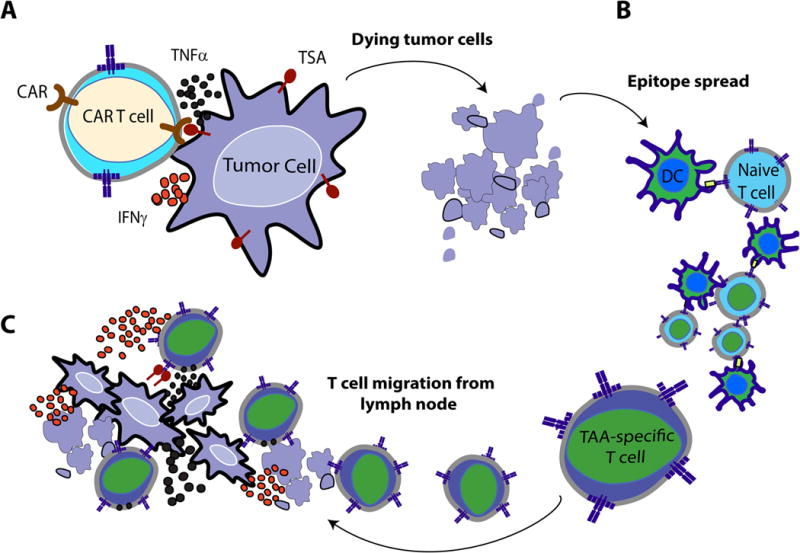
Figure 1
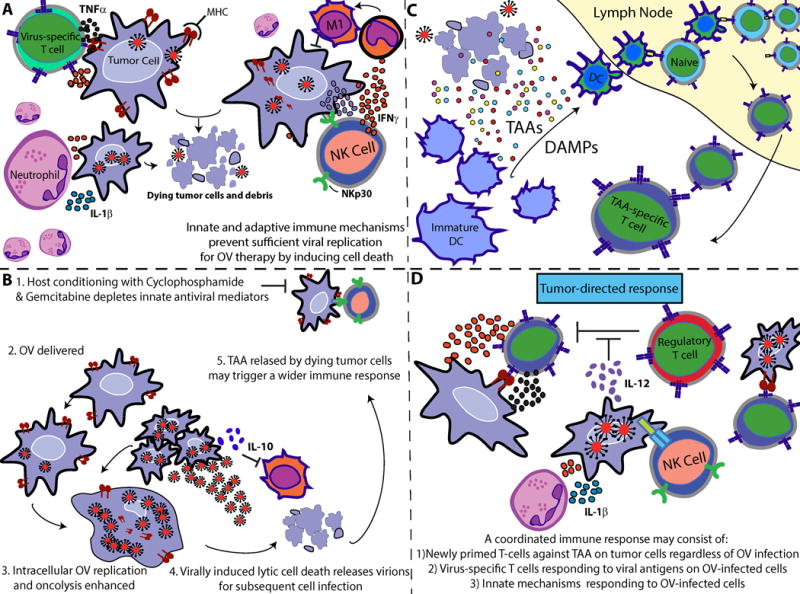
Figure 1
(A) Upon administration of OV therapy, infected tumor cells are recognized and quickly eradicated by antiviral innate mediators, including NK cells, M1 macrophages, neutrophils, and virus-specific T-cells of the cellular compartment. (B) Host-conditioning with cyclophosphamide and gemcitabine chemotherapy can blunt antiviral immune mechanisms to provide a window of sufficient OV replication. OV-infected tumor cells eventually die through lytic mechanisms or by immune-cell recognition during the rebound phase after chemotherapy. Dying tumor cells may lead to an efflux of tumor-associated antigens (TAA) or damage-associated molecular pattern molecules (DAMPs), (C) which can be engulfed by immature dendritic cells (DCs) and later presented to naïve T cells in the local tumor-draining lymph node. Together, these mechanisms may act in concert to promote (D) a coordinated tumor-directed immune response comprising of OV-mediated cell lysis, anti-viral immunity against OV-infected cells, and adaptive immunity responding to TAA. Reproduced with permission from reference.
Figure 2
Figure 2. Proposed mechanism of induced immunological protection
(A) CARs migrate to, engage, and induce cytotoxicity against tumor cells in an antigen-specific manner. Immunogenic debris from dying tumor cells (B) drain or are carried by professional APCs into local lymph nodes, where naïve T-cells become primed against tumor antigens. (C) Newly-primed T cells exit the lymph nodes and migrate to distant tumor sites to engage malignant cells.

References

    1. Ostrom QT, Gittleman H, Liao P, et al. CBTRUS Statistical Report: Primary Brain and Central Nervous System Tumors Diagnosed in the United States in 2007–2011. Neuro-oncology. 2014 Oct;16(Suppl 4):iv1–iv63. - PMC - PubMed
    1. Ostrom QT, Gittleman H, Farah P, et al. CBTRUS statistical report: Primary brain and central nervous system tumors diagnosed in the United States in 2006–2010. Neuro-oncology. 2013 Nov;15(Suppl 2):ii1–56. - PMC - PubMed
    1. DeAngelis LM. Brain tumors. The New England journal of medicine. 2001 Jan 11;344(2):114–23. - PubMed
    1. Rulseh AM, Keller J, Klener J, et al. Long-term survival of patients suffering from glioblastoma multiforme treated with tumor-treating fields. World J Surg Oncol. 2012 Oct 24;10 - PMC - PubMed
    1. McLendon RE, Halperin EC. Is the long-term survival of patients with intracranial glioblastoma multiforme overstated? Cancer. 2003 Oct 15;98(8):1745–48. - PubMed