


Effect of Continuing Care for Cocaine Dependence on HIV Sex-Risk Behaviors
- PMID: 27224980
- PMCID: PMC5123976
- DOI: 10.1007/s10461-016-1434-6
Effect of Continuing Care for Cocaine Dependence on HIV Sex-Risk Behaviors
Abstract
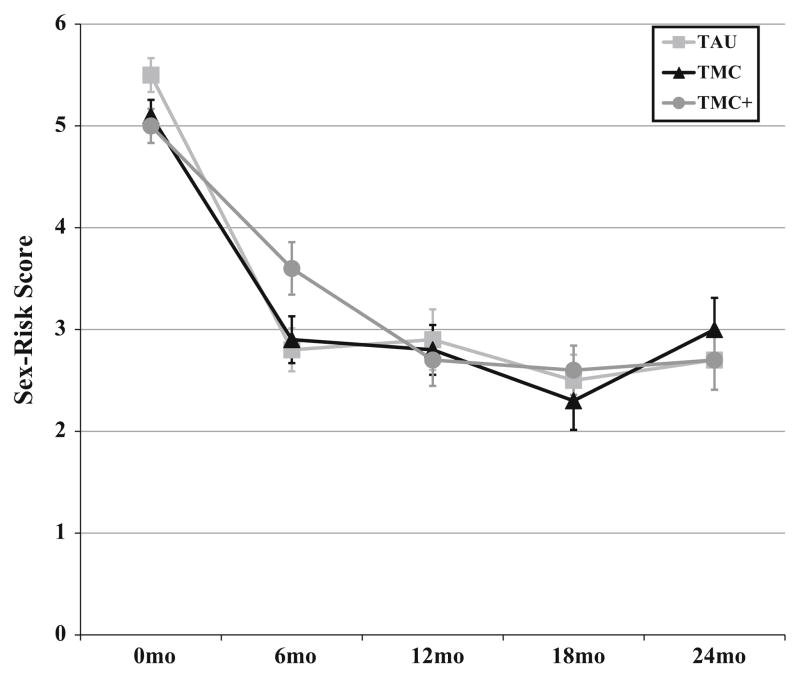
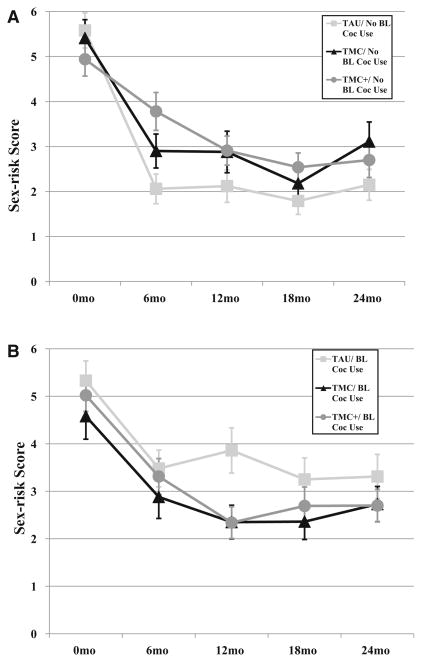
Evaluate the effect of continuing care interventions for cocaine use with HIV risk-reduction components on HIV sex-risk. Explore whether cocaine use at treatment initiation interacts with the type of continuing care intervention to affect HIV sex-risk. Cocaine dependent participants (N = 321) were randomized to: (1) Treatment as usual (TAU): intensive outpatient treatment, (2) TAU and telephone monitoring and counseling (TMC), and (3) TAU and TMC plus incentives for participation in telephone contacts (TMC+). Participants in TMC and TMC+ received a brief HIV intervention, with booster sessions as needed. Generalized estimating equations analysis compared TAU, TMC and TMC+ at 6, 12, 18, 24 months post-baseline on the following outcomes: overall HIV sex-risk, number of sexual partners, condom usage, exchange of drugs for sex, exchange of sex for drugs, exchange of money for sex, exchange of sex for money, and crack house visits. Overall sex-risk decreased for all treatment conditions at follow-up, with no treatment main effects. For people with no cocaine use at baseline, TAU experienced greater sex-risk reductions than TMC (p < .01) and TMC+ (p < .001). The three treatment conditions are effective in reducing HIV sex-risk. TMC with HIV risk-reduction components is unnecessary for cocaine-dependent clients who stop using cocaine early in treatment.
Keywords: Cocaine; Continuing care; HIV; Sex-risk.
Conflict of interest statement
Figures
References
-
- Center for Disease Control and Prevention. New HIV infections in the United States (Internet) 2012:1–6. cited 2015 Apr 30. http://www.cdc.gov/nchhstp/newsroom/docs/2012/hiv-infections-2007-2010.pdf.
-
- Flom PL, Friedman SR, Kottiri BJ, Neaigus A, Curtis R, Des Jarlais DC, et al. Stigmatized drug use, sexual partner concurrency, and other sex risk network and behavior characteristics of 18- to 24-year-old youth in a high-risk neighborhood. Sex Transm Dis. 2001;28(10):598–607. - PubMed
-
- Booth RE, Kwiatkowski CF, Chitwood DD. Sex related HIV risk behaviors: differential risks among injection drug users, crack smokers, and injection drug users who smoke crack. Drug Alcohol Depend. 2000;58(3):219–26. - PubMed
-
- Gossop M, Marsden J, Stewart D, Treacy S. Reduced injection risk and sexual risk behaviours after drug misuse treatment: results from the National Treatment Outcome Research Study. AIDS Care. 2002;14(1):77–93. - PubMed
Publication types
MeSH terms
Grants and funding
LinkOut - more resources
Full Text Sources
Other Literature Sources
Medical
