Review
. 2016 Mar;43(2):96-108.
doi: 10.1159/000445215. Epub 2016 Mar 18.

A Player and Coordinator: The Versatile Roles of Eosinophils in the Immune System

Affiliations
Review

A Player and Coordinator: The Versatile Roles of Eosinophils in the Immune System

Hai Long et al. Transfus Med Hemother. 2016 Mar.

Abstract

Eosinophils have traditionally been associated with allergic diseases and parasite infection. Research advances in the recent decades have brought evolutionary changes in our understanding of eosinophil biology and its roles in immunity. It is currently recognized that eosinophils play multiple roles in both innate and adaptive immunity. As effector cells in innate immunity, eosinophils exert a pro-inflammatory and destructive role in the Th2 immune response associated with allergic inflammation or parasite infection. Eosinophils can also be recruited by danger signals released by pathogen infections or tissue injury, inducing host defense against parasitic, fungal, bacterial or viral infection or promoting tissue repair and remodeling. Eosinophils also serve as nonprofessional antigen-presenting cells in response to allergen challenge or helminth infection, and, meanwhile, are known to function as a versatile coordinator that actively regulates or interacts with various immune cells including T lymphocytes and dendritic cells. More roles of eosinophils implicated in immunity have been proposed including in immune homeostasis, allograft rejection, and anti-tumor immunity. Eosinophil interactions with structural cells are also implicated in the mechanisms in allergic inflammation and in Helicobacter pylori gastritis. These multifaceted roles of eosinophils as both players and coordinators in immune system are discussed in this review.

Keywords: APCs; Antigen-presenting cells; Effector cell functions; Eosinophil; Helicobacter pylori; Immunomodulation; Th2 immune response; Thymic stromal lymphopoietin.


Figures
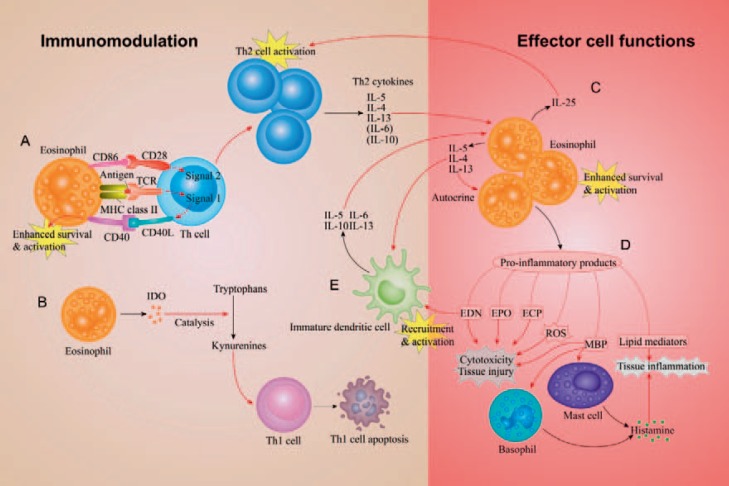
Fig. 1
Fig. 1
An illustration of the mechanisms involved in the immunomodulatory functions and the effector cell functions of eosinophils in Th2 immunity, a common immune response present in allergic inflammation and host defense against parasite infection. A. The eosinophil presents antigens to the Th cell. MHC class II molecules of the eosinophil present antigens to TCR receptors on the Th cell, producing ‘Signal 1’, and the costimulating molecule CD86 binds to CD28 of the Th cell, serving as ‘Signal 2’. These signals promote the Th2 immune response characterized by Th2-cell activation and production of Th2 cytokines, i.e. IL-5, IL-4, and IL-13. Meanwhile, upon activation by the two signals, the Th cell expresses CD40L and binds to CD40 expressed on eosinophils, promoting eosinophil activation. B. Eosinophils express IDO, an enzyme that catalyzes the catabolism of tryptophans to kynurenines, which leads to Th1-cell apoptosis and thus favors the polarization of Th2 immunity. C. The regulatory effects of Th2 cytokines lead to eosinophil differentiation, recruitment, survival and activation. The activated eosinophils, in turn, release cytokines including IL-5, IL-4, IL-13, and IL-25, enhancing their own activity as an autocrine regulation and contributing to the Th2 polarization by regulating Th cells and immature DCs. D. Activated eosinophils release various pro-inflammatory products, including lipid mediators (e.g. leukotrienes), ROS, and granule proteins EDN, EPO, ECP, and MBP, which posing different effects such as cytotoxicity, tissue injury, and tissue inflammation. Of note, MBP can stimulate mast cells and basophils to release histamine, contributing to the tissue inflammation. E. EDN can also serve as an innate immune alarmin that recruits immature DCs and induces their differentiation into a Th2-promoting phenotype.
Fig. 2
Fig. 2
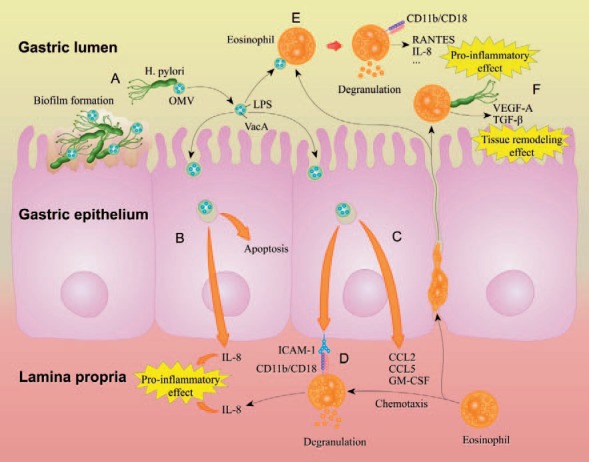
The role of eosinophils and its mechanisms in H. pylori gastritis. A. OMVs continuously shed from the surface of H. pylori in the gastric lumen. OMVs contain LPS and VacA. Part of H. pylori form biofilms on the surface of gastric epithelium. B. Upon the uptake and internalization of H. pylori OMVs, gastric epithelial cells show increased apoptosis and release of IL-8, causing pro-inflammatory effect. C. Internalization of H. pylori OMV causes gastric epithelial cells to actively express ICAM-1 and release chemokines CCL2, CCL5, and GM-CSF that recruit eosinophil migration from the lamina propria to the epithelium. D. Infiltrated eosinophils, expressing the β2 integrin CD11b/CD18, are stimulated by the gastric epithelial cells via binding to ICAM-1, leading to eosinophil degranulation and IL-8 production, which contributes to the inflammatory response. E. Eosinophils can also transmigrate through the epithelium into the gastric lumen, where contact with H. pylori OMVs may stimulate eosinophil expression of CD11b/CD18, release of RANTES and IL-8, and also eosinophil degranulation, participating in the inflammatory response. F. H. pylori can probably induce eosinophils in the gastric lumen to produce VEGF-A and TGF-β, accelerating tissue remodeling and would healing of gastric mucosa.

References

    1. Gleich GJ, Adolphson CR. The eosinophilic leukocyte: structure and function. Adv Immunol. 1986;39:177–253. - PubMed
    1. Furuta GT, Atkins FD, Lee NA, Lee JJ. Changing roles of eosinophils in health and disease. Ann Allergy Asthma Immunol. 2014;113:3–8. - PMC - PubMed
    1. Rosenberg HF, Dyer KD, Foster PS. Eosinophils: changing perspectives in health and disease. Nat Rev Immunol. 2013;13:9–22. - PMC - PubMed
    1. Kita H. Eosinophils: Multifaceted biological properties and roles in health and disease. Immunol Rev. 2011;242:161–177. - PMC - PubMed
    1. Shamri R, Xenakis JJ, Spencer LA. Eosinophils in innate immunity: an evolving story. Cell Tissue Res. 2011;343:57–83. - PMC - PubMed