


Prognostic Model of Death and Distant Metastasis for Nasopharyngeal Carcinoma Patients Receiving 3DCRT/IMRT in Nonendemic Area of China
- PMID: 27227955
- PMCID: PMC4902379
- DOI: 10.1097/MD.0000000000003794
Prognostic Model of Death and Distant Metastasis for Nasopharyngeal Carcinoma Patients Receiving 3DCRT/IMRT in Nonendemic Area of China
Abstract
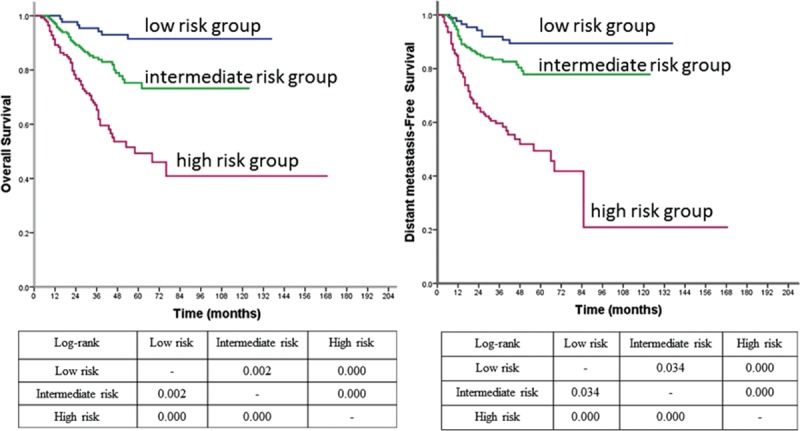
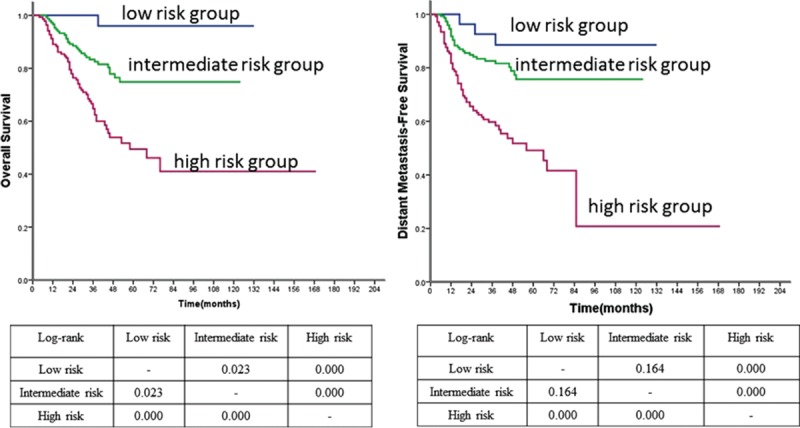
Few studies were conducted to explore the prognostic factors for nonendemic nasopharyngeal carcinoma (NPC) in the era of 3-dimensional conformal radiation therapy (3DCRT)/intensity-modulated radiation therapy (IMRT). The aim of this study was to evaluate the potential prognostic factors for nonendemic NPC.Between January 2004 and December 2011, a total of 393 nonendemic NPC patients receiving 3DCRT/IMRT were reviewed according to the inclusion and exclusion criteria. The prognostic factors we analyzed included age, T stage, N stage, lymph node diameter, primary tumor volume, WHO histology types, and cranial nerve related symptoms. All patients were staged according to the 7th edition of the American Joint Committee on Cancer (AJCC) system. The factors found to be associated with the endpoints by univariate analyses were then entered into multivariate Cox proportional hazards regression analysis.The median follow-up time was 61.4 months (range: 4-130 months). The 5-year local recurrent-free survival (LRFS), nodal relapse-free survival (NRFS), distant metastasis free survival (DMFS), and disease-specific survival (DSS) for all patients were 89.3%, 96.4%, 73.5%, and 74.3%, respectively. Multivariate analysis indicated that N stage (N2-3), WHO pathologic type II, and primary tumor volume (>23 mL) were 3 independent prognostic factors for DSS and DMFS. According to the number of prognostic factors, patients were divided into 3 risk groups: low-risk group (patients without any risk factors); intermediate-risk group (patients with only 1 risk factor); and high-risk group (patients with more than 2 risk factors). The 5-year DSS for low, intermediate, and high-risk groups were 91.5%, 75.2%, and 49.3%, respectively (P < 0.001). The 5-year DMFS for low, intermediate, and high-risk groups were 89.4%, 77.9%, and 49.4%, respectively (P < 0.001).Advanced N stage (N2-3), larger tumor volume (>23 mL), and histological WHO type II are independently prognostic factors for nonendemic NPC patients in China.
Conflict of interest statement
The authors declare that they have no competing interests.
Figures
References
-
- Sun X, Su S, Chen C, et al. Long-term outcomes of intensity-modulated radiotherapy for 868 patients with nasopharyngeal carcinoma: an analysis of survival and treatment toxicities. Radiother Oncol 2014; 110:398–403. - PubMed
-
- Guo R, Sun Y, Yu X-L, et al. Is primary tumor volume still a prognostic factor in intensity modulated radiation therapy for nasopharyngeal carcinoma? Radiother Oncol 2012; 104:294–299. - PubMed
-
- Airoldi M, Gabriele AM, Garzaro M, et al. Induction chemotherapy with cisplatin and epirubicin followed by radiotherapy and concurrent cisplatin in locally advanced nasopharyngeal carcinoma observed in a non-endemic population. Radiother Oncol 2009; 92:105–110. - PubMed
-
- Demirci S, Kamer S, Kara G, et al. Does the prognosis of nasopharyngeal cancer differ among endemic and non-endemic regions? Acta Otolaryngol 2011; 131:852–860. - PubMed
-
- Boscolo-Rizzo P, Tirelli G, Mantovani M, et al. Non-endemic locoregionally advanced nasopharyngeal carcinoma: long-term outcome after induction plus concurrent chemoradiotherapy in everyday clinical practice. Eur Arch Otorhinolaryngol 2015; 272:3491–3498. - PubMed
Publication types
MeSH terms
LinkOut - more resources
Full Text Sources
Other Literature Sources
