


Renal denervation in treatment-resistant essential hypertension. A randomized, SHAM-controlled, double-blinded 24-h blood pressure-based trial
- PMID: 27228432
- PMCID: PMC4933576
- DOI: 10.1097/HJH.0000000000000977
Renal denervation in treatment-resistant essential hypertension. A randomized, SHAM-controlled, double-blinded 24-h blood pressure-based trial
Abstract
Background: Renal denervation (RDN), treating resistant hypertension, has, in open trial design, been shown to lower blood pressure (BP) dramatically, but this was primarily with respect to office BP.
Method: We conducted a SHAM-controlled, double-blind, randomized, single-center trial to establish efficacy data based on 24-h ambulatory BP measurements (ABPM). Inclusion criteria were daytime systolic ABPM at least 145 mmHg following 1 month of stable medication and 2 weeks of compliance registration. All RDN procedures were carried out by an experienced operator using the unipolar Medtronic Flex catheter (Medtronic, Santa Rosa, California, USA).
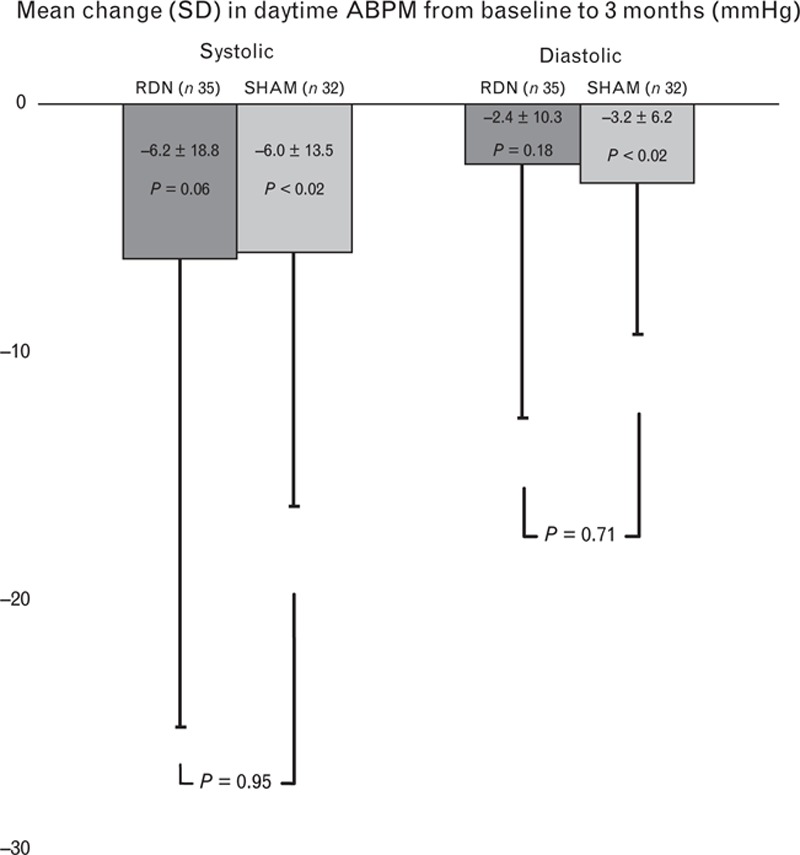
Results: We randomized 69 patients with treatment-resistant hypertension to RDN (n = 36) or SHAM (n = 33). Groups were well balanced at baseline. Mean baseline daytime systolic ABPM was 159 ± 12 mmHg (RDN) and 159 ± 14 mmHg (SHAM). Groups had similar reductions in daytime systolic ABPM compared with baseline at 3 months [-6.2 ± 18.8 mmHg (RDN) vs. -6.0 ± 13.5 mmHg (SHAM)] and at 6 months [-6.1 ± 18.9 mmHg (RDN) vs. -4.3 ± 15.1 mmHg (SHAM)]. Mean usage of antihypertensive medication (daily defined doses) at 3 months was equal [6.8 ± 2.7 (RDN) vs. 7.0 ± 2.5 (SHAM)].RDN performed at a single center and by a high-volume operator reduced ABPM to the same level as SHAM treatment and thus confirms the result of the HTN3 trial.
Conclusion: Further, clinical use of RDN for treatment of resistant hypertension should await positive results from double-blinded, SHAM-controlled trials with multipolar ablation catheters or novel denervation techniques.
Figures
Comment in
-
Renal denervation for resistant hypertension: closing in on potential confounders.J Hypertens. 2016 Aug;34(8):1505-6. doi: 10.1097/HJH.0000000000001016. J Hypertens. 2016. PMID: 27356001 No abstract available.
References
-
- Krum H, Schlaich MP, Sobotka PA, Böhm M, Mahfoud F, Rocha-Singh K, et al. Percutaneous renal denervation in patients with treatment resistant hypertension: final 3-year report of the Symplicity HTN-1 study. Lancet 2014; 383:622–629. - PubMed
-
- Böhm M, Mahfoud F, Ukena C, Hoppe UC, Narkiewicz K, Negoita M, et al. First report of the Global SYMPLICITY Registry on the effect of renal artery denervation in patients with uncontrolled hypertension. Hypertension 2015; 65:766–774. - PubMed
-
- Sarafidis P, Bakris G. Resistant hypertension. An overview of evaluation and treatment. J Am Coll Cardiol 2008; 52:1749–1757. - PubMed
-
- Calhoun DA, Jones D, Textor S, Goff DC, Murphy TP, Toto RD, et al. Resistant hypertension: diagnosis, evaluation, and treatment. A scientific statement from the American Heart Association Professional Education Committee of the Council for High Blood Pressure Research. Hypertension 2008; 117:510–526. - PubMed
Publication types
MeSH terms
Substances
Supplementary concepts
LinkOut - more resources
Full Text Sources
Other Literature Sources
Medical
