. 2016 May 26:17:406.
doi: 10.1186/s12864-016-2741-z.

The essential genome of Streptococcus agalactiae

Affiliations

The essential genome of Streptococcus agalactiae

Thomas A Hooven et al. BMC Genomics. .

Abstract

Background: Next-generation sequencing of transposon-genome junctions from a saturated bacterial mutant library (Tn-seq) is a powerful tool that permits genome-wide determination of the contribution of genes to fitness of the organism under a wide range of experimental conditions. We report development, testing, and results from a Tn-seq system for use in Streptococcus agalactiae (group B Streptococcus; GBS), an important cause of neonatal sepsis.

Methods: Our method uses a Himar1 mini-transposon that inserts at genomic TA dinucleotide sites, delivered to GBS on a temperature-sensitive plasmid that is subsequently cured from the bacterial population. In order to establish the GBS essential genome, we performed Tn-seq on DNA collected from three independent mutant libraries-with at least 135,000 mutants per library-at serial 24 h time points after outgrowth in rich media.

Results: After statistical analysis of transposon insertion density and distribution, we identified 13.5 % of genes as essential and 1.2 % as critical, with high levels of reproducibility. Essential and critical genes are enriched for fundamental cellular housekeeping functions, such as acyl-tRNA biosynthesis, nucleotide metabolism, and glycolysis. We further validated our system by comparing fitness assignments of homologous genes in GBS and a close bacterial relative, Streptococcus pyogenes, which demonstrated 93 % concordance. Finally, we used our fitness assignments to identify signal transduction pathway components predicted to be essential or critical in GBS.

Conclusions: We believe that our baseline fitness assignments will be a valuable tool for GBS researchers and that our system has the potential to reveal key pathogenesis gene networks and potential therapeutic/preventative targets.


Figures
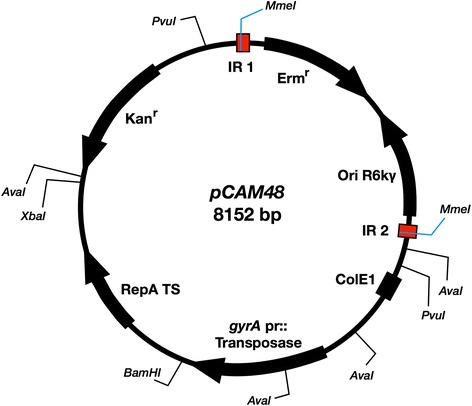
Fig. 1
Fig. 1
pCAM48 map. pCAM48 is a temperature-sensitive shuttle vector for delivery of a Himar1 mini-transposon, flanked by inverted repeat (IR) sequences modified to contain MmeI restriction enzyme sites. An erythromycin resistance marker (Ermr) is included within the transposon, as is the R6kγ origin of replication (Ori R6kγ), which can be used for plasmid rescue (not employed in this study). Outside of the mini-transposon, the vector contains a ColE1 origin of replication, the Gram-positive temperature-sensitive replicase RepA TS, in which the single-bp deletion present in pCAM45 has been repaired, and a kanamycin resistance marker (Kanr). The C9 Himar1 transposase gene is under the control of the S. pyogenes M1 gyrA promoter. Restriction enzyme sites used in development and analysis of pCAM48 are labeled
Fig. 2
Fig. 2
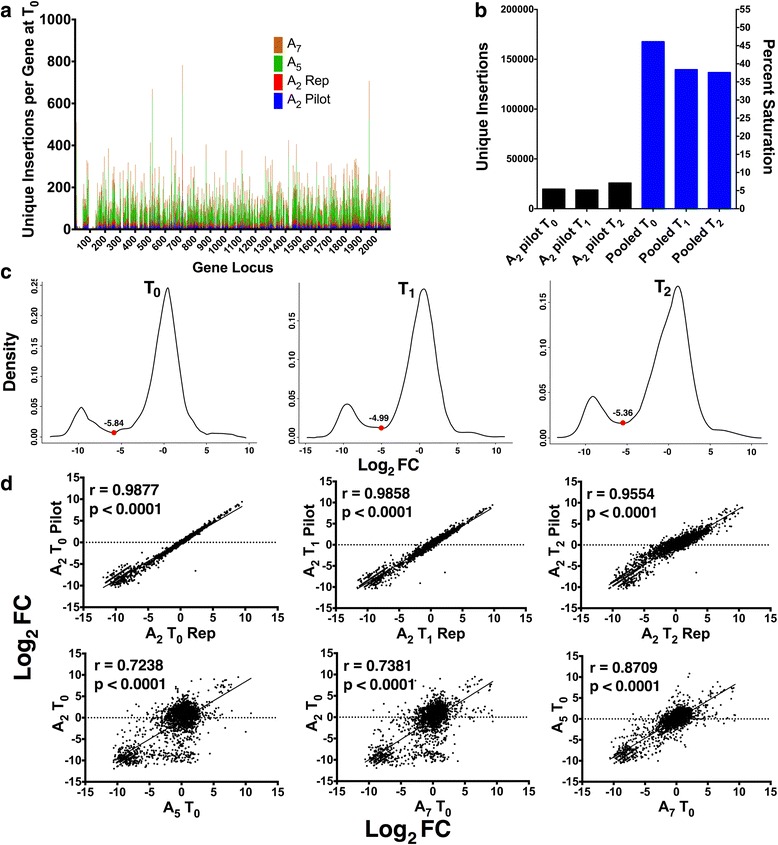
Transposon mutant library metrics. Sequential pooling of data from four T0 sequencing runs (for libraries A2 pilot, A2 repeat, A5, and A7) demonstrates increasing unique insertion counts per gene (a). Library transposon saturation rates (percent of unique TA sites with an insertion) are shown for pilot and pooled datasets (b). ESSENTIALS plots of a kernel density function of log transformed measured vs. expected transposon insertion ratios show the expected bimodal distribution separating essential from nonessential genes using pooled libraries. Local minima values were used as determinants of gene essentiality at each time point (c). Correlation of library A2 log2 FC values for each gene from the pilot and technical replicate experiments for each time point, and between the three pairs of biological triplicate libraries for T0. Pearson r values and two-tailed P values are listed (d)
Fig. 3
Fig. 3
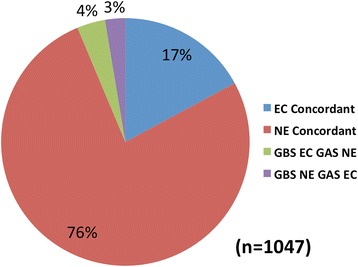
Concordance between GBS and GAS essential genes. Fitness was compared between 1047 orthologous genes of S. pyogenes M1T1 5448 and GBS A909. Orthologs were classified as either essential/critical (EC) concordant, nonessential (NE) concordant, or EC in one species and NE in the other
Fig. 4
Fig. 4
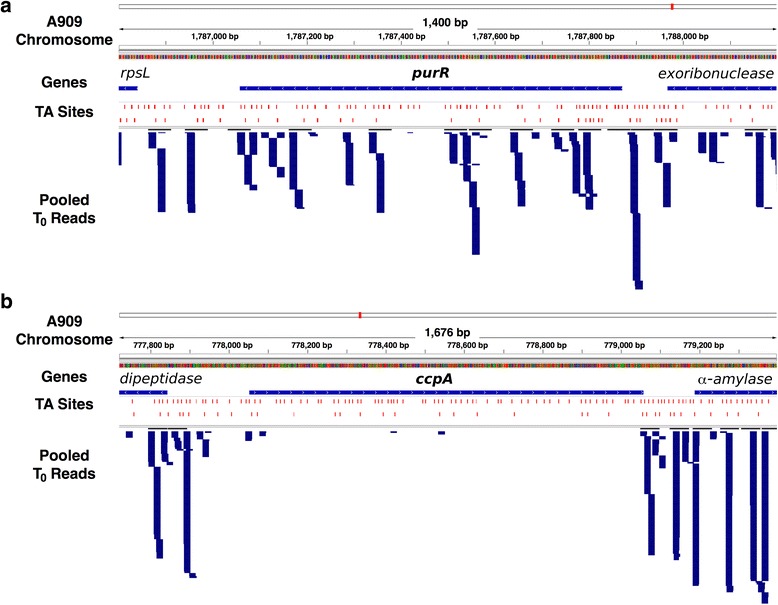
Examples of Tn-seq reads mapped onto essential and non-sessential genes. Pooled T0 reads mapped onto transcriptional regulator genes demonstrating characteristic insertion patterns of nonessential genes, such as purR (a), and essential genes, such as ccpA (b). For each panel, the rows (from top to bottom) denote the visualized site on the A909 chromosome (with nucleotide number labeling), the gene of interest and its flanking neighbors, available TA sites for transposon insertion, and locations of mapped reads
Fig. 5
Fig. 5
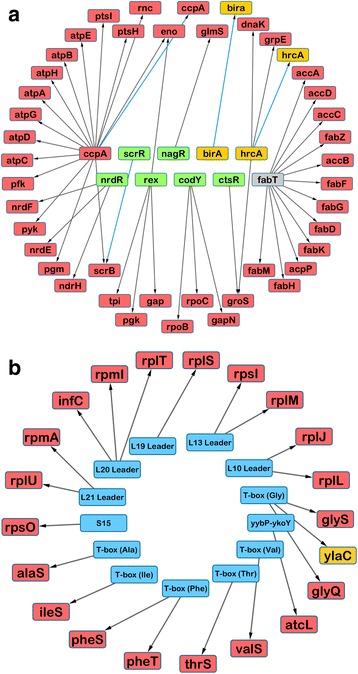
A909 fitness data mapped onto transcription factor- and RNA-based regulons. Essential and critical genes involved in transcription factor- (a) and RNA-based (b) regulons are depicted. The center set consists of regulatory genes or RNA regulators predicted to affect transcription of genes in the outer ring. Individual genes are color-coded (green = nonessential, yellow = critical, red = essential, gray = undefined). Transcription factor autoregulatory signaling is denoted with a blue arrow
Fig. 6
Fig. 6
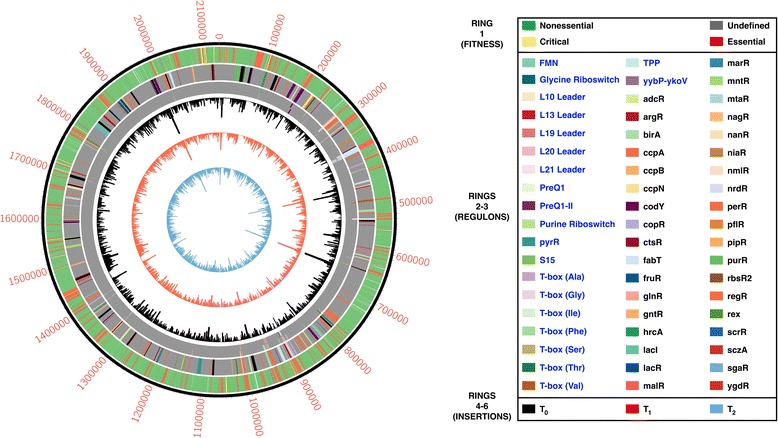
Circos plot of gene fitness, regulons, and library insertion metrics. The outer ring (ring 1) illustrates gene fitness categorizations from consensus data generated by all pooled libraries and time points. The next concentric ring (ring 2) shows all genes that are predicted to participate in an RNA-based (blue text in legend) or transcription factor-based (black text in legend) regulon. Genes that participate in multiple regulons are black. Essential or critical genes that participate in a regulon are tiled in the next ring (ring 3; if an essential or critical gene participates in multiple regulons, the appropriately colored tiles are stacked). The inner three rings (4–6) show unique transposon insertions per gene for each of the three pooled time points

References

    1. Land M, Hauser L, Jun S-R, Nookaew I, Leuze MR, Ahn T-H, Karpinets T, Lund O, Kora G, Wassenaar T, Poudel S, Ussery DW. Insights from 20 years of bacterial genome sequencing. Funct Integr Genomics. 2015;15:141–61. doi: 10.1007/s10142-015-0433-4. - DOI - PMC - PubMed
    1. van Opijnen T, Bodi KL, Camilli A. Tn-seq: high-throughput parallel sequencing for fitness and genetic interaction studies in microorganisms. Nat Methods. 2009;6:767–72. doi: 10.1038/nmeth.1377. - DOI - PMC - PubMed
    1. van Opijnen T, Lazinski DW, Camilli A. Genome-Wide Fitness and Genetic Interactions Determined by Tn-seq, a High-Throughput Massively Parallel Sequencing Method for Microorganisms. Curr Protoc Mol Biol. 2014;106:7.16.1–7.16.24. doi: 10.1002/0471142727.mb0716s106. - DOI - PMC - PubMed
    1. Gibbs RS, Schrag S, Schuchat A. Perinatal infections due to group B streptococci. Obstet Gynecol. 2004;104:1062–76. doi: 10.1097/01.AOG.0000144128.03913.c2. - DOI - PubMed
    1. Campbell JR, Hillier SL, Krohn MA, Ferrieri P, Zaleznik DF, Baker CJ. Group B streptococcal colonization and serotype-specific immunity in pregnant women at delivery. Obstet Gynecol. 2000;96:498–503. - PubMed

Publication types

MeSH terms

Substances