. 2016 May 26;9(1):304.
doi: 10.1186/s13071-016-1577-3.

Spread and establishment of Aedes albopictus in southern Switzerland between 2003 and 2014: an analysis of oviposition data and weather conditions

Affiliations

Spread and establishment of Aedes albopictus in southern Switzerland between 2003 and 2014: an analysis of oviposition data and weather conditions

Eleonora Flacio et al. Parasit Vectors. .

Abstract

Background: The Asian tiger mosquito, Aedes albopictus, is a highly invasive mosquito species of public health importance. In the wake of its arrival in neighbouring Italy the authorities of the canton of Ticino in southern Switzerland initiated a surveillance programme in 2000 that is still on-going. Here we explored the unique data set, compiled from 2003 to 2014, to analyse the local dynamic of introduction and establishment of Ae. albopictus, its relative density in relation to precipitation and temperature, and its potential distribution at the passage from southern to northern Europe.

Methods: The presence of Ae. albopictus was recorded by ovitraps placed across Ticino. In addition to presence-absence, the relationship between relative egg densities and year, month, temperature and precipitation was analysed by a generalised linear mixed model.

Results: Since its first detection in 2003 at Ticino's border with Italy Ae. albopictus has continuously spread north across the lower valleys, mainly along the trans-European motorway, E35. Detailed local analysis showed that industrial areas were colonised by the mosquito before residential areas and that, afterwards, the mosquito was more present in residential than in industrial areas. Ae. albopictus appeared sporadically and then became more present in the same places the following years, suggesting gradual establishment of locally reproducing populations that manage to overwinter. This trend continues as witnessed by both a growing area being infested and increasing egg counts in the ovitraps. There was a clear South-North gradient with more traps being repeatedly positive in the South and fewer eggs laid during periods of intensive precipitation. In the North, the mosquito appeared repeatedly through the years, but never managed to establish, probably because of unfavourable weather conditions and low road traffic.

Conclusions: Given the present results we assume that additional areas may still become infested. While the current study provides good estimates of relative egg densities and shows the local and regional dynamics of Ae. albopictus invasion, additional parameters ought to be measured to make an objective risk assessment for epidemic disease transmission. The likelihood of Ae. albopictus to further spread and increase in densities calls for continued surveillance.


Figures
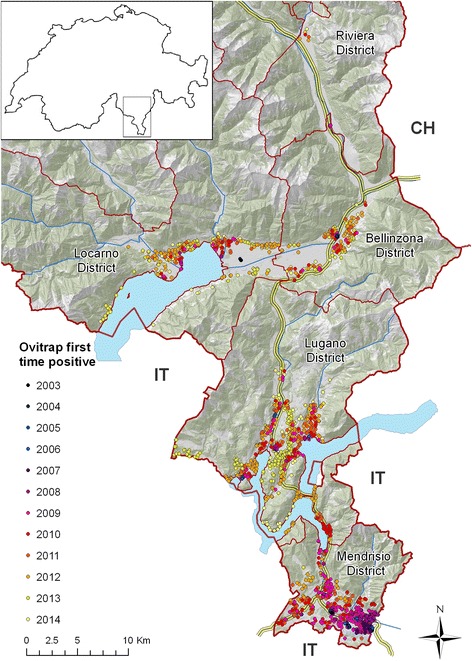
Fig. 1
Fig. 1
Spatial and temporal distribution of Aedes albopictus in the Canton of Ticino since its introduction to Switzerland. Dot colours indicate when the ovitraps were first positive to Ae. albopictus. The yellow lines show the motorways. CH: Switzerland; IT: Italy. Map layers were purchased from the Swiss Federal Office of Topography
Fig. 2
Fig. 2
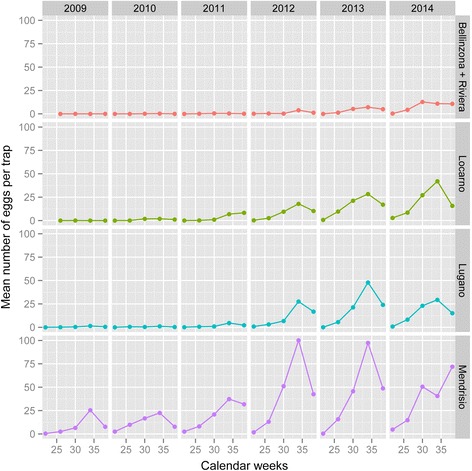
Mean Aedes albopictus egg numbers per trap according to districts between 2009 and 2014. The graphs show the average egg numbers per trap by year and calendar week
Fig. 3
Fig. 3
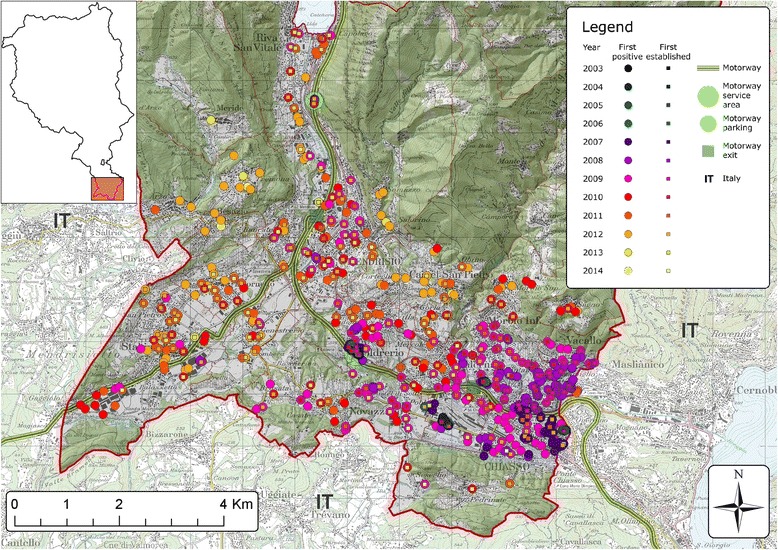
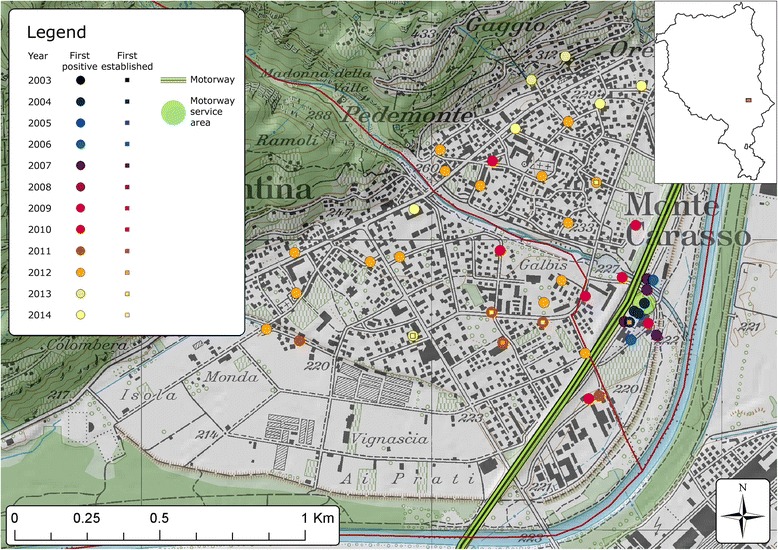
Detailed view of Ae. albopictus first detections and first evidences of establishment on ovitraps in the Mendrisio district from 2003 to 2014. Dots represent an ovitrap and the colour indicates the year when ovitraps were positive for Ae. albopictus the first time. The squares indicate the year in which Ae. albopictus was considered to have established a local population. For this an ovitrap had to be positive for three consecutive 4 week periods. Map layers were purchased from the Swiss Federal Office of Topography
Fig. 4
Fig. 4
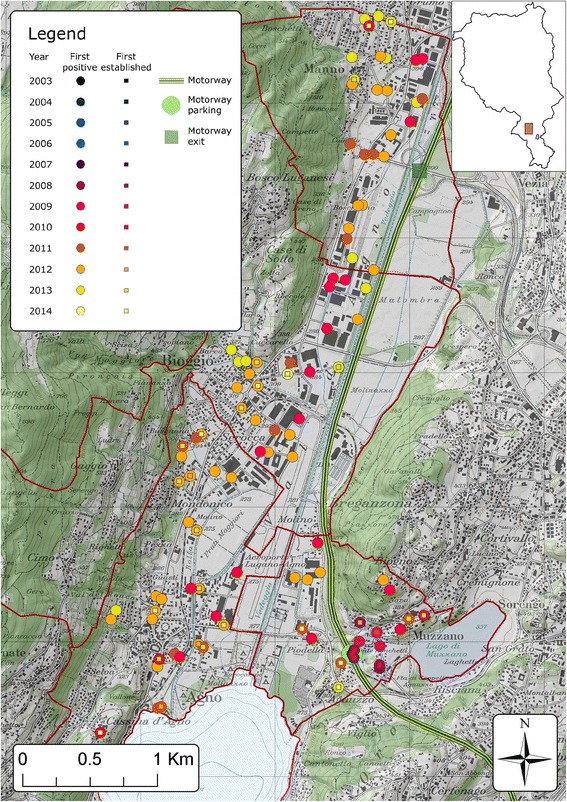
Detailed view of Ae. albopictus first detections and first evidences of establishment on ovitraps in the Lugano district from 2003 to 2014. Dots represent an ovitrap and the colour indicates the year when ovitraps were positive for Ae. albopictus the first time. The squares indicate the year in which Ae. albopictus was considered to have established a local population. For this an ovitrap had to be positive for three consecutive 4 week periods. Map layers were purchased from the Swiss Federal Office of Topography
Fig. 5
Fig. 5
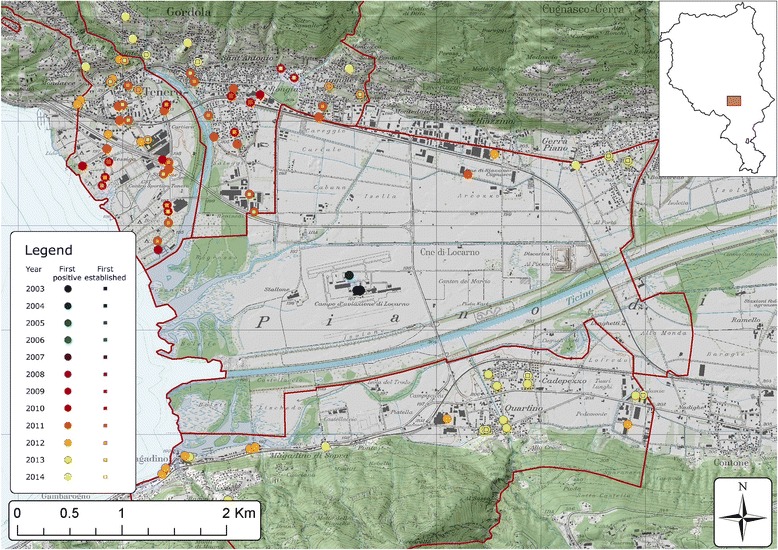
Detailed view of Ae. albopictus first detections and first evidences of establishment on ovitraps in the Locarno district from 2003 to 2014. Dots represent an ovitrap and the colour indicates the year when ovitraps were positive for Ae. albopictus the first time. The squares indicate the year in which Ae. albopictus was considered to have established a local population. For this an ovitrap had to be positive for three consecutive 4 week periods. Map layers were purchased from the Swiss Federal Office of Topography
Fig. 6
Fig. 6
Detailed view of Ae. albopictus first detections and first evidences of establishment on ovitraps in the Bellinzona district from 2003 to 2014. Dots represent an ovitrap and the colour indicates the year when ovitraps were positive for Ae. albopictus the first time. The squares indicate the year in which Ae. albopictus was considered to have established a local population. For this an ovitrap had to be positive for three consecutive 4 week periods. Map layers were purchased from the Swiss Federal Office of Topography
Fig. 7
Fig. 7
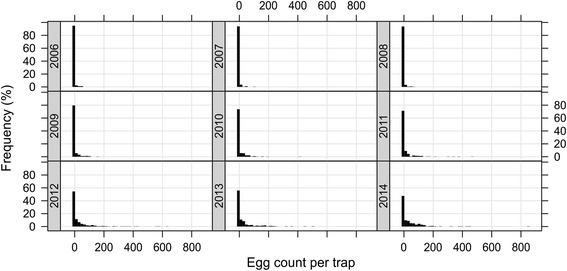
Egg numbers in sentinel sites between 2006 and 2014. The histograms show the percentage frequencies of egg counts in the 46 sentinel traps present throughout 2006 to 2014
Fig. 8
Fig. 8
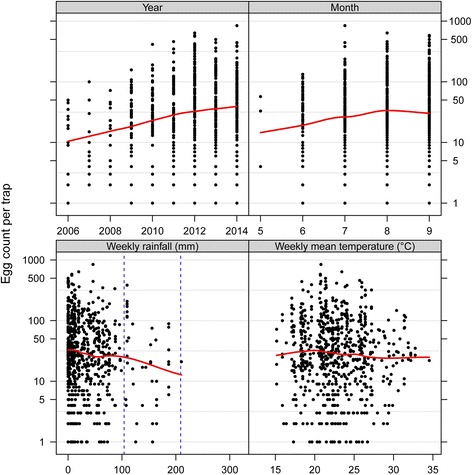
Relationship between egg numbers and covariates in the sentinel traps of the Ticino Aedes albopictus surveillance since 2006. The multi-panel scatterplots show the egg counts on each slat from the 46 sentinel ovitraps as a function of the four covariates; year, month, rain and temperature. Rain was calculated as the cumulative precipitation over the week before collecting the slat and temperature accordingly as the mean temperature during the preceding week. A LOESS smoother (red line) was added to aid visual interpretation. The visual inspection indicates an increase in egg counts over the years and a seasonal maximum in August. The variable “rain” was split into three levels, represented by the vertical blue stippled lines. The levels were “low”, “middle” and “high” with 0–104 mm, over 104 to 209 mm and over 209 to 314 mm, respectively. Note that egg counts are plotted on a logarithmic scale; and hence zero counts are not shown due to points at infinity

References

    1. issg Database: Ecology of Aedes albopictus [Internet]. [cited 2016 Apr 6]. Available from: http://www.issg.org/database/species/ecology.asp?si=109
    1. Medlock JM, Hansford KM, Schaffner F, Versteirt V, Hendrickx G, Zeller H, et al. A review of the invasive mosquitoes in Europe: ecology, public health risks, and control options. Vector-Borne Zoonotic Dis. 2012;12:435–47. doi: 10.1089/vbz.2011.0814. - DOI - PMC - PubMed
    1. Paupy C, Delatte H, Bagny L, Corbel V, Fontenille D. Aedes albopictus, an arbovirus vector: from the darkness to the light. Microbes Infect Inst Pasteur. 2009;11:1177–85. doi: 10.1016/j.micinf.2009.05.005. - DOI - PubMed
    1. Medlock JM, Hansford KM, Versteirt V, Cull B, Kampen H, Fontenille D, et al. An entomological review of invasive mosquitoes in Europe. Bull Entomol Res. 2015;105:637-63. - PubMed
    1. Ayres CFJ. Identification of Zika virus vectors and implications for control. Lancet Infect Dis. 2016;16:278–9. doi: 10.1016/S1473-3099(16)00073-6. - DOI - PubMed

LinkOut - more resources