


Follow-up strategies for women treated for early breast cancer
- PMID: 27230946
- PMCID: PMC7073405
- DOI: 10.1002/14651858.CD001768.pub3
Follow-up strategies for women treated for early breast cancer
Abstract
Background: Follow-up examinations are commonly performed after primary treatment for women with breast cancer. They are used to detect recurrences at an early (asymptomatic) stage. This is an update of a Cochrane review first published in 2000.
Objectives: To assess the effectiveness of different policies of follow-up for distant metastases on mortality, morbidity and quality of life in women treated for stage I, II or III breast cancer.
Search methods: For this 2014 review update, we searched the Cochrane Breast Cancer Group's Specialised Register (4 July 2014), MEDLINE (4 July 2014), Embase (4 July 2014), CENTRAL (2014, Issue 3), the World Health Organization (WHO) International Clinical Trials Registry Platform (4 July 2014) and ClinicalTrials.gov (4 July 2014). References from retrieved articles were also checked.
Selection criteria: All randomised controlled trials (RCTs) assessing the effectiveness of different policies of follow-up after primary treatment were reviewed for inclusion.
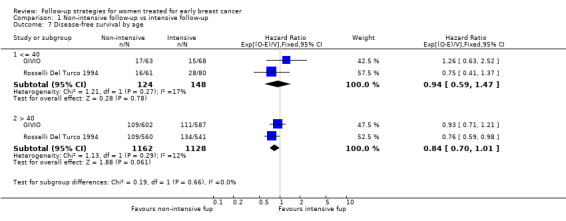
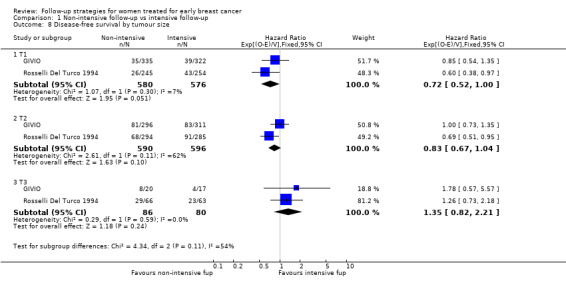
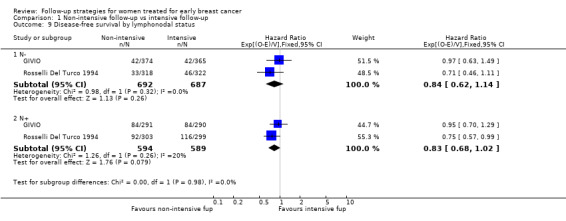
Data collection and analysis: Two review authors independently assessed trials for eligibility for inclusion in the review and risk of bias. Data were pooled in an individual patient data meta-analysis for the two RCTs testing the effectiveness of different follow-up schemes. Subgroup analyses were conducted by age, tumour size and lymph node status.
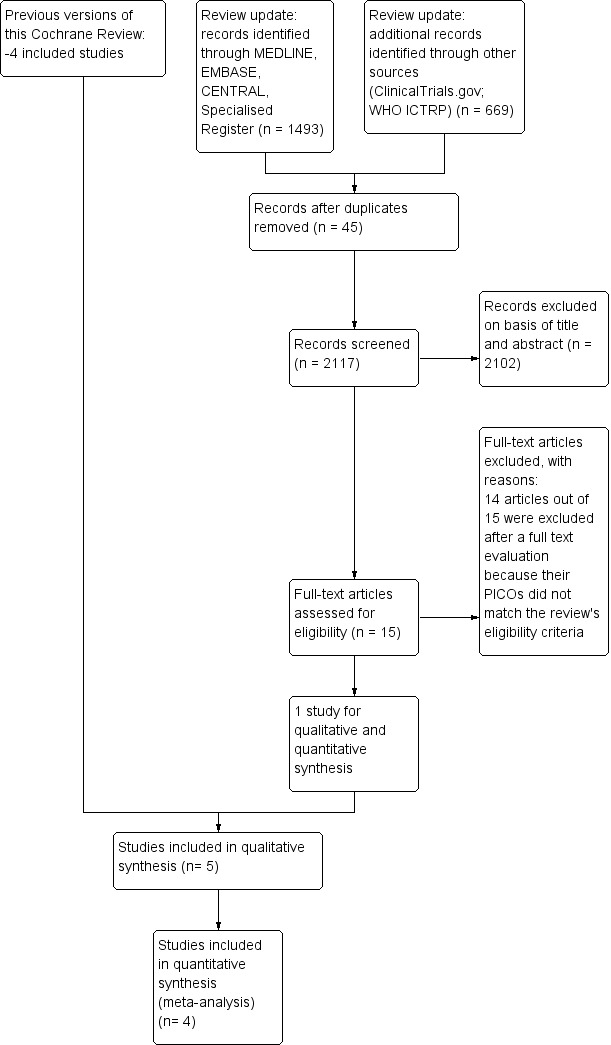
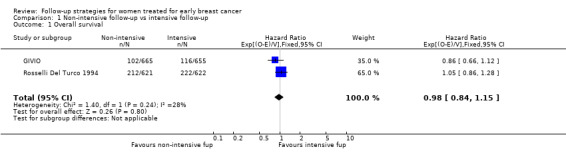
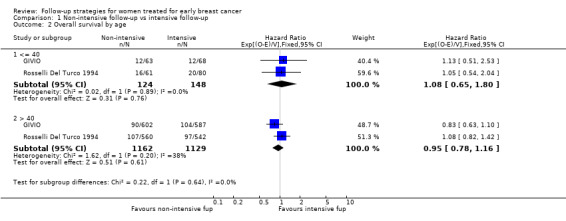
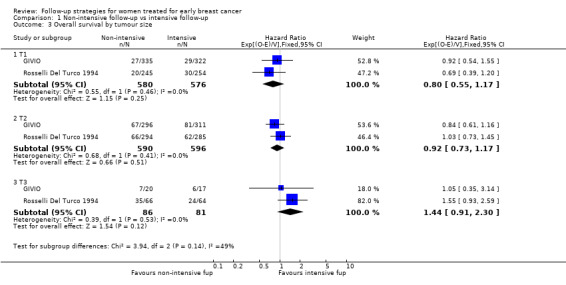
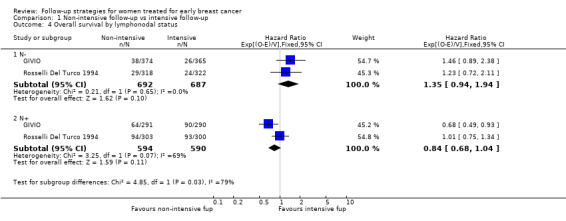
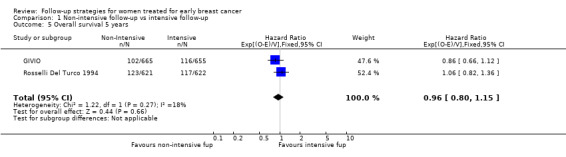
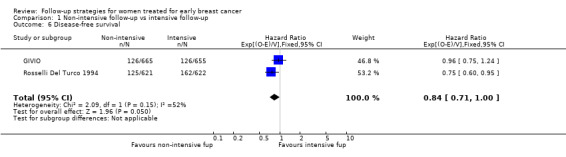
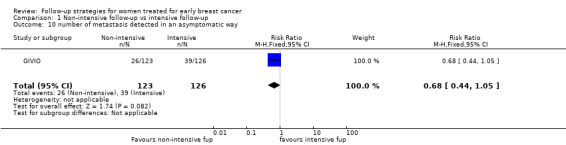
Main results: Since 2000, one new trial has been published; the updated review now includes five RCTs involving 4023 women with breast cancer (clinical stage I, II or III).Two trials involving 2563 women compared follow-up based on clinical visits and mammography with a more intensive scheme including radiological and laboratory tests. After pooling the data, no significant differences in overall survival (hazard ratio (HR) 0.98, 95% confidence interval (CI) 0.84 to 1.15, two studies, 2563 participants, high-quality evidence), or disease-free survival (HR 0.84, 95% CI 0.71 to 1.00, two studies, 2563 participants, low-quality evidence) emerged. No differences in overall survival and disease-free survival emerged in subgroup analyses according to patient age, tumour size and lymph node status before primary treatment. In 1999, 10-year follow-up data became available for one trial of these trials, and no significant differences in overall survival were found. No difference was noted in quality of life measures (one study, 639 participants, high-quality evidence).The new included trial, together with a previously included trial involving 1264 women compared follow-up performed by a hospital-based specialist versus follow-up performed by general practitioners. No significant differences were noted in overall survival (HR 1.07, 95% CI 0.64 to 1.78, one study, 968 participants, moderate-quality evidence), time to detection of recurrence (HR 1.06, 95% CI 0.76 to 1.47, two studies, 1264 participants, moderate-quality evidence), and quality of life (one study, 356 participants, high-quality evidence). Patient satisfaction was greater among patients treated by general practitioners. One RCT involving 196 women compared regularly scheduled follow-up visits versus less frequent visits restricted to the time of mammography. No significant differences emerged in interim use of telephone and frequency of general practitioners's consultations.
Authors' conclusions: This updated review of RCTs conducted almost 20 years ago suggests that follow-up programs based on regular physical examinations and yearly mammography alone are as effective as more intensive approaches based on regular performance of laboratory and instrumental tests in terms of timeliness of recurrence detection, overall survival and quality of life.In two RCTs, follow-up care performed by trained and not trained general practitioners working in an organised practice setting had comparable effectiveness to that delivered by hospital-based specialists in terms of overall survival, recurrence detection, and quality of life.
Conflict of interest statement
Roldano Fossati (RF) and Alessandro Liberati (AL) were members of the Steering Group of the GIVIO study included in this review and wrote several review articles of the effect of follow‐up care. The GIVIO trial (of which RF and AL were authors) was originally partially supported by a educational grant from Astra Zeneca Italia. No specific funding was available for the original conduct and update of this review. Ivan Moschetti, Michela Cinquini, Alessia Levaggi and Laura Coe do not have any conflict of interests.
Figures
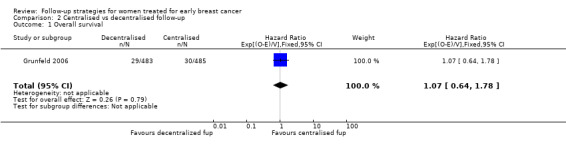
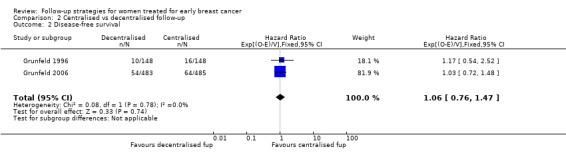
Update of
-
Follow-up strategies for women treated for early breast cancer.Cochrane Database Syst Rev. 2005 Jan 25;(1):CD001768. doi: 10.1002/14651858.CD001768.pub2. Cochrane Database Syst Rev. 2005. Update in: Cochrane Database Syst Rev. 2016 May 27;(5):CD001768. doi: 10.1002/14651858.CD001768.pub3. PMID: 15674884 Updated.
References
References to studies included in this review
GIVIO {published and unpublished data}
-
- The GIVIO Investigators. Impact of follow‐up testing on survival and health‐related quality of life in breast cancer patients. A multicenter randomized controlled trial. JAMA 1994;271(20):1587‐92. - PubMed
Grunfeld 1996 {published data only}
Grunfeld 2006 {published data only}
-
- Grunfeld E, Levine MN, Julian JA, Coyle D, Szechtman B, Mirsky D, et al. Randomized trial of long‐term follow‐up for early‐stage breast cancer: a comparison of family physician versus specialist care. Journal of Clinical Oncology 2006;24(6):848‐55. - PubMed
Gulliford 1997 {published data only}
Rosselli Del Turco 1994 {published and unpublished data}
-
- Palli D, Russo A, Saieva C, Ciatto S, Rosselli Del Turco M, Distante V, et al: for the National Research Council Project on Breast Cancer Follow‐up. Intensive vs clinical follow‐up after treatment of primary breast cancer: 10‐year update of a randomized trial. JAMA 1999;281(17):1586. - PubMed
-
- Rosselli Del Turco M, Palli D, Cariddi A, Ciatto S, Pacini P, Distante V. Intensive diagnostic follow‐up after treatment of primary breast cancer. A randomized trial. National Research Council Project on Breast Cancer follow‐up. JAMA 1994;271(20):1593‐7. - PubMed
Additional references
ASCO 2013
-
- Khatcheressian JL, Hurley P, Bantug E, Esserman LJ, Grunfeld E, Halberg F, et al. Breast cancer follow‐up and management after primary treatment: American Society of Clinical Oncology clinical practice guideline update. Journal of Clinical Oncology 2013;31(7):961–5. - PubMed
Burstein 2000
-
- Burstein HJ, Winer EP. Primary care for survivors of breast cancer. New England Journal of Medicine 2000;343(15):1086‐94. - PubMed
Carlotti 1993
-
- Carlotti A, Siragusa A, Grillo Ruggeri F, Vitali ML, Grimaldi A, Barone D. The mammographic images of the irradiated breast after conservative therapy for carcinoma [Quadri mammografici della mammela irradiata dopo terapia conservativa per carcinoma]. La Radiologia Medica 1993;86:101‐5. - PubMed
Chopra 2014
Clinical trial 2014
-
- Home ‐ ClinicalTrials.gov [Internet]. [cited 2014 Mar 29]. Available from: http://www.clinicaltrials.gov/.
Constantinidou 2011
-
- Constantinidou A, Martin A, Sharma B, Johnston SRD. Positron emission tomography/computed tomography in the management of recurrent/metastatic breast cancer: a large retrospective study from the Royal Marsden Hospital. Annals of Oncology 2011;22(2):307–14. - PubMed
De Lena 1995
-
- Lena M, Ferguson J, Liberati A. Consensus Conference on Follow‐up in Breast Cancer. Selected Papers. Annals of Oncology 1995;6 Suppl 2:1‐70. - PubMed
Duffy 2008
-
- Duffy SW, Nagtegaal ID, Wallims M, Cafferty FH, Houssami N, Warwich J, et al. Correcting for lead time and length bias in estimating the effect of screen detection on cancer survival. American Journal of Epidemiology 2008;168(1):98‐104. - PubMed
ESMO 2013
-
- Senkus E, Kyriakides S, Penault‐Llorca F, Poortmans P, Thompson A, Zackrisson S, et al. Primary breast cancer: ESMO Clinical Practice Guidelines for diagnosis, treatment and follow‐up. Annals of Oncology 2013;Suppl 6:vi7–23. - PubMed
Ferlay 2013
-
- Ferlay J, Steliarova‐Foucher E, Lortet‐Tieulent J, Rosso S, Coebergh JW, Comber H, et al. Cancer incidence and mortality patterns in Europe: estimate for 40 countries in 2012. European Journal of Cancer 2013;49(6):1374‐403. - PubMed
Globocan 2012
-
- International Agency for Research on Cancer, World Health Organization. GLOBOCAN 2012: Estimated Cancer Incidence, Mortality and Prevalence Worldwide in 2012.. Available from: http://globocan.iarc.fr/Default.aspx (accessed 15 May 2015) 2012.
Goldhirsch 2013
-
- Goldhirsch A, Winer EP, Coates AS, Gelber RD, Piccart‐Gebhart M, Thürlimann B, et al. Personalizing the treatment of women with early breast cancer: highlights of the St Gallen International Expert Consensus on the Primary Therapy of Early Breast Cancer 2013. Annals of Oncology 2013;24(9):2206–23. - PMC - PubMed
GRADE 2004
Grandjean 2012
-
- Grandjean I, Kwast AB, Vries H, Klaase J, Schoevers WJ, Siesling S. Evaluation of the adherence to follow‐up care guidelines for women with breast cancer. European Journal of Oncology Nursing 2012;16(3):281‐5. - PubMed
Greco 1998
-
- Greco M, Agresti R, Giovanazzi R. Impact of the diagnostic methods on the therapeutics strategies. The Quarterly Journal of Nuclear Medicine and Molecular Imaging 1998;42:66‐80. - PubMed
Grunfeld 1999
Grunfeld 2010
Hannisdal 1993
-
- Hannisdal E, Gundersen S, Kvaloy S, Lindegaard, Aas M, Finnanger AM, et al. Follow‐up of breast cancer patients stage I‐II: A baseline strategy. European Journal of Cancer 1993;29A(7):992‐7. - PubMed
Harries 1996
Hietanen 1986
-
- Hietanen P. Chest radiography in the follow‐up of breast cancer. Acta Radiologica Oncology 1986;25:15‐8. - PubMed
Higgins 2011
-
- Higgins JPT, Green S (editors). Cochrane Handbook for Systematic Reviews of Interventions Version 5.1.0 [updated March 2011]. The Cochrane Collaboration, 2011. Available from handbook.cochrane.org.
Holli 1998
Hortobagyi 2002
-
- Hortobagyi GN. Can we cure limited metastatic breast cancer?. Journal of Clinical Oncology 2002;20(3):620‐3. - PubMed
Jatoi 2011
Kennecke 2010
-
- Kennecke H, Yerushalmi R, Woods R, Cheang MCU, Voduc D, Speers CH, et al. Metastatic behavior of breast cancer subtypes. Journal of Clinical Oncology 2010;28(20):3271‐7. - PubMed
Kobayashi 2012
-
- Kobayashi T, Ichiba T, Sakuyama T, Arakawa Y, Nagasaki E, Aiba K, et al. Possible clinical cure of metastatic breast cancer: lessons from our 30‐year experience with oligometastatic breast cancer patients and literature review. Breast Cancer 2012;19(3):218–37. - PubMed
Logarer 1990
-
- Logarer VB, Vestergaard A, Herrstedt J, Thomsen HS, Zedeler K, Dombernowsky. The limited value of routine chest X‐ray in the follow‐up of stage II breast cancer. European Journal of Cancer 1990;26(5):553‐5. - PubMed
Loprinzi 1994
-
- Loprinzi CL. It is now the age to define the appropriate follow‐up of primary breast cancer patients [editorial]. Journal of Clinical Oncology 1994;12(5):881‐3. - PubMed
Lucci 2012
-
- Lucci A, Hall CS, Lodhi AK, Bhattacharyya A, Anderson AE, Xiao L, et al. Circulating tumour cells in non‐metastatic breast cancer: a prospective study. Lancet Oncology 2012;13(7):688–95. - PubMed
Mahoney 1986
-
- Mahoney L. Methods for detecting locally recurrent and controlateral second primary breast cancer. Canadian Journal of Surgery 1986;29(5):372‐3. - PubMed
Margenthaler 2012
Metzger‐Filho 2013
-
- Metzger‐Filho O, Sun Z, Viale G, Price KN, Crivellari D, Snyder RD, et al. Patterns of Recurrence and outcome according to breast cancer subtypes in lymph node‐negative disease: results from international breast cancer study group trials VIII and IX. Journal of Clinical Oncology 2013;31(25):3083–90. - PMC - PubMed
NCCN 2014
-
- NCCN Clinical Practice Guidelines in Oncology (NCCN Guidelines®) Breast Cancer ‐ breast.pdf [Internet]. [cited 2014 Mar 29]. Available from: http://www.nccn.org/professionals/physician_gls/pdf/breast.pdf.
Pandya 1983
-
- Pandya KJ, McFadden ET, Kalish LA, Carbone PP. Frequency and patterns of early disease recurrence and method of detection in operable breast cancer with pathologically positive axillary lymph nodes on Eastern Cooperative Oncology Group Adjuvant studies: A preliminary report. Cancer Treatment Symposium 1983;2:117‐22.
Puglisi 2014
-
- Puglisi F, Fontanella C, Numico G, Sini V, Evangelista L, Monetti F, et al. Follow‐up of patients with early breast cancer: is it time to rewrite the story?. Critical Reviews in Oncology/Hematology 2014;91(2):130‐41. - PubMed
RevMan [Computer program]
-
- The Nordic Cochrane Centre, The Cochrane Collaboration. Review Manager (RevMan). Version 5.3. Copenhagen: The Nordic Cochrane Centre, The Cochrane Collaboration, 2014.
Rutgers 1989
-
- Rutgers EJ, Slooten EA, Kluck HM. Follow‐up after treatment of primary breast cancer. British Journal of Surgery 1989;76:187‐90. - PubMed
SEER database 2014
-
- National Cancer Institute. Surveillance, Epidemiology, and End Results Program. SEER Stat Fact Sheets: Female Breast Cancer. Available from: http://seer.cancer.gov (accessed 15 May 2015) 2014.
Stark 1996
-
- Stark ME, Crowe JP Jr. Breast cancer evaluation and follow‐up: a survey of The Ohio Chapter of The American College of Surgeons. American Surgeon 1996 Jun;62(6):458‐60. - PubMed
Tomiak 1998
-
- Tomiak EM, Diverty B, Verma S, Evans WK, Petit C, Will P, et al. Follow‐up practices for patients with early stage breast cancer: a survey of Canadian oncologists. Cancer Prevention & Control 1998;2(2):63‐71. - PubMed
Vestergaard 1989
-
- Vestergaard A, Herrstedt J, Thomsen HS, Dombernowsky P, Zedeler K. The value of yearly chest x‐ray in patients with stage I breast cancer. European Journal of Cancer and Clinical Oncology 1989;25(4):687‐9. - PubMed
WHO 2014
-
- WHO | Welcome to the WHO ICTRP [Internet]. [cited 2014 Mar 29]. Available from: http://www.who.int/ictrp/en/.
Wickerhan 1986
-
- Wickerham L, Fisher B, Cronin W and Members of the NSABP Committee for treatment failure Criteria. The efficacy of bone scanning in the follow‐up of patients with operable breast cancer. Breast Cancer Research and Treatment 1984;4:303‐7. - PubMed
References to other published versions of this review
Rojas 2000
Publication types
MeSH terms
LinkOut - more resources
Full Text Sources
Other Literature Sources
Medical
