Diabetes in pregnancy and infant adiposity: systematic review and meta-analysis
- PMID: 27231266
- PMCID: PMC5256410
- DOI: 10.1136/archdischild-2015-309750
Diabetes in pregnancy and infant adiposity: systematic review and meta-analysis
Abstract
Objective: Maternal glycaemia and anthropometry-derived newborn adiposity are strongly correlated. The children of mothers with diabetes are at greater risk of adverse metabolic health, and increased adiposity is a plausible mediator. We undertook a systematic review and meta-analysis to compare adiposity in infants of diabetic mothers (IDM) and infants of mothers without diabetes (NIDM).
Design: We identified observational studies reporting adiposity in IDM and NIDM. We searched references, traced forward citations and contacted authors for additional data. We considered all body composition techniques and compared fat mass, fat-free mass, body fat % and skinfold thickness. We used random effects meta-analyses and performed subgroup analyses by maternal diabetes type (type 1, type 2 and gestational) and infant sex. We examined the influence of pre-pregnancy body mass index (BMI) and conducted sensitivity analyses.
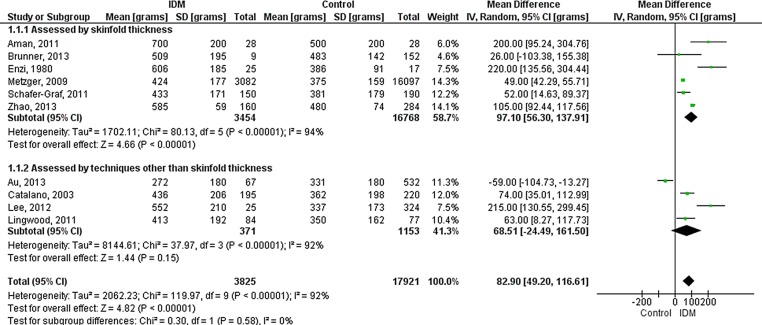
Results: We included data from 35 papers and over 24 000 infants. IDM have greater fat mass than NIDM (mean difference (95% CI)): 83 g (49 to 117). Fat mass is greater in infants of mothers with gestational diabetes: 62 g (29 to 94) and type 1 diabetes: 268 g (139 to 397). Insufficient studies reported data for type 2 diabetes separately. Compared with NIDM, fat mass was greater in IDM boys: 87 g (30 to 145), but not significantly different in IDM girls: 42 g (-33 to 116). There was no attenuation after adjustment for maternal BMI.
Conclusions: IDM have significantly greater adiposity in comparison with NIDM. These findings are justification for studies to determine whether measures to reduce infant adiposity will improve later health.
Keywords: Endocrinology; Neonatology; Obesity; Outcomes research.
Published by the BMJ Publishing Group Limited. For permission to use (where not already granted under a licence) please go to http://www.bmj.com/company/products-services/rights-and-licensing/.
Conflict of interest statement
KML and NM declare financial support for the submitted work from an Action Medical Research Fellowship; CG, MJH and SS have received funding from the National Institute of Health Research and NM has held research grants awarded by the National Institute of Health Research, Wellcome Trust, Action Medical Research, Child Growth Foundation, Department of Health, Westminster Medical School Research Trust, Healthcare Quality Improvement Partnership, HCA International and Bliss. CG's contribution to this study was supported by an Academy of Medical Sciences Starter Grant for Clinical Lecturers (supported by the Medical Research Council, Wellcome Trust, British Heart Foundation, Arthritis Research UK, Prostate Cancer UK and The Royal College of Physicians) and through a MRC Clinician Scientist Fellowship.
Figures

References
-
- NICE. NICE guideline 63: diabetes in pregnancy. Management of diabetes and its complications in pregnancy from the preconception to the postnatal period. http://www.nice.org.uk/guidance/CG63 (accessed 30 Jun 2014 2009).
Publication types
MeSH terms
Grants and funding
LinkOut - more resources
Full Text Sources
Other Literature Sources
Medical