. 2016 May 10;3(4):e240.
doi: 10.1212/NXI.0000000000000240. eCollection 2016 Aug.

Immunologic profiles of multiple sclerosis treatments reveal shared early B cell alterations

Affiliations

Immunologic profiles of multiple sclerosis treatments reveal shared early B cell alterations

James Dooley et al. Neurol Neuroimmunol Neuroinflamm. .

Abstract

Objective: We undertook a systems immunology approach of the adaptive immune system in multiple sclerosis (MS), overcoming tradeoffs between scale and level of detail, in order to identify the immunologic signature of MS and the changes wrought by current immunomodulatory treatments.

Methods: We developed a comprehensive flow cytometry platform measuring 38 immunologic cell types in the peripheral blood of 245 individuals in a routine clinical setting. These include patients with MS, untreated or receiving any of 4 current immunomodulatory treatments (interferon-β, glatiramer acetate, natalizumab, or fingolimod), patients with autoimmune thyroid disease, and healthy controls.

Results: An increase in memory CD8(+) T cells and B cells was observed in untreated patients with MS. Interferon-β and fingolimod induce significant changes upon multiple aspects of the peripheral immune system, with an unexpectedly prominent alteration of B cells. Overall, both treatments push the immune system in different directions, with only 2 significant effects shared across these treatments-an increase in transitional B cells and a decrease in class-switched B cells. We further identified heightened B cell-activating factor (BAFF) levels as regulating this shared B cell pathway.

Conclusions: A systems immunology approach established different immunologic profiles induced by current immunomodulatory MS treatments, offering perspectives for personalized medicine. Pathways shared between the immunologic architecture of existing efficacious treatments identify targets for future treatment design.


Figures
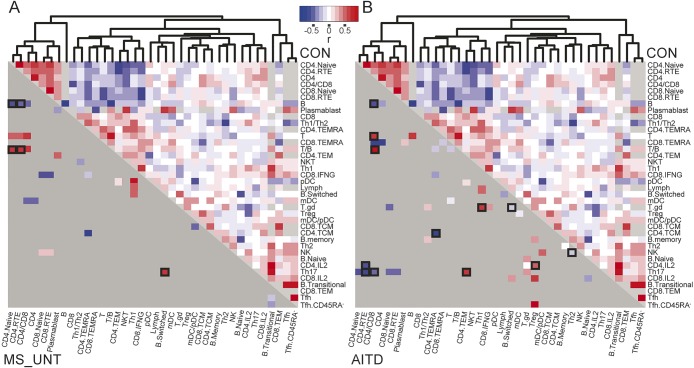
Figure 1
Figure 1. The human adaptive immune profile in multiple sclerosis (MS)
In A and B, the right upper half, above the diagonal, indicates coregulation between pairs of cell types in healthy controls (n = 36) (red: positive correlation coefficient, blue: negative correlation coefficient, light gray: no data available). Unbiased clustering of coefficients was performed to group coregulated cell types. Upon clustering, a main distinct naive cluster was observed, consisting of coregulated CD4+ T cells, CD4+/CD8+ ratio, and naive T cells, together with recent thymic emigrants (RTE) of both CD4+ and CD8+ lineages. This naive cluster was negatively correlated with activated and antigen-experienced lymphocyte subsets. Several microclusters were additionally observed, with coregulation of regulatory T cells (Tregs) with central memory CD4+ and CD8+ T cells (the antigen-experienced microcluster), coregulation of Th1 cells and interferon-γ-producing CD8+ cells (the Th1 microcluster), coregulation of Th2 and memory B cells (the Th2 microcluster), and so forth, revealing the emergence of known immunologic interactions through this systems immunology approach. In the lower left half, below the diagonal, dark gray indicates coregulation between pairs of cell types in (A) patients with untreated MS (MS_UNT, n = 56) and (B) patients with autoimmune thyroid disease (AITD, n = 55) that does not differ significantly from healthy controls. Coregulation between pairs of cell types that is significantly altered by disease (p < 0.05, and boxed if p < 0.01) in (A) untreated patients with MS vs controls and (B) patients with AITD vs controls is colored (red: positive correlation coefficient, blue: negative correlation coefficient, light gray: no data available).
Figure 2
Figure 2. Distinct changes to immunoprofile in autoimmune thyroid disease (AITD) and multiple sclerosis (MS)
A linear regression with covariates age, sex, and disease duration was applied to the immune profiling results of patients with AITD and untreated patients with MS vs healthy controls, and—within patients—untreated MS vs AITD. Significant differences in the peripheral immune system of untreated patients with MS compared to controls were restricted to (A) effector memory CD8+ cells and (B) memory B cells. Significant differences compared to controls observed for patients with AITD but not patients with MS include altered proportions of (C) recent thymic emigrant CD4+, (D) Th17, (E) transitional B cells, and (F) class-switched B cells. Median with boxes indicate 25th and 75th percentile and whiskers indicate 1.5 × interquartile range.
Figure 3
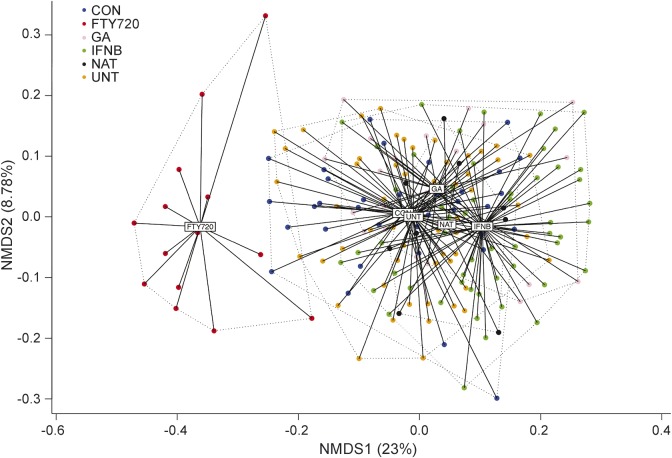
Figure 3. Multiple sclerosis (MS) immunomodulatory treatments interferon-β (IFNB) and fingolimod (FTY720) result in global perturbation of the immune system
Patients with MS being treated with one of 4 immunomodulatory treatments (GA = glatiramer acetate; NAT = natalizumab) were plotted together with controls (CON) and untreated (UNT) patients with MS using nonparametric multidimensional scaling over 38 immunologic variables. Individual patients and distance from the average of each condition are shown. Variation explained by each axis is indicated in the parentheses. Pairwise distance of samples was calculated based on Bray-Curtis dissimilarity index.
Figure 4
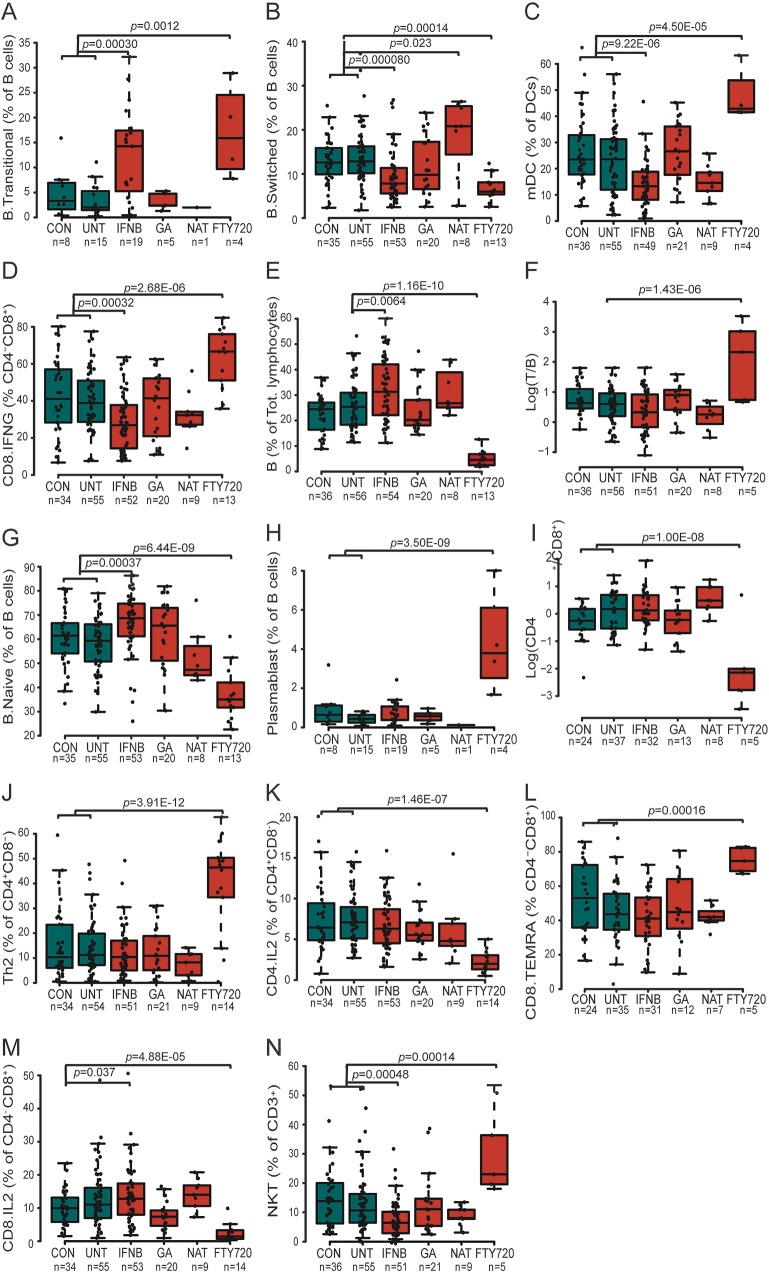
Figure 4. Shared and unique immune changes induced by multiple sclerosis (MS) immunomodulatory treatments
The effect of 4 immunomodulatory treatments (interferon-β [IFNB], glatiramer acetate [GA], natalizumab [NAT], fingolimod [FTY720]) was compared with combined controls (CON) and untreated (UNT) patients with MS, after establishing no significant difference between the latter 2 groups (except for panels E and F). A linear regression with covariates age and sex was applied. Significant differences (after multiple testing correction) in the peripheral immune system of patients with MS following treatment compared to controls and untreated patients with MS included altered proportions of (A) transitional B cells, (B) switched B cells, (C) myeloid dendritic cells (mDC), (D) interferon-γ-producing CD8+ T cells, (E) B cells, (F) T cell/B cell ratio, (G) naive B cells, (H) plasmablasts, (I) CD4+/CD8+ T cell ratio, (J) Th2 cells, (K) interleukin-2 (IL-2)–producing CD4+ T cells, (L) CD8+ terminally differentiated effector memory T cells (TEMRA), (M) IL-2-secreting CD8+ T cells, and (N) natural killer T cell (NKT) cells. Median with boxes indicating 25th and 75th percentile and whiskers indicating 1.5 × interquartile range.
Figure 5
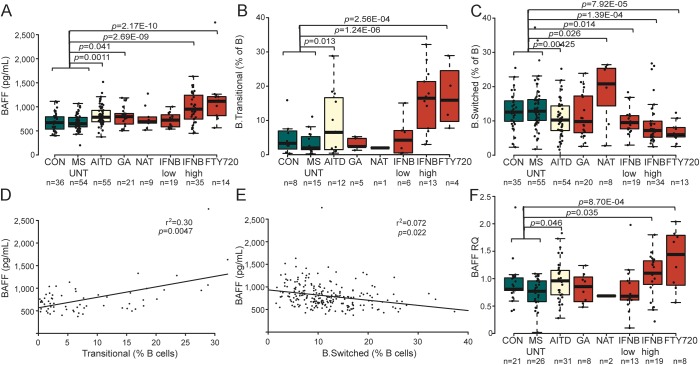
Figure 5. Increased B cell-activating factor (BAFF) levels are shared between immunomodulatory treatments
(A) Plasma BAFF levels, (B) transitional B cells, (C) switched B cells, and (F) total peripheral blood mononuclear cells (PBMC) BAFF gene expression levels (RQ = relative quantity compared to housekeeping gene, with addition of n = 13 additional controls not part of the immunophenotyping cohort) were quantified in controls (CON), patients with autoimmune thyroid disease (AITD), and patients with multiple sclerosis (MS) either untreated (MS_UNT) or treated with 4 immunomodulatory treatments (interferon [IFN]–β low and IFN-β high = IFN-β low or high dose; GA = glatiramer acetate; NAT = natalizumab; FTY720 = fingolimod). Median with boxes indicating 25th and 75th percentile and whiskers indicating 1.5 × interquartile range. A linear regression with covariates age and sex was applied. Correlation between plasma BAFF levels and (D) transitional B cells and (E) switched B cells in the entire cohort after accounting for disease/treatment group, age, and sex.

References

    1. The International Multiple Sclerosis Genetics Consortium. Analysis of immune-related loci identifies 48 new susceptibility variants for multiple sclerosis. Nat Genet 2013;45:1353–1360. - PMC - PubMed
    1. The International Multiple Sclerosis Genetics Consortium and The Wellcome Trust Case Control Consortium 2. Genetic risk and a primary role for cell-mediated immune mechanisms in multiple sclerosis. Nature 2011;476:214–219. - PMC - PubMed
    1. Roep BO, Buckner J, Sawcer S, Toes R, Zipp F. The problems and promises of research into human immunology and autoimmune disease. Nat Med 2012;18:48–53. - PubMed
    1. Linker RA, Kieseier BC, Gold R. Identification and development of new therapeutics for multiple sclerosis. Trends Pharmacol Sci 2008;29:558–565. - PubMed
    1. Hauser SL, Chan JR, Oksenberg JR. Multiple sclerosis: prospects and promise. Ann Neurol 2013;74:317–327. - PubMed