


Alarmins and Their Receptors as Modulators and Indicators of Alloimmune Responses
- PMID: 27232285
- PMCID: PMC5124552
- DOI: 10.1111/ajt.13887
Alarmins and Their Receptors as Modulators and Indicators of Alloimmune Responses
Abstract
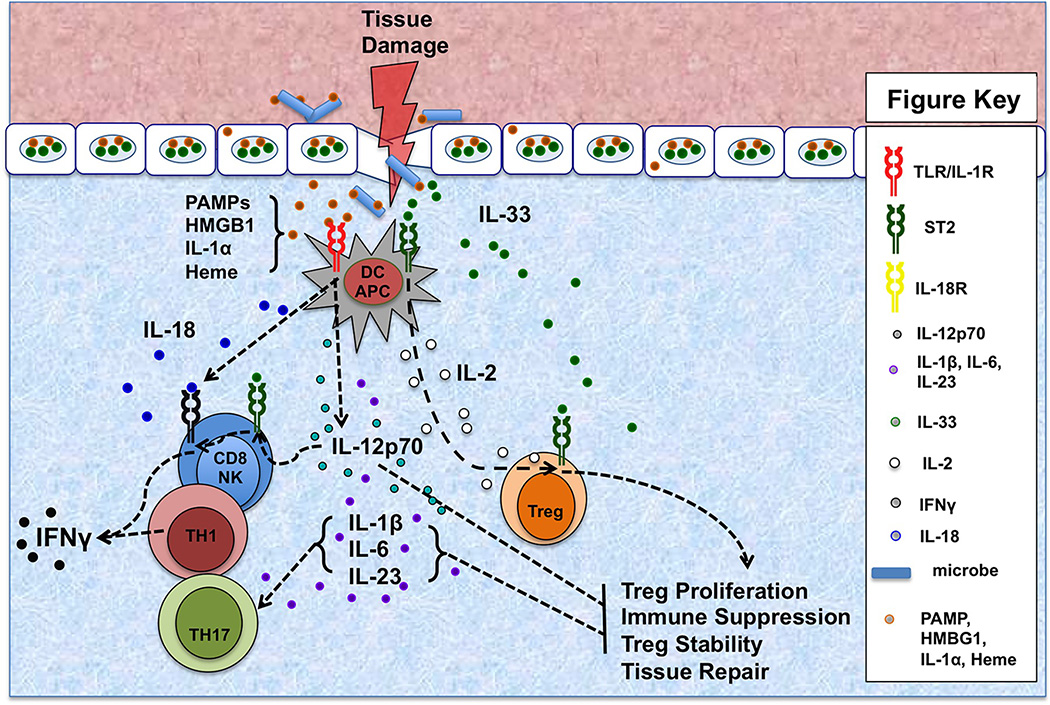
Cell damage and death releases alarmins, self-derived immunomodulatory molecules that recruit and activate the immune system. Unfortunately, numerous processes critical to the transplantation of allogeneic materials result in the destruction of donor and recipient cells and may trigger alarmin release. Alarmins, often described as damage-associated molecular patterns, together with exogenous pathogen-associated molecular patterns, are potent orchestrators of immune responses; however, the precise role that alarmins play in alloimmune responses remains relatively undefined. We examined evolving concepts regarding how alarmins affect solid organ and allogeneic hematopoietic cell transplantation outcomes and the mechanisms by which self molecules are released. We describe how, once released, alarmins may act alone or in conjunction with nonself materials to contribute to cytokine networks controlling alloimmune responses and their intensity. It is becoming recognized that this class of molecules has pleotropic functions, and certain alarmins can promote both inflammatory and regulatory responses in transplant models. Emerging evidence indicates that alarmins and their receptors may be promising transplantation biomarkers. Developing the therapeutic ability to support alarmin regulatory mechanisms and the predictive value of alarmin pathway biomarkers for early intervention may provide opportunities to benefit graft recipients.
Keywords: basic (laboratory) research/science; biomarker; bone marrow/hematopoietic stem cell transplantation; cytokines/cytokine receptors; graft-versus-host disease (GVHD); heart transplantation/cardiology; immunobiology; innate immunity; translational research/science.
© Copyright 2016 The American Society of Transplantation and the American Society of Transplant Surgeons.
Conflict of interest statement
The authors of this manuscript have no conflicts of interest to disclose as described by the American Journal of Transplantation.
Figures
References
-
- Kawai T, Akira S. The role of pattern-recognition receptors in innate immunity: update on Toll-like receptors. Nature immunology. 2010;11(5):373–384. - PubMed
-
- MacLeod H, Wetzler LM. T cell activation by TLRs: a role for TLRs in the adaptive immune response. Science's STKE : signal transduction knowledge environment. 2007;2007(402):e48. - PubMed
-
- Bianchi ME. DAMPs, PAMPs and alarmins: all we need to know about danger. J Leukoc Biol. 2007;81(1):1–5. - PubMed
-
- Lotze MT, Zeh HJ, Rubartelli A, Sparvero LJ, Amoscato AA, Washburn NR, et al. The grateful dead: damage-associated molecular pattern molecules and reduction/oxidation regulate immunity. Immunological reviews. 2007;220:60–81. - PubMed
Publication types
MeSH terms
Substances
Grants and funding
LinkOut - more resources
Full Text Sources
Other Literature Sources
