Clinical Trial
. 2016 Sep 1;128(9):1282-9.
doi: 10.1182/blood-2015-11-683102. Epub 2016 May 27.

Novel mutations in RASGRP2, which encodes CalDAG-GEFI, abrogate Rap1 activation, causing platelet dysfunction

Affiliations
Clinical Trial

Novel mutations in RASGRP2, which encodes CalDAG-GEFI, abrogate Rap1 activation, causing platelet dysfunction

María Luisa Lozano et al. Blood. .

Abstract

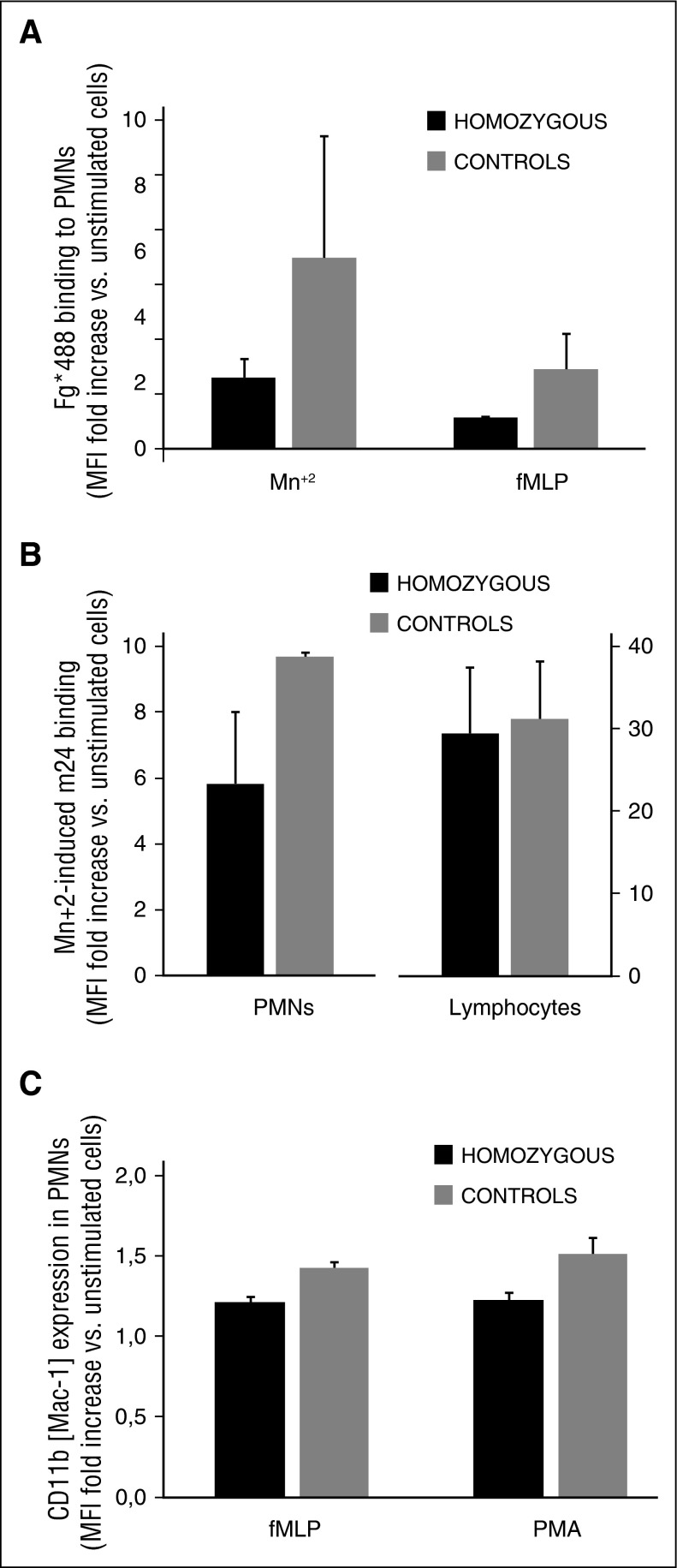
In addition to mutations in ITG2B or ITGB3 genes that cause defective αIIbβ3 expression and/or function in Glanzmann's thrombasthenia patients, platelet dysfunction can be a result of genetic variability in proteins that mediate inside-out activation of αIIbβ3 The RASGRP2 gene is strongly expressed in platelets and neutrophils, where its encoded protein CalDAG-GEFI facilitates the activation of Rap1 and subsequent activation of integrins. We used next-generation sequencing (NGS) and whole-exome sequencing (WES) to identify 2 novel function-disrupting mutations in RASGRP2 that account for bleeding diathesis and platelet dysfunction in 2 unrelated families. By using a panel of 71 genes, we identified a homozygous change (c.1142C>T) in exon 10 of RASGRP2 in a 9-year-old child of Chinese origin (family 1). This variant led to a p.Ser381Phe substitution in the CDC25 catalytic domain of CalDAG-GEFI. In 2 Spanish siblings from family 2, WES identified a nonsense homozygous variation (c.337C>T) (p.Arg113X) in exon 5 of RASGRP2 CalDAG-GEFI expression was markedly reduced in platelets from all patients, and by using a novel in vitro assay, we found that the nucleotide exchange activity was dramatically reduced in CalDAG-GEFI p.Ser381Phe. Platelets from homozygous patients exhibited agonist-specific defects in αIIbβ3 integrin activation and aggregation. In contrast, α- and δ-granule secretion, platelet spreading, and clot retraction were not markedly affected. Integrin activation in the patients' neutrophils was also impaired. These patients are the first cases of a CalDAG-GEFI deficiency due to homozygous RASGRP2 mutations that are linked to defects in both leukocyte and platelet integrin activation.


Figures

Figure 1
Figure 1
Platelet aggregation and integrin activation is markedly impaired in index cases with lifelong bleeding diathesis from 2 unrelated families. (A) Platelet aggregation in response to the indicated platelet agonists was evaluated in unadjusted PRP from index cases (P) and a healthy and unrelated control (C). (B) Platelets from index cases and healthy and unrelated controls (controls) (combined data from 3 participants) were stimulated under static conditions (30 minutes at room temperature) with agonist (5 and 25 μM ADP [ADP-5 and ADP-25], 25 μM PAR1p, 250 μM PAR4p, 2 and 10 μg/mL collagen-related peptide [CRP-2 and CRP-10], 2 μg/mL convulxin [Cvx], and 100 nM PMA) in the presence of fibrinogen-Alexa 488. The samples were evaluated by flow cytometry and the median fluorescence intensity (MFI) for fibrinogen-A488 binding is shown.
Figure 2
Figure 2
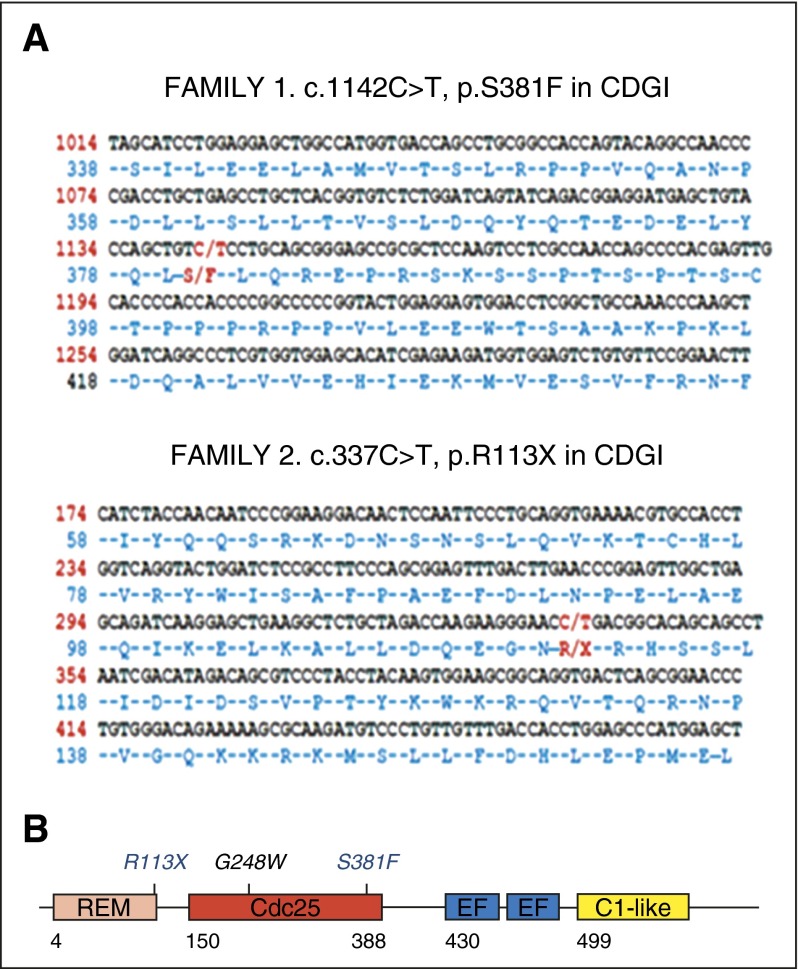
Localization of the novel c.1142C>T (p.S381F) and c.337C>T (p.R113X) mutations within the RASGRP2 sequence and the encoded protein CalDAG-GEFI. DNA from index cases was analyzed by NGS or WES, and novel mutations in RASGRP2 were identified. (A) Localization of the novel c.1142C>T (p.S381F; family 1) and c.337C>T (p.R113X; family 2) mutations within the RASGRP2 sequence. (B) Schematic representation for CalDAG-GEFI showing the different domains: Ras exchange motif (REM), catalytic domain (Cdc25), calcium-binding EF hands (EF), and C1-like domain (unknown function). The positions of the recently reported G248W mutation and the novel p.R113X and p.S381F mutations within the REM and Cdc25 domains are shown. CDGI, CalDAG-GEFI.
Figure 3
Figure 3
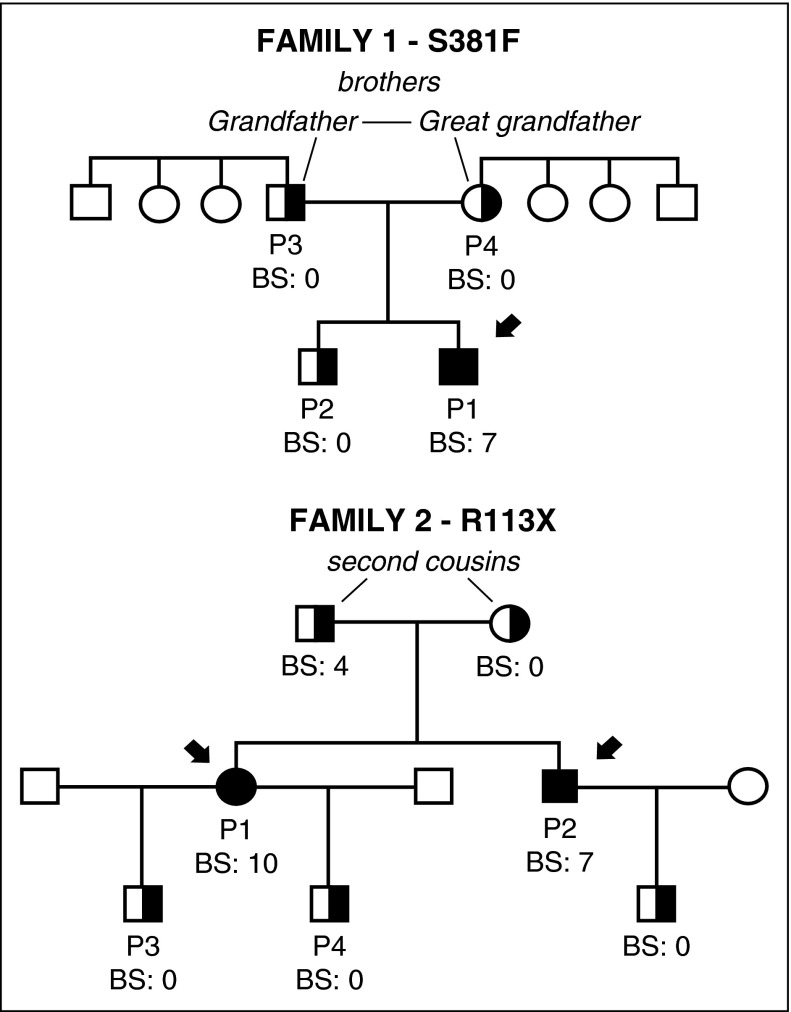
Family pedigrees and bleeding scores in 2 unrelated families carrying novel mutations S381F and R113X in CalDAG-GEFI. The index cases in each family are indicated with black arrows. Bleeding in patients and available family members was evaluated and a bleeding score was assigned by using the International Society on Thrombosis and Haemostasis Bleeding Assessment tool. Filled and partially filled black symbols indicate homozygosis and heterozygosis for the corresponding mutation in RASGRP2. Other family members (white symbols) were not available for study.
Figure 4
Figure 4
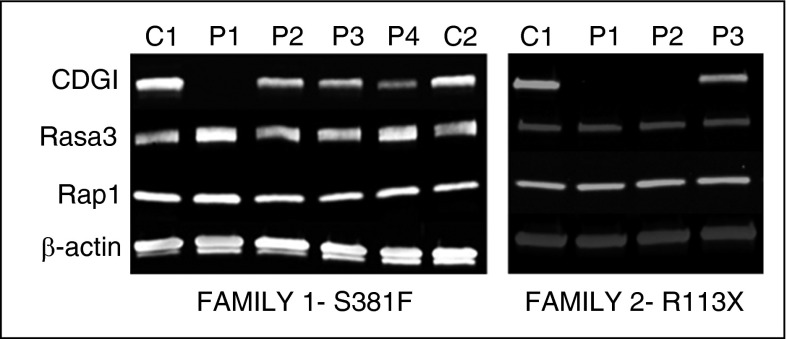
Novel mutations R113X and S381F severely affect the expression of CalDAG-GEFI. Immunoblot analysis for CalDAG-GEFI (CDGI), Rasa3, Rap1, and β-actin in platelet lysates from carriers of the indicated mutations in CalDAG-GEFI. Left: p.S381F (P1 homozygous; P2, P3, P4 heterozygous); Right: p.R113X mutation (P1 and P2 homozygous; P3 heterozygous). Protein expression in lysates from healthy and unrelated controls (C) analyzed in parallel is also shown.
Figure 5
Figure 5
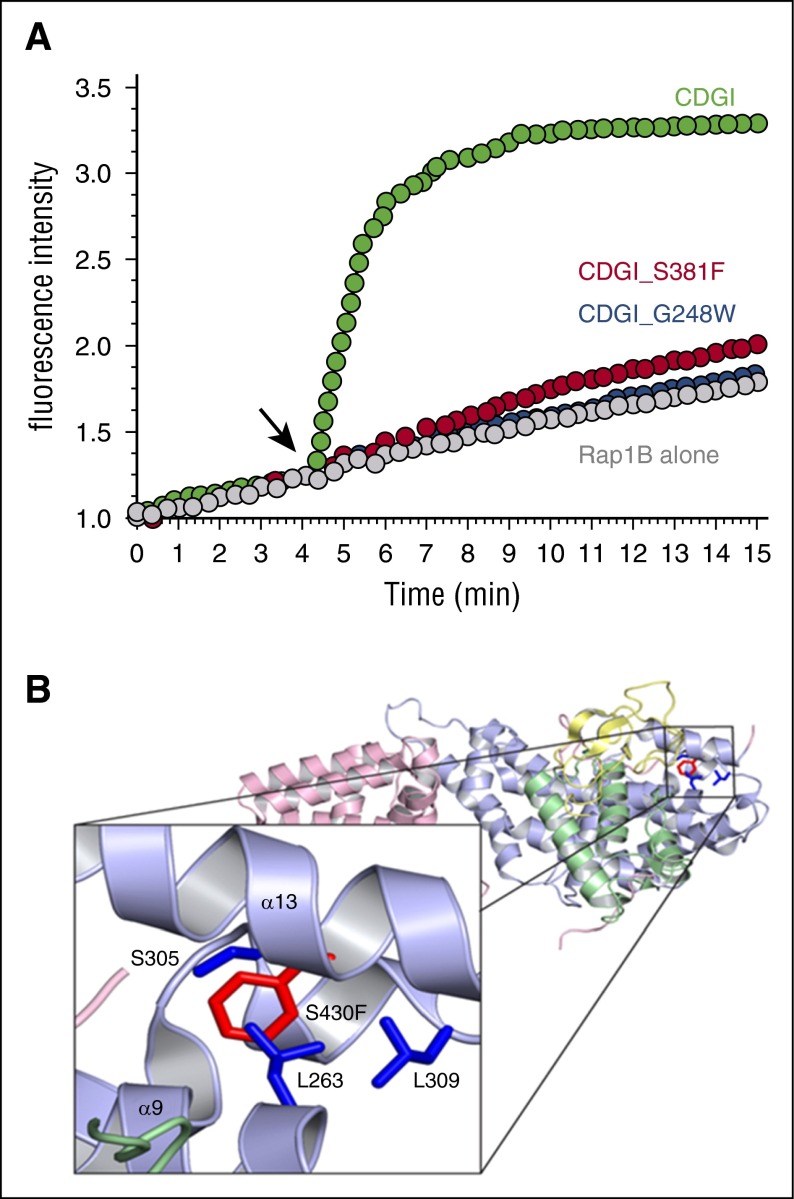
The S381F substitution alters CalDAG-GEFI structure and markedly impairs its nucleotide exchange activity. (A) Bodipy fluorescence-based assay to monitor nucleotide exchange on purified Rap1B. Black arrow indicates where wild-type (green) or S381F (red) or G248W (blue) CalDAG-GEFI was added. The increase in fluorescence intensity, a measure of nucleotide exchange, over time is shown. (B) A structural model of the S381F substitution using the mutagenesis feature in pymol. This model was built on the basis of the crystal structure of CalDAG-GEFII and represents phenylalanine substituted for serine at position 430, the homologous position of serine 381 of CalDAG-GEFI. On the basis of this model, there are 3 residues that clash with the phenylalanine substitution at S430: leucine 263, serine 305, and leucine 309.
Figure 6
Figure 6
Impaired integrin activation in leukocytes from homozygous carriers of the CalDAG-GEFI S381F and R113X mutations. (A,B) β2 integrin activation. Neutrophils were kept resting or were stimulated with the indicated agonists in the presence of (A) Alexa Fluor 488-fibrinogen or (B) m24 antibody to determine the activation state of αMβ2 and αLβ2, respectively. C) Granule secretion. Neutrophils were kept resting or were stimulated with N-formylmethionyl-leucyl-phenylalanine (fMLP; 1 mM) or PMA (100 nM) in the presence of a phycoerythrin-labeled antibody to CD11b (Mac-1). Results are expressed as the mean fold increase, plus standard error, in median fluorescence intensity from data obtained in the 3 homozygous patients (black bars) and 3 healthy controls (gray bars).

Comment in

  • Inherited CalDAG-GEFI deficiency.
    Cattaneo M. Cattaneo M. Blood. 2016 Sep 1;128(9):1165-7. doi: 10.1182/blood-2016-07-719906. Blood. 2016. PMID: 27587867 No abstract available.

References

    1. Bolton-Maggs PH, Chalmers EA, Collins PW, et al. UKHCDO. A review of inherited platelet disorders with guidelines for their management on behalf of the UKHCDO. Br J Haematol. 2006;135(5):603–633. - PubMed
    1. Nurden AT, Nurden P. Congenital platelet disorders and understanding of platelet function. Br J Haematol. 2014;165(2):165–178. - PubMed
    1. Sánchez-Guiu I, Antón AI, Padilla J, et al. Functional and molecular characterization of inherited platelet disorders in the Iberian Peninsula: results from a collaborative study. Orphanet J Rare Dis. 2014;9:213. - PMC - PubMed
    1. Nurden AT, Pillois X, Fiore M, et al. Expanding the Mutation Spectrum Affecting αIIbβ3 Integrin in Glanzmann Thrombasthenia: Screening of the ITGA2B and ITGB3 Genes in a Large International Cohort. Hum Mutat. 2015;36(5):548–561. - PubMed
    1. Canault M, Ghalloussi D, Grosdidier C, et al. Human CalDAG-GEFI gene (RASGRP2) mutation affects platelet function and causes severe bleeding. J Exp Med. 2014;211(7):1349–1362. - PMC - PubMed

Publication types

MeSH terms

Substances