


Mechanisms of Change in the ARC Organizational Strategy: Increasing Mental Health Clinicians' EBP Adoption Through Improved Organizational Culture and Capacity
- PMID: 27236457
- PMCID: PMC5125909
- DOI: 10.1007/s10488-016-0742-5
Mechanisms of Change in the ARC Organizational Strategy: Increasing Mental Health Clinicians' EBP Adoption Through Improved Organizational Culture and Capacity
Abstract
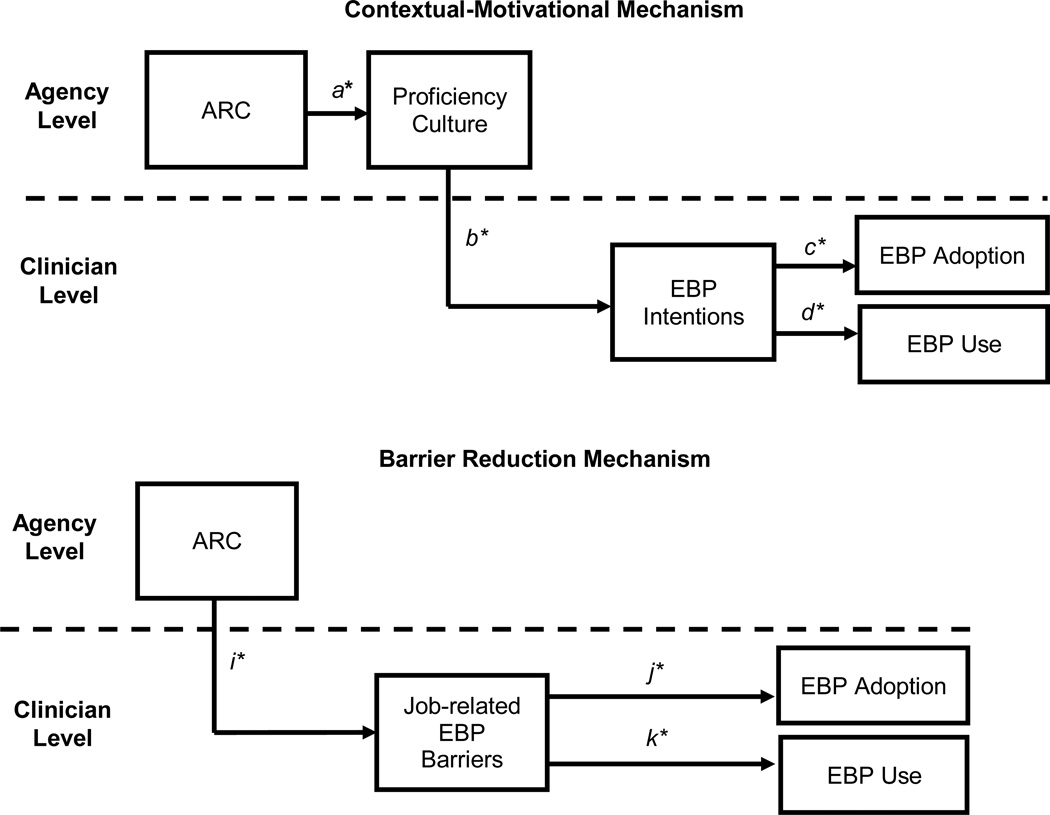
The development of efficient and scalable implementation strategies in mental health is restricted by poor understanding of the change mechanisms that increase clinicians' evidence-based practice (EBP) adoption. This study tests the cross-level change mechanisms that link an empirically-supported organizational strategy for supporting implementation (labeled ARC for Availability, Responsiveness, and Continuity) to mental health clinicians' EBP adoption and use. Four hundred seventy-five mental health clinicians in 14 children's mental health agencies were randomly assigned to the ARC intervention or a control condition. Measures of organizational culture, clinicians' intentions to adopt EBPs, and job-related EBP barriers were collected before, during, and upon completion of the three-year ARC intervention. EBP adoption and use were assessed at 12-month follow-up. Multilevel mediation analyses tested changes in organizational culture, clinicians' intentions to adopt EBPs, and job-related EBP barriers as linking mechanisms explaining the effects of ARC on clinicians' EBP adoption and use. ARC increased clinicians' EBP adoption (OR = 3.19, p = .003) and use (81 vs. 56 %, d = .79, p = .003) at 12-month follow-up. These effects were mediated by improvement in organizational proficiency culture leading to increased clinician intentions to adopt EBPs and by reduced job-related EBP barriers. A combined mediation analysis indicated the organizational culture-EBP intentions mechanism was the primary carrier of ARC's effects on clinicians' EBP adoption and use. ARC increases clinicians' EBP adoption and use by creating proficient organizational cultures that increase clinicians' intentions to adopt EBPs.
Keywords: ARC; Evidence-based practice; Intervention; Mechanism; Mediation; Mental health; Organizational implementation strategy; Organizational culture.
Conflict of interest statement
Nathaniel Williams declares that he has no conflict of interest. Charles Glisson declares that he has no conflict of interest. Anthony Hemmelgarn declares that he has no conflict of interest. Philip Green declares that he has no conflict of interest.
Figures
References
-
- Aarons GA, Glisson C, Green PD, Hoagwood K, Kelleher KJ, Landsverk JA The Research Network on Youth Mental Health. The organizational social context of mental health services and clinician attitudes toward evidence-based practice: A United States national study. Implementation Science. 2012;7(56) - PMC - PubMed
-
- Ajzen I. The theory of planned behavior. Organizational Behavior and Human Decision Processes. 1991;50:179–211.
Publication types
MeSH terms
Grants and funding
LinkOut - more resources
Full Text Sources
Other Literature Sources
