


Facilitators and Barriers of Drop-In Center Use Among Homeless Youth
- PMID: 27238839
- PMCID: PMC4958549
- DOI: 10.1016/j.jadohealth.2016.03.035
Facilitators and Barriers of Drop-In Center Use Among Homeless Youth
Abstract
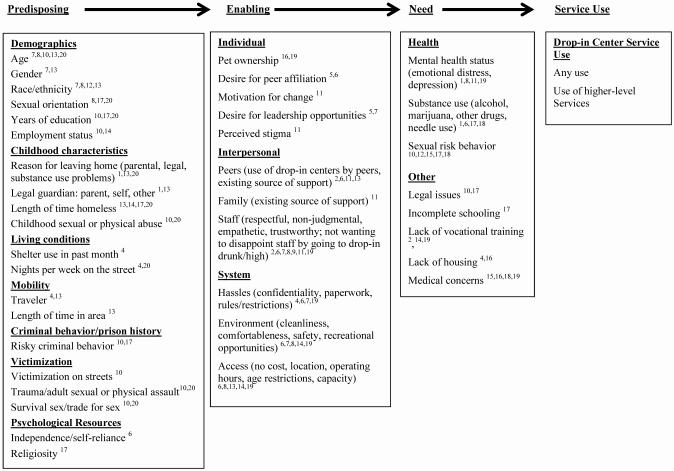
Drop-in centers for homeless youth address basic needs for food, hygiene, and clothing but can also provide critical services that address youth's "higher level" needs (e.g., substance use treatment, mental health care, HIV-related programs). Unlike other services that have restrictive rules, drop-in centers typically try to break down barriers and take a "come as you are" approach to engaging youth in services. Given their popularity, drop-in centers represent a promising location to deliver higher level services to youth that may not seek services elsewhere. A better understanding of the individual-level factors (e.g., characteristics of homeless youth) and agency-level factors (e.g., characteristics of staff and environment) that facilitate and impede youth engagement in drop-in centers will help inform research and outreach efforts designed to engage these at-risk youth in services. Thus, the goal of this review was to develop a preliminary conceptual model of drop-in center use by homeless youth. Toward this goal, we reviewed 20 available peer-reviewed articles and reports on the facilitators and barriers of drop-in center usage and consulted broader models of service utilization from both youth and adult studies to inform model development.
Keywords: Drop-in center; Homeless youth; Review; Service receipt.
Copyright © 2016 Society for Adolescent Health and Medicine. All rights reserved.
Figures
References
-
- National Association for the Education of Homeless Children and Youth . Facts and resources about the education of children and youth experiencing homelessness, in Education for Homeless Children and Youth Program Data Collection Summary. U.S. Department of Education; Washington, DC: 2013. Available at http://naehcy.org/sites/default/files/dl/homeless-ed-101.pdf.
-
- Hammer H, Finkelhor D, Sedlak AJ. NISMART Bulletin, October 2002. Office of Juvenile Justice and Delinquency Prevention; Washington, DC: 2002. Runaway/Thrownaway Children: National Estimates and Characteristics.
-
- Henry M, et al. The U.S. Department of Housing and Urban Development. Office of Community Planning and Development; Washington, DC: 2014. The 2014 Annual Homeless Assessment Report (AHAR) to Congress. Part 1: Point-in-Time Estimates of Homelessness.
-
- Greene JM, et al. Incidence and Prevalence of Homeless and Runaway Youth. RTI International; Research Triangle Park, NC: 2003.
-
- Rew L, et al. Correlates of resilience in homeless adolescents. J Nurs Scholarsh. 2001;33(1):33–40. - PubMed
Publication types
MeSH terms
Grants and funding
LinkOut - more resources
Full Text Sources
Other Literature Sources
Medical
