


Quantum-limited heat conduction over macroscopic distances
- PMID: 27239219
- PMCID: PMC4878655
- DOI: 10.1038/nphys3642
Quantum-limited heat conduction over macroscopic distances
Abstract
The emerging quantum technological apparatuses1, 2, such as the quantum computer3-6, call for extreme performance in thermal engineering7. Cold distant heat sinks are needed for the quantized electric degrees of freedom due to the increasing packaging density and heat dissipation. Importantly, quantum mechanics sets a fundamental upper limit for the flow of information and heat, which is quantified by the quantum of thermal conductance8-10. However, the short distance between the heat-exchanging bodies in the previous experiments11-14 hinders their applicability in quantum technology. Here, we present experimental observations of quantum-limited heat conduction over macroscopic distances extending to a metre. We achieved this improvement of four orders of magnitude in the distance by utilizing microwave photons travelling in superconducting transmission lines. Thus, it seems that quantum-limited heat conduction has no fundamental distance cutoff. This work establishes the integration of normal-metal components into the framework of circuit quantum electrodynamics15-17 which provides a basis for the superconducting quantum computer18-21. Especially, our results facilitate remote cooling of nanoelectronic devices using far-away in-situ-tunable heat sinks22, 23. Furthermore, quantum-limited heat conduction is important in contemporary thermodynamics24, 25. Here, the long distance may lead to ultimately efficient mesoscopic heat engines with promising practical applications26.
Conflict of interest statement
The authors declare no competing financial interests.
Figures
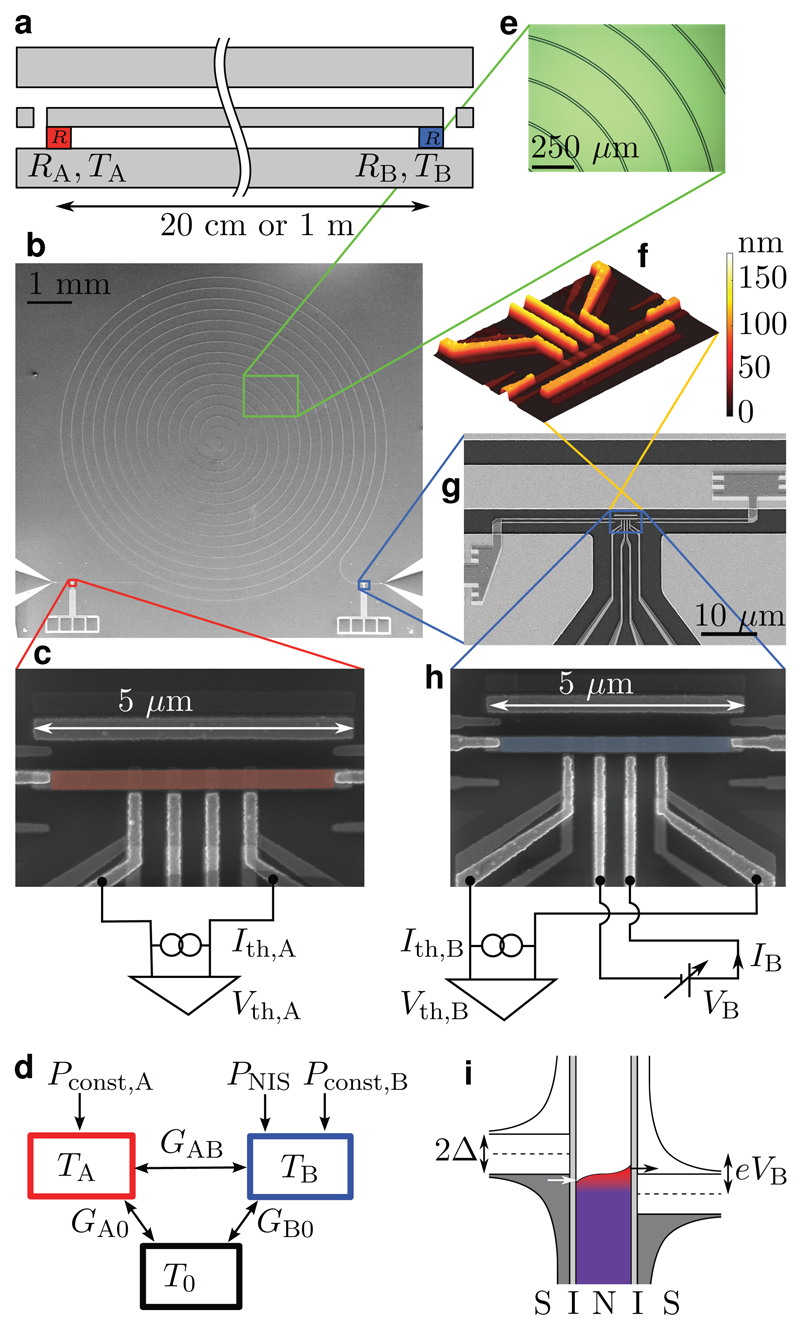
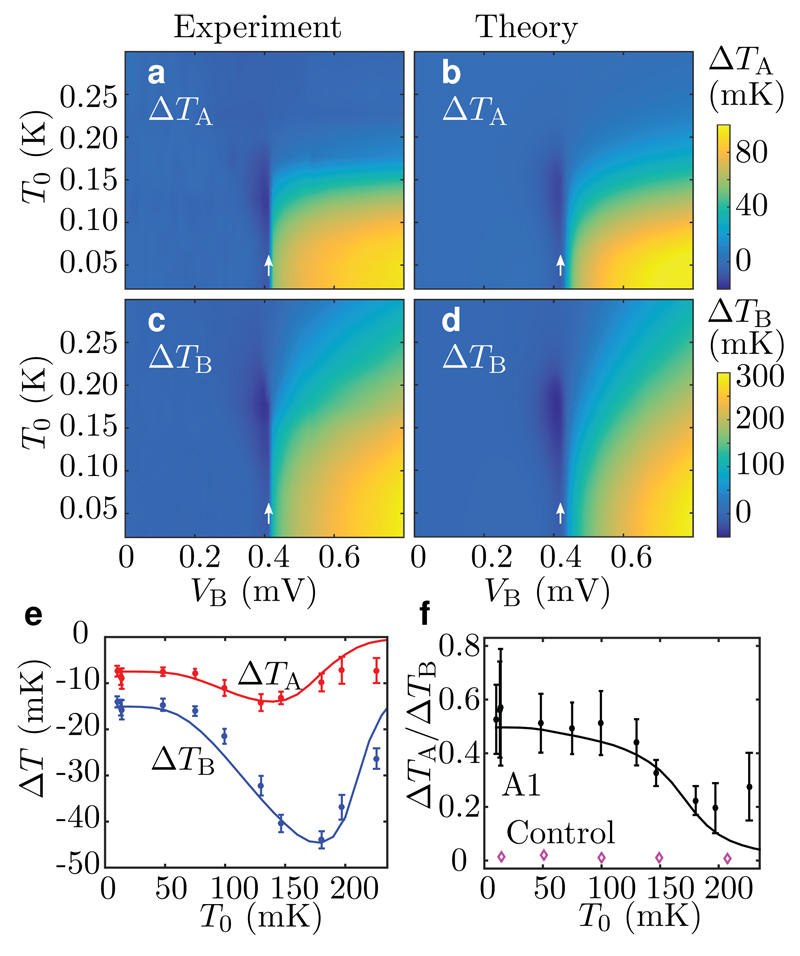
 ) are shown for comparison.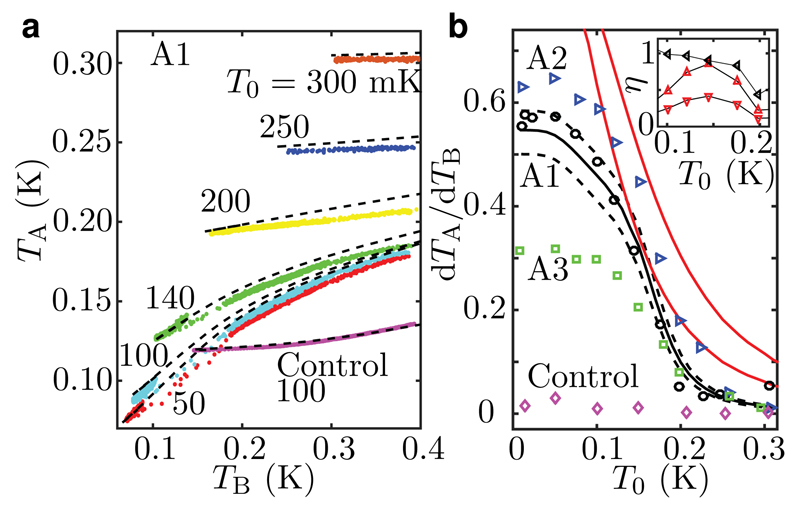
 ) from (a) at the lowest TB for each bath temperature. The experimental uncertainty is of the order of the marker size. For comparison, we also show the corresponding experimental data for the control sample (), for Sample A2 (
 ), and for A3 (
 ). The solid black line shows the prediction of the full thermal model of Supplementary Fig. 2. The dashed lines are calculated with 80 % (bottom) and 115 % (top) of the quantum of thermal conductance indicating the sensitivity of the results to the photonic heat conduction. The solid red lines are calculated with the simplified thermal model (equation (2)) for Sample A1 with electron–phonon coupling constants ΣN↓ = 2 × 10⁹ WK−5m−3 (right), and ΣN↑ = 4 × 10⁹ WK−5m−3 (left). The inset shows the extracted fraction η = GAB/GQ for Sample A1 for the simplified model with ΣN↓ (
 ) and ΣN↑ (
 ) and for the full thermal model (
 ) as functions of T0.
References
-
- Wolf EL. Quantum Nanoelectronics: An Introduction to Electronic Nanotechnology and Quantum Computing. Weinheim: Wiley-VCH; 2009.
-
- Dowling JP, Milburn GJ. Quantum technology: the second quantum revolution. Philosophical Transactions of the Royal Society of London A: Mathematical, Physical and Engineering Sciences. 2003;361:1655–1674. - PubMed
Grants and funding
LinkOut - more resources
Full Text Sources
Other Literature Sources
Miscellaneous