


Patient-centred physical therapy is (cost-) effective in increasing physical activity and reducing frailty in older adults with mobility problems: a randomized controlled trial with 6 months follow-up
- PMID: 27239405
- PMCID: PMC4864107
- DOI: 10.1002/jcsm.12091
Patient-centred physical therapy is (cost-) effective in increasing physical activity and reducing frailty in older adults with mobility problems: a randomized controlled trial with 6 months follow-up
Abstract
Background: Despite the well-known health benefits of physical activity, it is a great challenge to stay physically active for frail-older adults with mobility limitations. The aim of this study was to test the (cost-) effectiveness of a patient-centred physical therapy strategy (Coach2Move) in which individualized treatment (motivational interviewing, physical examination, individualized goal setting, coaching and advice on self management, and physical training) is combined to increase physical activity level and physical fitness and, thereby, to decrease the level of frailty.
Methods: A randomized controlled trial was performed in 13 physical therapy practices with measurements at 3 and 6 months. Eligible patients were aged 70 years or over and had mobility problems (i.e. difficulties with walking, moving, getting up and changing position from bed or chair to standing, or stair climbing). The primary outcome was physical activity (total and moderate intensity) in minutes per day. Secondary outcomes were as follows: frailty, walking speed and distance, mobility, and quality of life. Data were analysed using linear mixed models for repeated measurements. Healthcare costs and quality-adjusted life years (QALYs) were computed and combined using net monetary benefit (NMB) for different willingness to pay thresholds. Data on costs, QALYs, and NMBs were analysed using linear mixed models.
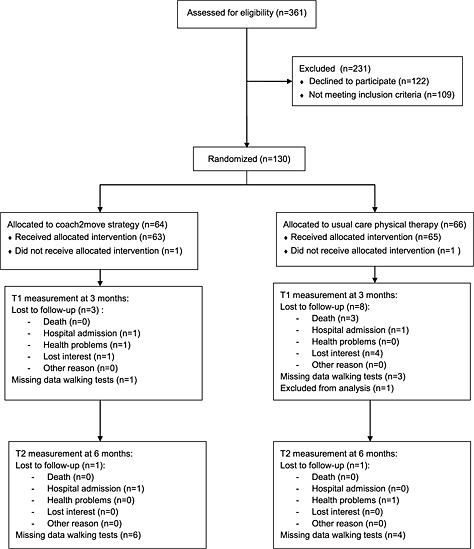
Results: One hundred and thirty patients participated in this study. At 6 months, the between-group difference was significant for moderate-intensity physical activity in favour of the Coach2Move group [mean difference: 17.9 min per day; 95% confidence interval (CI) 4.0 to 34.9; P = 0.012]. The between-group difference for total physical activity was 14.1 min per day (95% CI -6.6 to 34.9; P = 0.182). Frailty decreased more in the Coach2Move group compared with usual care [mean difference: -0.03 (95% CI: -0.06 to -0.00; P = 0.027)]. Compared with usual treatment, the Coach2Move strategy resulted in cost savings (€849.8; 95% CI: 1607 to 90; P = 0.028), an improvement in QALYs, (0.02; 95% CI: 0.00 to 0.03; P = 0.03), and a higher NMB at every willingness to pay threshold.
Conclusions: Older adults with mobility problems are able to safely increase physical activity in their own environment and reduce frailty. This study emphasizes both the potential cost-effectiveness of a patient-centred approach in the frail elderly and the importance of physical activity promotion in older adults with mobility limitations.
Keywords: Frailty; Mobility limitations; Physical activity; Physical therapy.
Figures

References
-
- Chodzko‐Zajko WJ, Proctor DN, Fiatarone Singh MA, Minson CT, Nigg CR, Salem GJ, et al American College of Sports Medicine position stand. Exercise and physical activity for older adults. Med Sci Sports Exerc 2009;41:1510–1530. - PubMed
-
- de Vries NM, van Ravensberg CD, Hobbelen JSM, Olde Rikkert MG, Staal JB, Nijhuis‐van der Sanden MW. Effects of physical exercise therapy on mobility, physical functioning, physical activity and quality of life in community‐dwelling older adults with impaired mobility, physical disability and/or multi‐morbidity: a meta‐analysis. Ageing Res Rev 2012;11:136–149. - PubMed
-
- Landi F, Marzetti E, Martone AM, Bernabei R, Onder G. Exercise as a remedy for sarcopenia. Curr Opin Clin Nutr Metabol Care 2014;17:25–31. - PubMed
LinkOut - more resources
Full Text Sources
Other Literature Sources
Medical
