. 2016 Dec;44(6):1474-1482.
doi: 10.1002/jmri.25304. Epub 2016 May 30.

Prospective frequency correction for macromolecule-suppressed GABA editing at 3T

Affiliations

Prospective frequency correction for macromolecule-suppressed GABA editing at 3T

Richard A E Edden et al. J Magn Reson Imaging. 2016 Dec.

Abstract

Purpose: To investigate the effects of B0 field offsets and drift on macromolecule (MM)-suppressed GABA-editing experiments, and to implement and test a prospective correction scheme. "Symmetric" editing schemes are proposed to suppress unwanted coedited MM signals in GABA editing.

Materials and methods: Full density-matrix simulations of both conventional (nonsymmetric) and symmetric MM-suppressed editing schemes were performed for the GABA spin system to evaluate their offset-dependence. Phantom and in vivo (15 subjects at 3T) GABA-edited experiments with symmetrical suppression of MM signals were performed to quantify the effects of field offsets on the total GABA+MM signal (designated GABA+). A prospective frequency correction method based on interleaved water referencing (IWR) acquisitions was implemented and its experimental performance evaluated during positive and negative drift.

Results: Simulations show that the signal from MM-suppressed symmetrical editing schemes is an order of magnitude more susceptible to field offsets than the signal from nonsymmetric editing schemes. The MM-suppressed GABA signal changes by 8.6% per Hz for small field offsets. IWR significantly reduces variance in the field offset and measured GABA levels (both P < 0.001 by F-tests), maintaining symmetric suppression of MM signal.

Conclusion: Symmetrical editing schemes substantially increase the dependence of measurements on B0 field offsets, which can arise due to patient movement and/or scanner instability. It is recommended that symmetrical editing should be used in combination with effective B0 stabilization, such as that provided by IWR. J. Magn. Reson. Imaging 2016;44:1474-1482.

Keywords: B0 drift; GABA; MM-suppressed; field-frequency lock; instability; symmetrical editing.


Figures

Figure 1
Figure 1
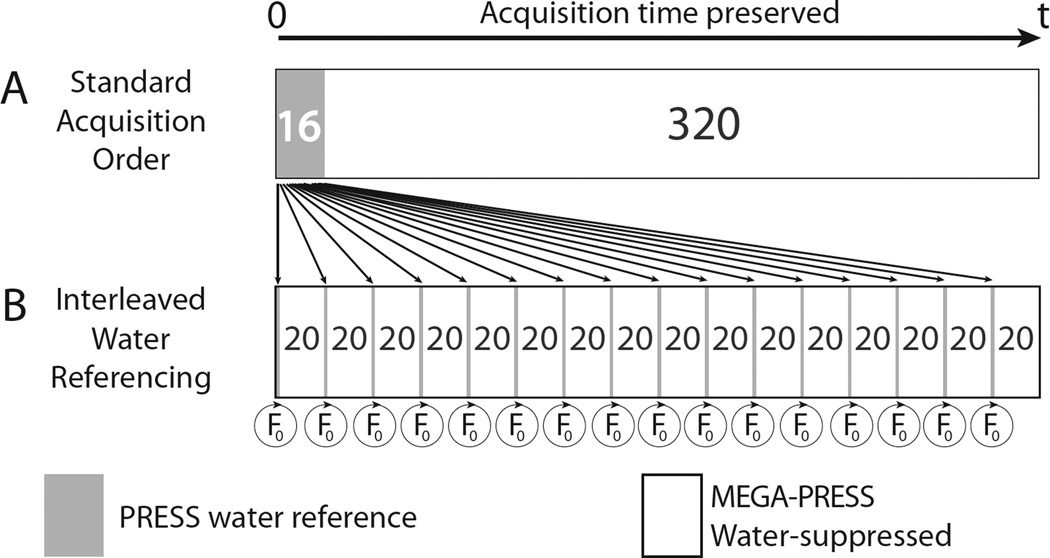
Schematic diagram of the Interleaved Water Reference (IWR) acquisition scheme. (A) Typically, the 16 water-reference scans are acquired en bloc before the 320 water-suppressed scans. (B) In the IWR scheme, the same number of water-reference TRs can be distributed throughout the acquisition (1 for every 20 water-suppressed scans) without changing the total acquisition time, allowing accurate determination of the field offset and periodic F0 update during the scan.
Figure 2
Figure 2
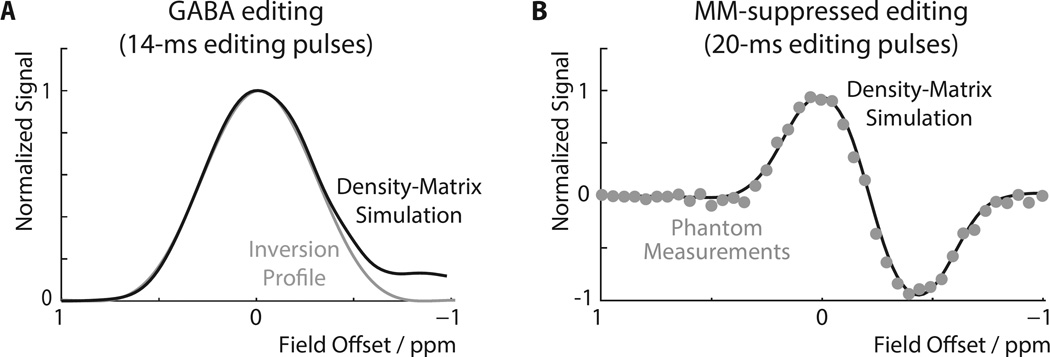
B0 Offset-dependence of GABA editing. (A) Full density-matrix simulation of the GABA signal as a function of B0 offset (zero field offset = edit ON pulse at 1.9 ppm) using 14-ms editing pulses at TE = 68 ms. The signal profile has a single positive lobe with a maximum at zero offset. The inversion profile of the editing pulses is overlaid. (B) Full density-matrix simulations (solid line) and experimental data in the phantom (data points) for the MM-suppressed experiment applying editing pulses at 1.9 ppm (ON) and 1.5 ppm (OFF).
Figure 3
Figure 3
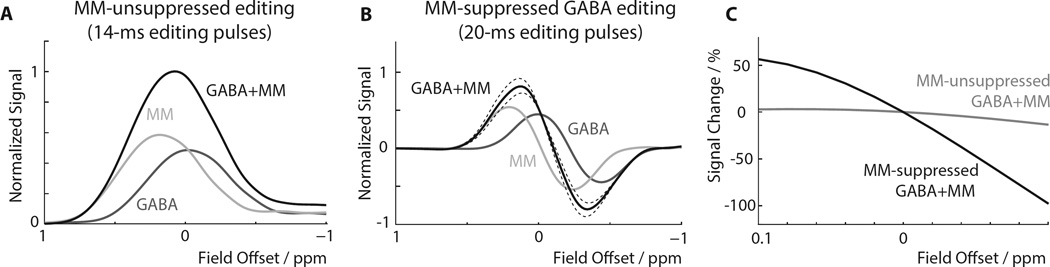
Simulations of the B0 field offset-dependence of GABA and MM. Normalization of the signal curves was performed with respect to the maximum total signal of the GABA+ experiment to allow for comparison between both editing schemes. (A) GABA and MM signals, as well as their sum (GABA+), are shown for the MM-unsuppressed experiment with 14 ms editing pulses. The relative amounts of GABA and MM are set to be equal at zero offset. (B) GABA and MM signals for the MM-suppressed acquisition with 20 ms editing pulses. The MM response to the MM-suppressed experiment shows a zero-crossing at zero field offset, as expected. As the field offset increases or decreases, the total observed signal will contain contributions from both GABA and MM, with either positive or negative MM contributions depending on the direction of the offset. The solid dark curve represents a 50:50 MM:GABA ratio; dashed lines indicate 45:55 and 55:45 ratios, respectively. (C) Percentage changes the MM-unsuppressed (from A) and MM-suppressed simulations (from B). It can be seen that the MM-suppressed signal changes much more rapidly (by about an order of magnitude) as a function of field offset.
Figure 4
Figure 4
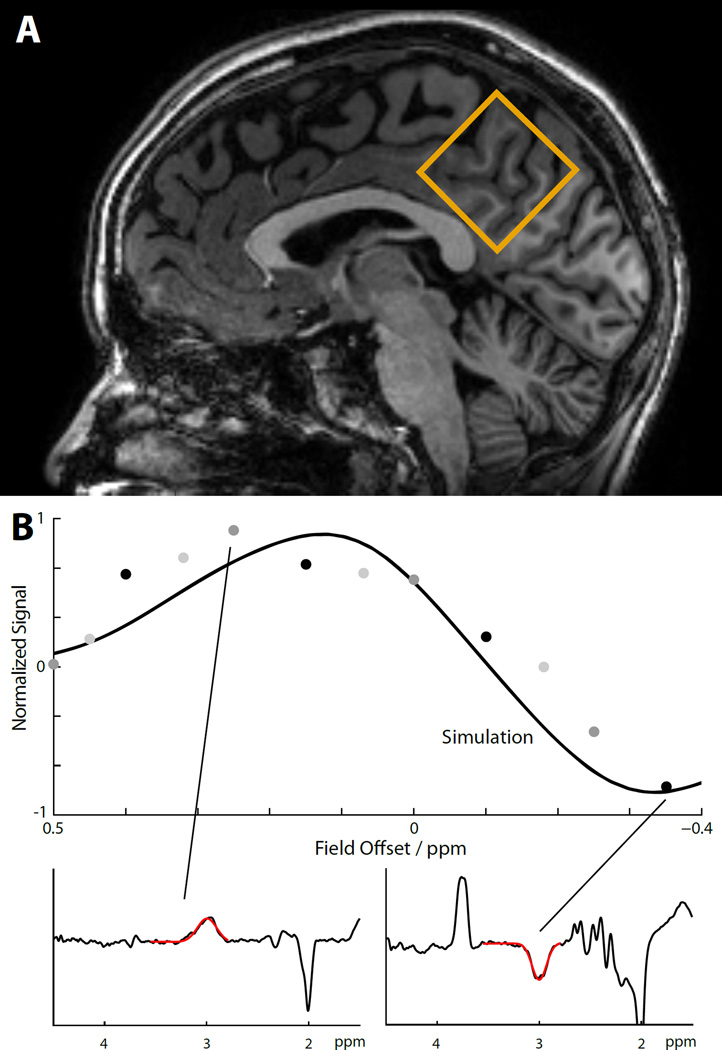
Offset-dependence of MM-suppressed GABA experiments in vivo. (A) Midline parietal voxel (35×35×35 mm3) from sagittal view. (B) Comparison of simulations and experimental in vivo measures for the total signal of the MM-suppressed experiment. The solid line shows the simulation pattern from Figure 3B for a 50:50 GABA:MM ratio, while experimental data points are indicated in gray and black (n=3, different shade of gray/black for each subject). The spectrum corresponding to a case of high positive field offset (+0.25 ppm) shows a large signal at 3 ppm due to co-editing of positive MM signal. The spectrum corresponding to a case of high negative field offset (−0.35 ppm) shows a negative signal at 3 ppm due to negative GABA-editing and simultaneous co-editing of negative MM signal, as predicted by simulations and phantom measurements. The red overlays in the inset spectra show the results of the Gannet curve-fitting routine to determine the area of the 3.0 ppm peak.
Figure 5
Figure 5
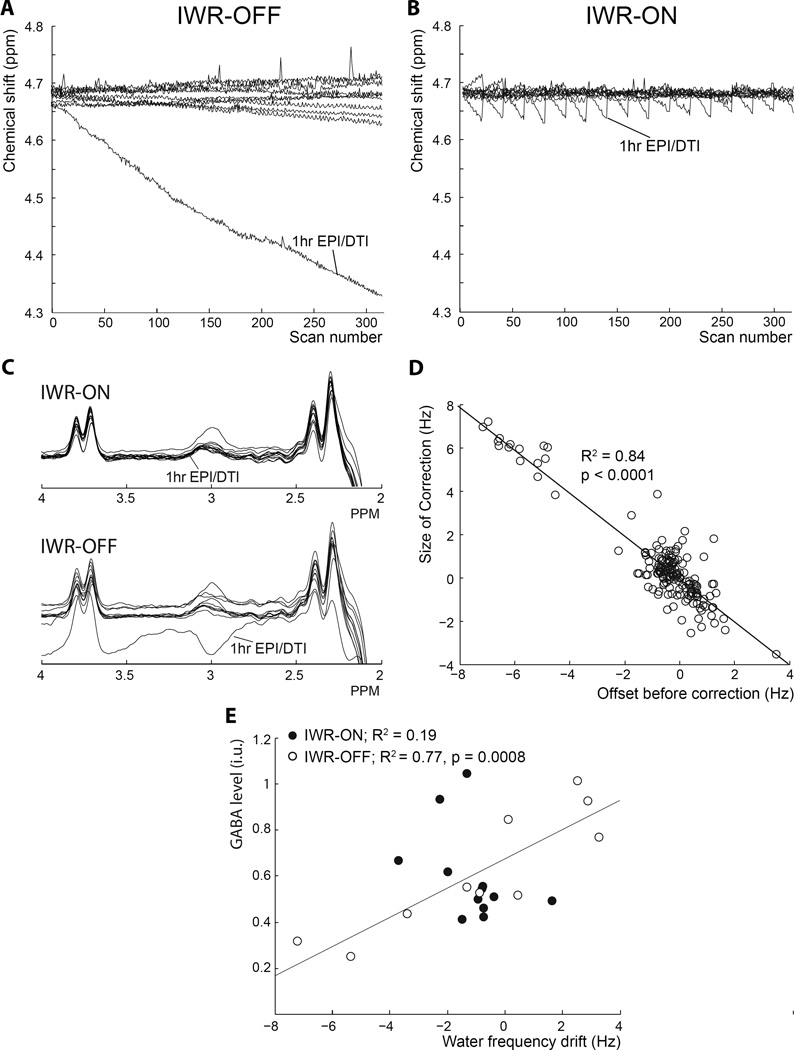
Interleaved Water Reference-based (IWR) Frequency Stabilization. (A) and (B) plot the voxel water frequency for 12 subjects over the course of a 10 min 10 sec MEGA-PRESS acquisition (320 averages). In one of the subjects, a large field drift was observed due to a prior acquisition causing considerable gradient heating. Compared to conditions with no field-frequency lock applied (A), the IWR frequency stabilization (B) dramatically improves the offset behavior of the experiments. Vertical lines indicate the timing of interleaved F0 updates. Since the field behavior is approximately linear in each segment, the stabilized behavior resembles a sawtooth pattern. The two datasets (with and without IWR) in each panel were acquired sequentially in each subject, so the field behavior was similar (but not identical) in stabilized and non-stabilized scans. (C) MEGA-PRESS spectra from all 12 subjects plotted with and without IWR. It can be seen that the consistency of individual MEGA-PRESS spectra was substantially improved in data collected with IWR. (D) The frequency offset, measured in the spectrum one TR before the correction was made, is plotted against the size of the actual IWR correction applied. The perfect one-to-one relationship is indicated by the diagonal (slope: −1, intercept −0.027). (E) With IWR switched off, there is a strong correlation between mean field offset and measured GABA levels (white circles). With IWR switched on, this correlation is reduced (black circles).

References

    1. Rothman DL, Petroff OA, Behar KL, Mattson RH. Localized 1H NMR measurements of gamma-aminobutyric acid in human brain in vivo. Proc. Natl. Acad. Sci. U. S. A. 1993;90:5662–5666. - PMC - PubMed
    1. Mescher M, Merkle H, Kirsch J, Garwood M, Gruetter R. Simultaneous in vivo spectral editing and water suppression. NMR Biomed. 1998;11:266–272. - PubMed
    1. Terpstra M, Henry P-G, Gruetter R. Measurement of reduced glutathione (GSH) in human brain using LCModel analysis of difference-edited spectra. Magn. Reson. Med. 2003;50:19–23. - PubMed
    1. Edden RAE, Pomper MG, Barker PB. In vivo differentiation of N-acetyl aspartyl glutamate from N-acetyl aspartate at 3 Tesla. Magn. Reson. Med. 2007;57:977–982. - PubMed
    1. Star-Lack J, Spielman D, Adalsteinsson E, Kurhanewicz J, Terris DJ, Vigneron DB. In Vivo Lactate Editing with Simultaneous Detection of Choline, Creatine, NAA, and Lipid Singlets at 1.5 T Using PRESS Excitation with Applications to the Study of Brain and Head and Neck Tumors. J. Magn. Reson. 1998;133:243–254. - PubMed

Publication types

Substances

LinkOut - more resources